Contact us
Contact Nuveen
Thank you for your message. We will contact you shortly.

Government employees benefit from some of the most stable and comprehensive benefits systems in the US, with strong provision across healthcare, retirement and paid leave. But as retirement rules change, healthcare costs rise and administrative demands increase, stability alone is no longer sufficient. Employees now need to engage more actively with benefits decisions that were historically treated as relatively predictable and straightforward.
Economist Enterprise’s 2025 Benefits 2.0 survey of government employees in the US finds that while benefits continue to provide a strong foundation of financial security, evolving policies and systems are increasing the need for more active engagement and ongoing support. Several priorities stand out for strengthening how benefits function in practice:
- benefits that are easier to navigate, reducing administrative friction and helping employees make better use of available support;
- retirement support that drives active planning, encouraging workers to periodically reassess long-term savings decisions rather than relying on initial choices that no longer fit their circumstances; and
- financial education and personalized guidance that help employees navigate evolving retirement policies, healthcare costs and administrative requirements with greater confidence.
Stability remains the sector’s strongest asset
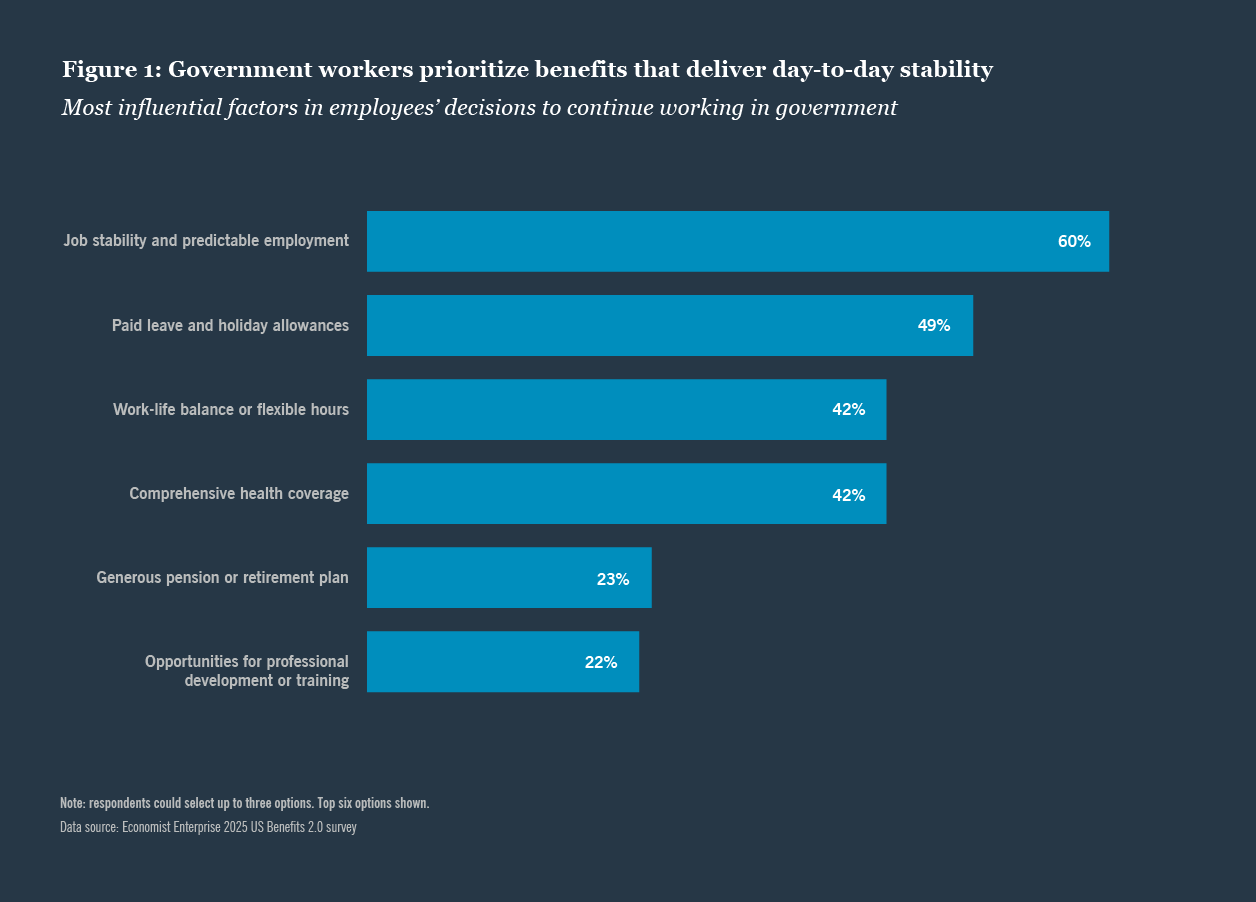
Government workers have historically traded private-sector earning potential for greater predictability, more comprehensive benefits and more secure employment. That value proposition continues to resonate in an uncertain economic environment, with employees in our survey consistently prioritizing benefits tied to stability and predictability (see figure 1).
Official data reflect the scale of supportive benefits. As of March 2026, employer benefit costs for state and local government employees averaged $25.04 per hour worked, compared with $13.68 in the private sector. Meanwhile, retirement and savings benefits are more than five times the private-sector average.1 Similarly, the Federal Employees Health Benefits Program offers the widest selection of health plans in the US.2 As a result, the government employees we surveyed reported lower levels of immediate financial strain: 30% said they had previously skipped or delayed medical care because of cost, compared with 46% across other sectors.
However, maintaining that stability is becoming more complex as policy changes, workforce pressures and administrative demands reshape the environment around public-sector benefits. The challenge is no longer simply offering strong benefits, but ensuring they remain accessible, responsive and effective for workers over time.
The hidden risk of stable benefits: encouraging passive planning
Government employees generally report slightly higher levels of confidence navigating their benefits than workers in other sectors, reflecting decades of relatively consistent public-sector benefit structures. In our survey, 77% said they feel confident comparing benefit options during open enrollment, while 75% said they understand the retirement planning options available to them. Rates of regret over past benefit decisions are also broadly in line with other sectors, suggesting that most government workers are comfortable making benefits choices within established systems.
Yet confidence does not always translate into ongoing engagement. Among government workers, only 28% say they actively review or adjust retirement choices after making initial decisions compared with 37% across other industries. This pattern cannot be explained by higher pension usage: government workers reported retirement plan structures similar to those in other sectors. Instead, it may reflect the long-standing stability of public-sector employment and benefits systems, which historically required less active reassessment and individualized decision-making over time.3
But that assumption is becoming harder to sustain as retirement eligibility thresholds change, retiree healthcare costs rise and workers face more frequent changes to contribution rules, enrollment requirements and benefits administration. Going forward, government employees should increasingly revisit decisions rather than rely on one-time enrollment choices.
This growing complexity may also increase demand for ongoing support and personalization. When asked which tools would best help benefits adapt to changing life needs, government employees ranked adaptive dashboards highest, which update as health, finances or family circumstances change. This was followed by real-time cost estimates and guidance during major life transitions. As employees increasingly face decisions and circumstances that evolve over time, employers have an opportunity to shift toward more active decision support to better reflect new financial, healthcare and workplace realities.
Modernizing benefit systems built for continuity
Government benefits systems have historically been designed around generosity, long-term continuity and predictability. However, recent policy changes are increasing the complexity of long-term planning, making it more important for employers and employees alike to engage more actively in how benefits are delivered and used.
In 2026, the retirement age threshold under the Federal Employee Retirement System changed, increasing early retirement penalties for some workers.4 Federal retiree healthcare premiums are also rising,5 while the Secure 2.0 Act6 and additional Internal Revenue Service amendments7 are introducing new contribution rules and compliance requirements. Together, these shifts make long-term benefits planning more difficult to treat as a one-time decision.
At the same time, the administrative limitations of legacy systems are making public-sector benefits harder to deliver consistently and efficiently. In 2025, more than 50,000 federal retirees reportedly experienced delays in receiving retirement funds because of processing backlogs.8
These pressures are unfolding alongside broader workforce disruption, with the US government cutting roughly 220,000 federal jobs between January and November 2025.9 In this context, less than a third of federal employees report feeling satisfied and engaged in their work.10 Yet benefits continue to provide an important buffer of stability for many workers: 94% of government employees in our survey say they feel at least as secure in their job and benefits as they did 12 months ago, including more than half who say they feel more secure. This suggests that even as confidence in workplace conditions fluctuates, stable benefits remain an important anchor during periods of uncertainty and change.
As benefits environments become more complex, maintaining stability increasingly depends not only on the strength of benefits themselves, but also on how reliably and clearly they can be delivered and used over time. For government employers, modernization is becoming as much a communication and usability challenge as a policy one.
From stable benefits to active support
Government benefits continue to provide a meaningful source of stability in an uncertain environment. But as policies, workforce conditions and administrative systems evolve, maintaining that stability increasingly depends on more than the comprehensiveness of benefits alone. Employers that help workers navigate changing decisions, costs and life circumstances with greater confidence will be better positioned to sustain trust, improve long-term engagement and support workforce resilience over time.
Related articles

Insights for government plan sponsors | Benefits 2.0

Shorter retirement delays, but not for all

What attracts workers to government jobs
Contact us

References
1 U.S. Bureau of Labor Statistics, “Compensation costs for civilian workers averaged $48.60 per hour worked in September 2025”, March 2026, https://www.bls.gov/opub/ted/2026/compensation-costs-for-civilian-workers-averaged-48-60-per-hour-worked-in september-2025.htm
2 OPM, “The Federal Employees Health Benefits (FEHB) Program”, https://www.opm.gov/healthcare-insurance/healthcare/
3 Georgetown University, Center for Retirement Initiatives, “The Evolution of Public Sector Retirement Plans: Lessons for State Facilitated Retirement Savings Programs”, https://cri.georgetown.edu/the-evolution-of-public-sector-retirement-plans/
4 Federal Benefits Service, “Is Your FERS Pension Safe? Here’s What the 2026 Changes Really Mean”, https://federalbenefitservice. com/is-your-fers-pension-safe-heres-what-the-2026-changes-really-mean/
5 Ibid
6 Employee Fiduciary, “The SECURE 2.0 Act Amendment: What Employers Can Expect in 2026”, January 2026, https://www. employeefiduciary.com/blog/secure-2-act-admendment
7 AARP, “9 Ways Retirement Will Be Different in 2026”, December 2025, https://www.aarp.org/money/retirement/biggest changes-2026/
8 ABC 7 News -WJLA (via YouTube), “Surge in federal retirements leaves thousands without income for months”, January 2026, https:// youtu.be/ptuuzIDEZR8?si=lvrV-HBbmftzIRE3
9 Center on Budget and Policy Priorities, “Administration’s Radical Personnel Cuts Bypassed Congress and Lacked Transparency, Obscuring Impact on Public Services”, January 2026, https://www.cbpp.org/research/federal-budget/administrations-radical personnel-cuts-bypassed-congress-and-lacked#220000-cbpp-anchor
10 Politico, “Federal workforce unhappy, disengaged, new survey finds”, March 2026, https://www.politico.com/news/2026/03/19/ federal-workforce-unhappy-disengaged-00836471
Nuveen and Economist Enterprise, or any of their affiliates or subsidiaries are not affiliated with or in any way related to each other. The research was independently developed by Economist Enterprise and is sponsored by Nuveen, LLC. This material is prepared by and represents the views and opinions of Economist Enterprise, and does not necessarily represent the views and polices of Nuveen, LLC, its affiliates, or other Nuveen staff.
This material, along with any views and opinions expressed within, are presented for informational and educational purposes only as of the date of production/writing and may change without notice at any time based on numerous factors, such as changing market, economic, political, or other conditions, legal and regulatory developments, additional risks and uncertainties and may not come to pass. There is no promise, representation, or warranty (express or implied) as to the past, future, or current accuracy, reliability or completeness of, nor liability for, decisions based on such information, and it should not be relied on as such. This material should not be regarded by the recipients as a substitute for the exercise of their own judgment.
Not registered yet? Register