Contact us
Contact Nuveen
Thank you for your message. We will contact you shortly.
Rates climb again: Is the muni opportunity still intact?

Key takeaways
- Heavy supply and dealer selling pushed municipal yields higher again last week.
- Technical pressures appear to be near-term noise rather than signaling a weakening of muni credit fundamentals; with state and local government tax collections continuing to show resilience.
- Municipal valuations versus Treasuries are more attractive due to short-term technical headwinds and volatility.
Market recap
Just as a path toward stability seemed to be forming, new pressures emerged. Tax loss harvesting (TLH) swaps, heavy dealer selling, and a steady stream of new issuance pushed municipal yields higher again last week. Rising oil prices added to the volatility, as renewed geopolitical tensions in the Middle East lifted broader interest rates and weighed on sentiment. Exchange-traded funds (ETFs) continued to attract flows, while open-end mutual funds have extended their multi-week streak of outflows – likely attributed to investors harvesting losses and swapping into ETFs (tax loss harvesting swaps). Despite the choppiness, the longer-term picture remains intact, in our view. Muni bond yields remain near multi-decade highs, and valuations relative to Treasuries continue to look attractive by historical standards. We believe the recent underperformance, largely due to volatility and technical pressures, continue to present a compelling opportunity for investors with cash on the sidelines to lock-in elevated yields and attractive valuations.
How is supply trending?
Supply was heavy last week but should moderate next week with a shortened holiday week.
Market impact: Deals last week were largely absorbed well despite struggling in some areas. As deals were pulled from the calendar in prior weeks amid volatility re-emerge as rates stabilize, yields could push higher.
Municipal market returns (%)
| Index returns by maturity | WTD | MTD | YTD |
|---|---|---|---|
| Muni Agg | -1.04% | -0.03% | -4.20% |
| Muni bond 5-year | -0.23% | 0.49% | -2.04% |
| Muni bond 10-year | -0.75% | 0.38% | -4.68% |
| Muni bond 15-year | -1.28% | 0.05% | -6.10% |
| Muni long bond (22+) | -1.94% | -0.84% | -5.82% |
| Muni bond 3-15-year blend | -0.64% | 0.34% | -3.76% |
| Source: Bloomberg L.P., 08 Oct 2026.Performance data shown represents past performance and does not predict or guarantee future results. All index returns are Bloomberg; shown in U.S. dollars. | |||
What do yields look like?
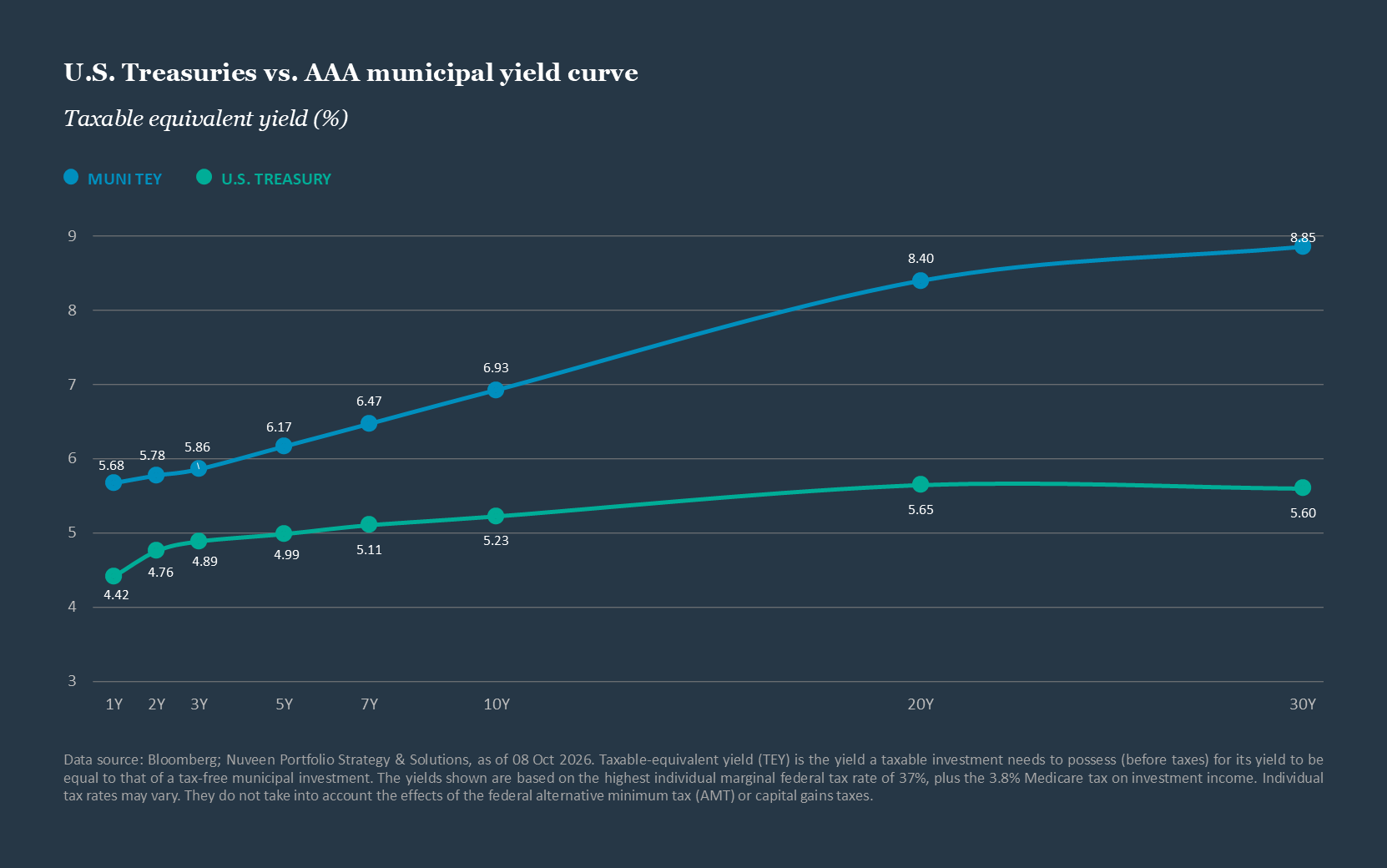
Yields increased across the curve last week, with longer maturities seeing bigger movement. Additional steepness can provide opportunity for investors looking further out.
| Municipal market yields (%) | Current (%) | Change (bps) | Ratio (%) |
|---|---|---|---|
| 5Y | 3.65 | +9 | 73% |
| 10Y | 4.10 | +13 | 78% |
| 30Y | 5.24 | +17 | 94% |
| Source: MMD, Bloomberg, L.P.; data from 02 Oct 2026 – 08 Oct 2026. | |||
What are flows doing?
Municipal bond flows turned positive, with money continuing to favor ETFs – a sign of continuing tax loss harvesting swaps, while open-end funds recorded their 21st straight outflow session1.
| OEFs | -$2.3B | ||
| ETFs | +$3.3B | ||
| Long-term funds | +$534M | ||
| High yield funds | -$164M | ||
| Source: LSEG Lipper, J.P. Morgan data from 01 Oct 2026 – 08 Oct 2026. The summation of OEFs + ETFs represents the total flows. | |||
Taxable equivalent yields are more attractive in longer-maturity municipals.
Related articles

Rate spike creates a compelling entry point for municipals

New York balances political pressure and fiscal discipline

California designs its fiscal comeback built to last
About the author

Contact us

You are on the site for: Financial Professionals and Individual Investors. You can switch to the site for: Institutional Investors or Global Investors
1 Source: J.P. Morgan, Municipal Morning Intelligence, , 09 Oct 2026.
Endnotes
Sources
Performance: Bloomberg, L.P. Issuance: S&P Ipreo and J.P. Morgan, Municipal Morning Intelligence. Fund flows: Lipper and J.P. Morgan. The sum of OEFs and ETFs represent the total municipal flows.
Any reference to credit ratings refers to the highest rating given by one of the following national rating agencies: S&P, Moody’s or Fitch. Credit ratings are subject to change. AAA, AA, A and BBB are investment grade ratings; BB, B, CCC, CC, C and D are below-investment grade ratings.
This material is not intended to be a recommendation or investment advice, does not constitute a solicitation to buy, sell or hold a security or investment strategy, and is not provided in a fiduciary capacity. The information provided does not take into account the specific objectives or circumstances of any particular investor or suggest any specific course of action. Investment decisions should be made based on an investor’s objectives and circumstances and in consultation with his or her advisors.
Representative indexes: Muni bond 5-year: Bloomberg Municipal Bond 5 Year (4–6) Index; Muni bond 10-year: Bloomberg Municipal Bond 10 Year (8–12) Index; Muni bond 15-year: Bloomberg Municipal Bond 15 Year (12–17) Index; Muni long bond: Bloomberg Municipal Long Bond (22+) Index; Muni bond 3–15 year blend: Bloomberg Municipal 3–15 year blend (2–17) Index; Muni AAA: Bloomberg Municipal AAA Index; Muni AA: Bloomberg Municipal AA Index; Muni A: Bloomberg Municipal A Index; Muni BBB: Bloomberg Municipal BBB Index; Muni Agg (1-30) bond: Bloomberg Municipal Bond Index; Muni high yield: Bloomberg High Yield Municipal Index; U.S. aggregate bond: Bloomberg U.S. Aggregate Bond Index; U.S. Treasury: Bloomberg U.S. Treasury Index; U.S. government related: Bloomberg U.S. Government-Related Index; U.S. corporate investment grade: Bloomberg U.S. Corporate Index; U.S. high yield corporate: Bloomberg U.S. Corporate High Yield Index; Taxable municipals: Bloomberg Taxable Municipal Index.
This material, along with any views and opinions expressed within, are presented for informational and educational purposes only as of the date of production/writing and may change without notice at any time based on numerous factors, such as changing market, economic, political, or other conditions, legal and regulatory developments, additional risks and uncertainties and may not come to pass. There is no promise, representation, or warranty (express or implied) as to the past, future, or current accuracy, reliability or completeness of, nor liability for, decisions based on such information, and it should not be relied on as such. This material should not be regarded by the recipients as a substitute for the exercise of their own judgment. It is important to review your investment objectives, risk tolerance and liquidity needs before choosing an investment style or manager.
This material may contain “forward-looking” information that is not purely historical in nature. Such information may include, among other things, projections, forecasts, estimates of yields and/or market returns, and proposed or expected portfolio composition. No representation is made that the performance presented will be achieved, or that every assumption made in achieving, calculating or presenting either the forward-looking information or the historical performance information herein has been considered or stated in preparing this material. Any changes to assumptions that may have been made in preparing this material could have a material impact on any of the data and/or information presented herein by way of example.
For term definitions and index descriptions, please access the glossary on nuveen.com. Please note, it is not possible to invest directly in an index.
Important information on risk
Past performance is no guarantee of future results. All investments carry a certain degree of risk, including the possible loss of principal, and there is no assurance that an investment will provide positive performance over any period of time. Certain products and services may not be available to all entities or persons. There is no guarantee that investment objectives will be achieved.
Investing in fixed income investments involves risks such as market risk, credit risk, interest rate/duration risk, call risk, tax risk, political and economic risk, derivatives risk, and income risk. Credit risk refers to an issuers ability to make interest and principal payments when due. Typically, the value of, and income generated by, fixed income investments will decrease, or increase based on changes in market interest rates. As interest rates rise, bond prices fall and as interest rates fall, bond prices rise. Income is only one component of performance and investors should consider all of the risk factors for an asset class before investing.
Investing in municipal bonds involves risks such as market risk, credit risk, interest rate/duration risk, call risk, tax risk, political and economic risk, derivatives risk, and income risk. Credit risk refers to an ability to make interest and principal payments when due. Typically, the value of, and income generated by, muni bonds will decrease, or increase based on changes in market interest rates. As interest rates rise, bond prices fall and as interest rates fall, bond prices rise. Income is only one component of performance and investors should consider all of the risk factors for an asset class before investing. Income is generally exempt from regular federal income tax and may be subject to state and local taxes, based on the investor’s state of residence, as well as to the federal alternative minimum tax (AMT). Capital gains, if any, are subject to tax. Income from municipal bonds could be declared taxable because of unfavorable changes in tax laws, adverse interpretations by the Internal Revenue Service or state tax authorities, or noncompliant conduct of a bond issuer. Please contact a tax professional regarding the suitability of tax-exempt investments as this information should not replace a client’s consultation with a financial/tax professional regarding their tax situation. Nuveen and its investment specialists do not provide tax advice.
Taxable-equivalent yields are based on the highest individual marginal federal tax rate of 37%, plus the 3.8% Medicare tax on investment income. Individual tax rates may vary.
Nuveen, LLC provides investment solutions through its investment specialists.
This information does not constitute investment research as defined under MiFID.
Not registered yet? Register