Contact us
Contact Nuveen
Thank you for your message. We will contact you shortly.

Municipal bonds can help build communities and investment portfolios
Municipal bonds help build bridges, schools, hospitals, roads and other structures that improve our communities. In addition to enhancing our quality of life, many investors find municipal bond investments to be a valuable addition to their portfolios.
Municipal bonds are debt instruments issued by states, cities, counties, special purpose districts and nonprofit organizations, typically to finance capital improvements, meet cash needs or refinance existing debt. Through municipal bonds, investors lend money to these entities to fund infrastructure projects and support essential services. Owning a municipal bond is similar to owning an IOU. The investor is owed the principal amount of the loan, plus interest, over a given time period. It is important to remember that there are no guarantees of payment.
The municipal bond market has changed
Investing in municipal bonds has become more complicated in recent years. Understanding the market dynamics may help investors evaluate the need for actively managed municipal bond solutions.
Municipal market changes underscore the need for credit research
Economic uncertainty and changes in credit fundamentals can cause movements in credit spreads, which are the difference between yields of lower- and higher-quality bonds. When spreads shift, opportunities may arise to capture additional yield. Investment managers conduct independent research to manage credit risk.
Elevated municipal bond supply is continuing
Municipal bond supply levels are expected to remain robust as additional infrastructure and capital improvement plans come to the market. Going forward, abundant coupons, calls and maturities signal strong reinvestment demand.
Bonds are not created equal, even when their ratings are the same
Because the rating scales have changed, bonds with the same credit rating may show a wide yield range, making it difficult to assess each bond. Investment managers do extensive research to determine if a higher-yielding bond is compensating an investor adequately for the risk.
Individual investors are at a pricing disadvantage
There is no central location like an exchange to trade municipal bonds, which can make it challenging for retail investors to obtain the best prices. Buying and selling bonds is generally more expensive for individual investors who trade in smaller blocks of bonds than for institutional investors that buy and sell in bulk.
Capture the tax-exempt advantage with municipal bonds
If you are seeking tax relief, the interest earned on municipal bonds is exempt from regular federal taxation. Additionally, bonds issued from entities within a certain state are often exempt from taxation in that state. Occasionally, bonds issued within a certain municipality or region are exempt from taxes in that municipality, possibly providing triple tax exemption — federal, state and local.
The tax-exempt advantage
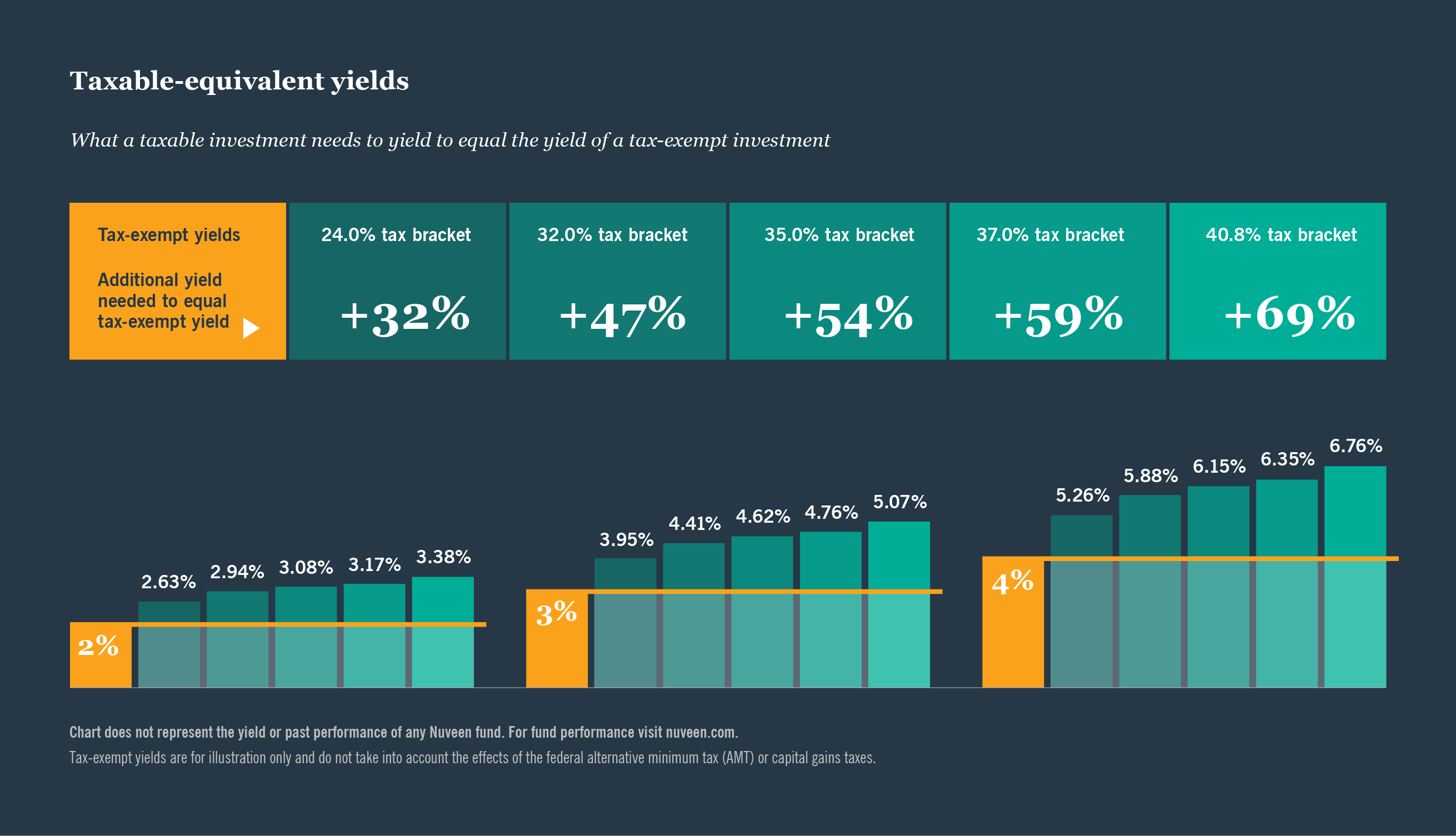
Municipal bonds can be advantageous, particularly if you are in a higher tax bracket. To make a fair comparison between a tax-exempt investment like a municipal bond and a taxable investment, you need to adjust the tax-exempt investment's yield to account for money you can save in income taxes, generally at federal and state levels.
Dampen volatility by enhancing portfolio diversification
Municipal bonds can act as a diversifier
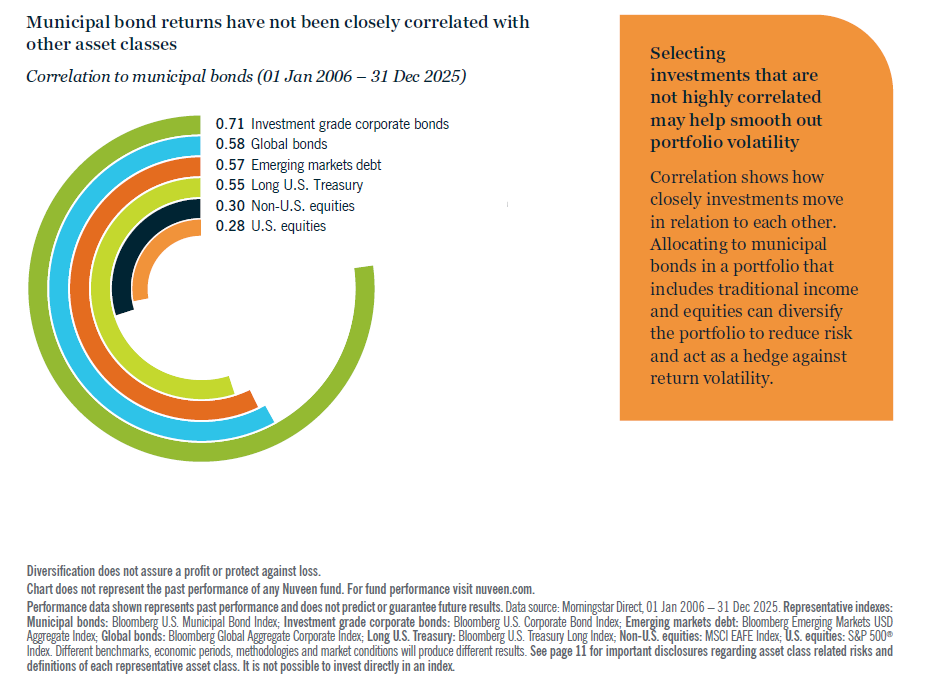
Municipal bond returns over the last 20 years have shown relatively low correlations with returns of select fixed income and equities. With this in mind, adding municipal bonds to an overall portfolio may help diversify and reduce the return volatility of the portfolio. It is important to remember that correlation patterns can change during periods of market corrections.
Selecting investments that are not highly correlated may help smooth out portfolio volatility
Correlation shows how closely investments move in relation to each other. Allocating to municipal bonds in a portfolio that includes traditional income and equities can diversify the portfolio to reduce risk and act as a hedge against return volatility.
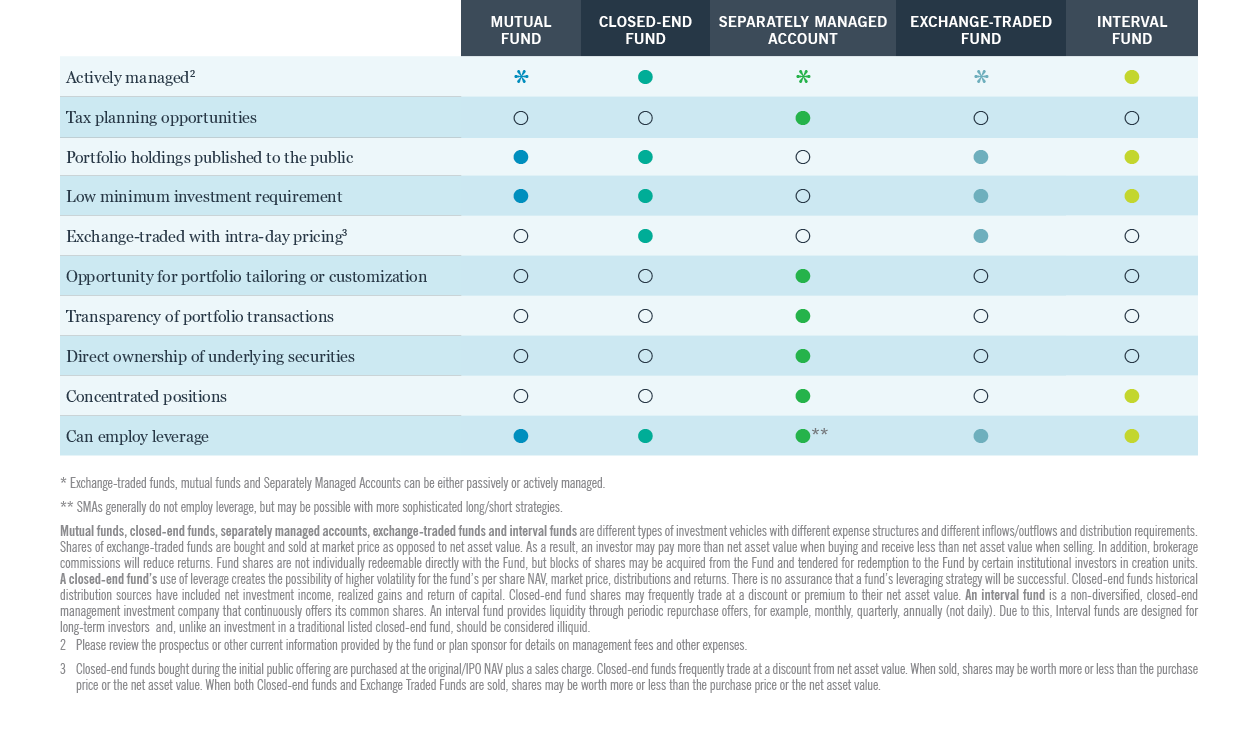
How do different investment solutions compare?
Municipal bond funds may allow investors to:
- Earn tax-exempt income
- Realize attractive after-tax returns
- Diversify an overall investment portfolio
- Reduce overall portfolio volatility
Active management can add value
Nuveen believes five key differentiators are important to creating portfolio growth.
- Credit research: The experienced research team evaluates municipal bonds and sectors, seeking to find value in bonds that the general public may have overlooked.
- Institutional access: Nuveen navigates the inefficient municipal bond market through established relationships with more than 100 national and regional dealers.
- Institutional trade execution: A large presence in the market provides greater access to inventory to find bonds in appropriate sizes and at institutional prices.
- Tax-aware investing: The ability to trade at institutional prices allows the team to potentially efficiently capture tax losses and use them to offset gains.
- Active portfolio oversight: By actively trading bonds, the team seeks to sell appreciated bonds, capture gains and purchase bonds that have the potential to enhance overall portfolio returns.
What are the ways to invest in municipal bonds?
Nuveen offers national and state municipal bond portfolios for investors seeking tax-exempt income.

National portfolios
Mutual funds
- All-American
- High Yield
- Intermediate Duration
- Limited Term
- Short Duration High Yield
- Short Term
- Strategic Municipal Opportunities
Closed-end funds
- AMT-Free Municipal Credit Income
- AMT-Free Municipal Value
- AMT-Free Quality Municipal Income
- Dynamic Municipal Opportunities
- Municipal Credit Income
- Municipal Credit Opportunities
- Municipal High Income Opportunity
- Municipal Income
- Municipal Value
- Quality Municipal Income
- Select Maturities Municipal
- Select Tax-Free Income Portfolio
Separately managed accounts
- Customized Portfolios
- Intermediate ESG
- Intermediate High-Quality
- Intermediate Term
- Laddered Portfolios
- Limited Maturity
- Long-Term
- Municipal Total Return
Exchange-traded funds
Interval fund
Contact us

You are on the site for: Financial Professionals and Individual Investors. You can switch to the site for: Institutional Investors or Global Investors
Before investing, carefully consider fund investment objectives, risks, charges and expenses. For this and other information that should be read carefully, please request a prospectus or summary prospectus from your financial professional or Nuveen at 800.257.8787 or visit nuveen.com.
Important information on risk
Past performance is no guarantee of future results. All investments carry a certain degree of risk, including the possible loss of principal, and there is no assurance that an investment will provide positive performance over any period of time. Certain products and services may not be available to all entities or persons. There is no guarantee that investment objectives will be achieved. See the applicable product literature for details.
Investing in fixed income investments involves risks such as market risk, credit risk, interest rate/duration risk, call risk, tax risk, political risk, economic risk, and income risk. Typically the value of, and income generated by, fixed income investments will decrease or increase based on changes in market interest rates. As interest rates rise, bond prices fall and as interest rates fall, bond prices rise. Income is only one component of performance and investors should consider all of the risk factors for an asset class before investing. Credit risk refers to an issuers ability to make interest and principal payments when due, as well as the prices of bonds declining when an issuer’s credit quality is expected to deteriorate.
Municipal Bond Income is generally exempt from regular federal income tax and may be subject to state and local taxes, based on the investor’s state of residence, as well as to the federal alternative minimum tax (AMT). Capital gains, if any, are subject to tax. Income from municipal bonds could be declared taxable because of unfavorable changes in tax laws, adverse interpretations by the Internal Revenue Service or state tax authorities, or noncompliant conduct of a bond issuer. Please contact a tax advisor regarding the suitability of tax-exempt investments as this information should not replace a client's consultation with a financial/tax professional regarding their tax situation. Nuveen and its investment specialists do not provide tax advice.
There are special risks associated with investments in high yield bonds. Lower rated and/or non-rated bonds commonly referred to as "high yield" or "junk" bonds are considered to be speculative, with heightened credit, liquidity, and investment risk. Bond insurance guarantees only the payment of principal and interest on the bond when due, and not the value of the bonds themselves, which can fluctuate. No representation is made as to an insurer's ability to meet their commitments.
Nuveen Asset Management, LLC is a registered investment adviser and an affiliate of Nuveen, LLC.
Nuveen Securities, LLC, member FINRA and SIPC.
Glossary
Correlation is a statistical measure of how two securities move in relation to each other. Perfect positive correlation (a correlation co-efficient of +1) implies that as one security moves the other security will move in lockstep, in the same direction. Alternatively, perfect negative correlation (a correlation co-efficient of -1) means that securities will move by an equal amount in the opposite direction. If the correlation is 0, the movements of the securities are said to have no correlation; their movements in relation to one another are completely random.
Taxable-equivalent yield is the yield an investor would have to realize on a fully taxable investment to equal the stated yield on a tax-exempt investment, at a specified assumed tax rate. It is calculated by dividing the tax-exempt yield by 1 minus the tax rate.
The Bloomberg Emerging Markets USD Aggregate Index is a flagship hard currency Emerging Markets debt benchmark that includes fixed and floating-rate U.S. dollar-denominated debt issued from sovereign, quasi-sovereign, and corporate EM issuers.
The Bloomberg Global Aggregate Index is a flagship measure of global investment grade debt from twenty-four local currency markets. This multi-currency benchmark includes treasury, government-related, corporate and securitized fixed-rate bonds from both developed and emerging markets issuers.
The Bloomberg Municipal Long Bond Index is a subset of the Bloomberg Municipal Bond Index including maturities of 22 or more years.
The Bloomberg U.S. Corporate Bond Index measures the investment grade, fixed-rate, taxable corporate bond market. It includes USD denominated securities publicly issued by U.S. and non- U.S. industrial, utility and financial issuers.
The Bloomberg U.S. Long Credit Index is a subset of the Bloomberg U.S. Credit Index which measures the investment grade, U.S. dollar-denominated, fixed-rate, taxable corporate and government-related bond markets.
The Bloomberg U.S. Municipal Bond Index covers the USD-denominated long-term tax-exempt bond market.
The Bloomberg U.S. Treasury Long Index includes securities in the long maturity range of the U.S. Treasury Index. Securities must have a maturity of 10 years or more.
The MSCI EAFE Index (Europe, Australasia, Far East) is a free float-adjusted market capitalization index that is designed to measure the equity market performance of developed markets, excluding the U.S. & Canada.
The S&P 500® Index is widely regarded as the best single gauge of large-cap U.S. equities. The index includes 500 leading companies and captures approximately 80% coverage of available market capitalization.
Not registered yet? Register