Contact us
Contact Nuveen
Thank you for your message. We will contact you shortly.

Section 2: The economy and markets
Key points to know
AI continues to drive global growth. The global economy enters the final stretch of 2026 on firmer footing than expected. Growth has proved resilient as AI-related capital spending, fiscal support and steady household demand offset the drag from higher borrowing and energy costs. The U.S. continues to stand out: We expect growth to remain above 2.0% this year and unemployment steadying near 4.1%. Europe has also held up better than anticipated despite the energy shock. We anticipate euro area growth at around 1.0%, while emerging markets growth remains comparatively firm.
The AI investment cycle is a key tailwind to U.S. activity and for economies embedded in the technology supply chain, such as Taiwan and Korea. Productivity gains should prove substantial but may lag, while the buildout’s energy and financing needs intensify competition for capital amid already elevated global yields.
Inflation remains the principal challenge. Elevated energy prices stemming from the ongoing Middle East conflict have interrupted disinflation. In the U.S., core PCE inflation should stay above 3.0% this year before easing to 2.5% in 2027. Our base case assumes energy prices moderate as geopolitical tensions ease, allowing disinflation to resume. A more persistent oil shock, however, would increase the risk of second-round effects and keep inflation above policymakers’ targets for longer.
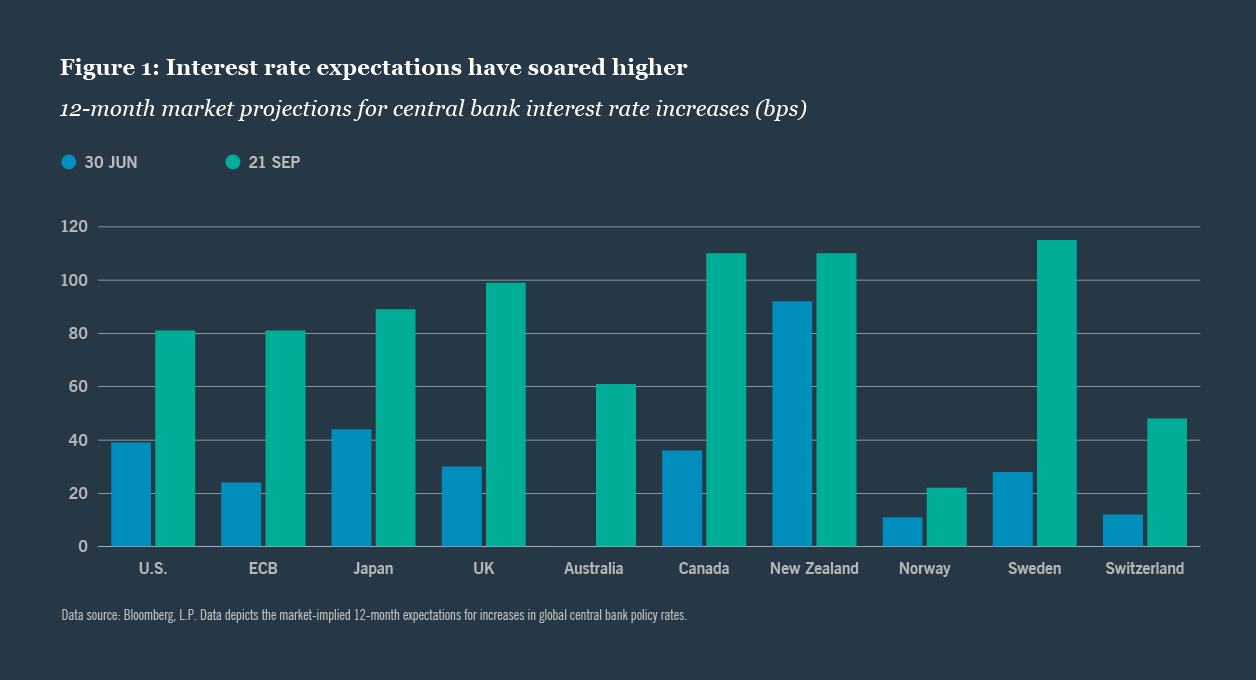
The interest rate outlook remains uncertain, but points to still-high rates. Central bank policy paths hinge on how the energy shock evolves. We lean toward one further U.S. Federal Reserve hike by year-end, as near-term energy pressures risk feeding into underlying inflation. A meaningful drop in oil prices, however, could reduce that need. The European Central Bank faces similar upside risks, while the Bank of England confronts a difficult trade-off between sticky inflation and weak growth. The Bank of Japan looks set to keep removing accommodation gradually as wages and inflation anchor more firmly around its 2.0% target. Notably, all major global central banks have grown significantly more hawkish since midyear (Figure 1).
Geopolitics remain a wildcard. Energy price pressures are playing out unevenly across the globe, especially in emerging markets, where technology exporters and commodity producers are better placed than energy importers and highly indebted economies. Growth is holding up heading into 2027, even as renewed inflation pressures and tighter financial conditions leave policymakers less room for error. This volatility, combined with a cloudy outlook for the Middle East conflict and elections in the U.S. and elsewhere, could add further uncertainty in the months ahead.
Continue reading




Global Investment Committee

Contact us

You are on the site for: Financial Professionals and Individual Investors. You can switch to the site for: Institutional Investors or Global Investors
Endnotes
Sources
All market and economic data from Bloomberg, FactSet and Morningstar.
This material is not intended to be a recommendation or investment advice, does not constitute a solicitation to buy, sell or hold a security or an investment strategy, and is not provided in a fiduciary capacity. The information provided does not take into account the specific objectives or circumstances of any particular investor, or suggest any specific course of action. Investment decisions should be made based on an investor’s objectives and circumstances and in consultation with his or her financial professionals.
The views and opinions expressed are for informational and educational purposes only as of the date of production/writing and may change without notice at any time based on numerous factors, such as market or other conditions, legal and regulatory developments, additional risks and uncertainties and may not come to pass. This material may contain “forward-looking” information that is not purely historical in nature.
Such information may include, among other things, projections, forecasts, estimates of market returns, and proposed or expected portfolio composition. Any changes to assumptions that may have been made in preparing this material could have a material impact on the information presented herein by way of example. Performance data shown represents past performance and does not predict or guarantee future results. Investing involves risk; principal loss is possible.
All information has been obtained from sources believed to be reliable, but its accuracy is not guaranteed. There is no representation or warranty as to the current accuracy, reliability or completeness of, nor liability for, decisions based on such information and it should not be relied on as such. For term definitions and index descriptions, please access the glossary on nuveen.com. Please note, it is not possible to invest directly in an index.
Important information on risk
All investments carry a certain degree of risk and there is no assurance that an investment will provide positive performance over any period of time. Equity investing involves risk. Investments are also subject to political, currency and regulatory risks. These risks may be magnified in emerging markets. Diversification is a technique to help reduce risk. There is no guarantee that diversification will protect against a loss of income. Debt or fixed income securities are subject to market risk, credit risk, interest rate risk, call risk, tax risk, political and economic risk, and income risk. As interest rates rise, bond prices fall. Investing in municipal bonds involves risks such as interest rate risk, credit risk and market risk, including the possible loss of principal. The value of the portfolio will fluctuate based on the value of the underlying securities. There are special risks associated with investments in high yield bonds, hedging activities and the potential use of leverage. Portfolios that include lower rated municipal bonds, commonly referred to as “high yield” or “junk” bonds, which are considered to be speculative, the credit and investment risk is heightened for the portfolio. Credit ratings are subject to change. AAA, AA, A, and BBB are investment grade ratings; BB, B, CCC/CC/C and D are below-investment grade ratings. As an asset class, real assets are less developed, more illiquid, and less transparent compared to traditional asset classes. Investments will be subject to risks generally associated with the ownership of real estate-related assets and foreign investing, including changes in economic conditions, currency values, environmental risks, the cost of and ability to obtain insurance, and risks related to leasing of properties. Investors should be aware that alternative investments including private equity and private debt are speculative, subject to substantial risks including the risks associated with limited liquidity, the use of leverage, short sales and concentrated investments and may involve complex tax structures and investment strategies. Alternative investments may be illiquid, there may be no liquid secondary market or ready purchasers for such securities, they may not be required to provide periodic pricing or valuation information to investors, there may be delays in distributing tax information to investors, they are not subject to the same regulatory requirements as other types of pooled investment vehicles, and they may be subject to high fees and expenses, which will reduce profits. Alternative investments are not appropriate for all investors and should not constitute an entire investment program. Investors may lose all or substantially all of the capital invested. The historical returns achieved by alternative asset vehicles is not a prediction of future performance or a guarantee of future results, and there can be no assurance that comparable returns will be achieved by any strategy. Responsible investing incorporates Environmental Social Governance (ESG) factors that may affect exposure to issuers, sectors, industries, limiting the type and number of investment opportunities available, which could result in excluding investments that perform well.
Nuveen, LLC provides investment services through its investment specialists.
This information does not constitute investment research as defined under MiFID.
Not registered yet? Register