Contact us
Contact Nuveen
Thank you for your message. We will contact you shortly.

Section 4: Five investment themes for 2026
- From AI boom to AI bifurcation: knowing where to invest
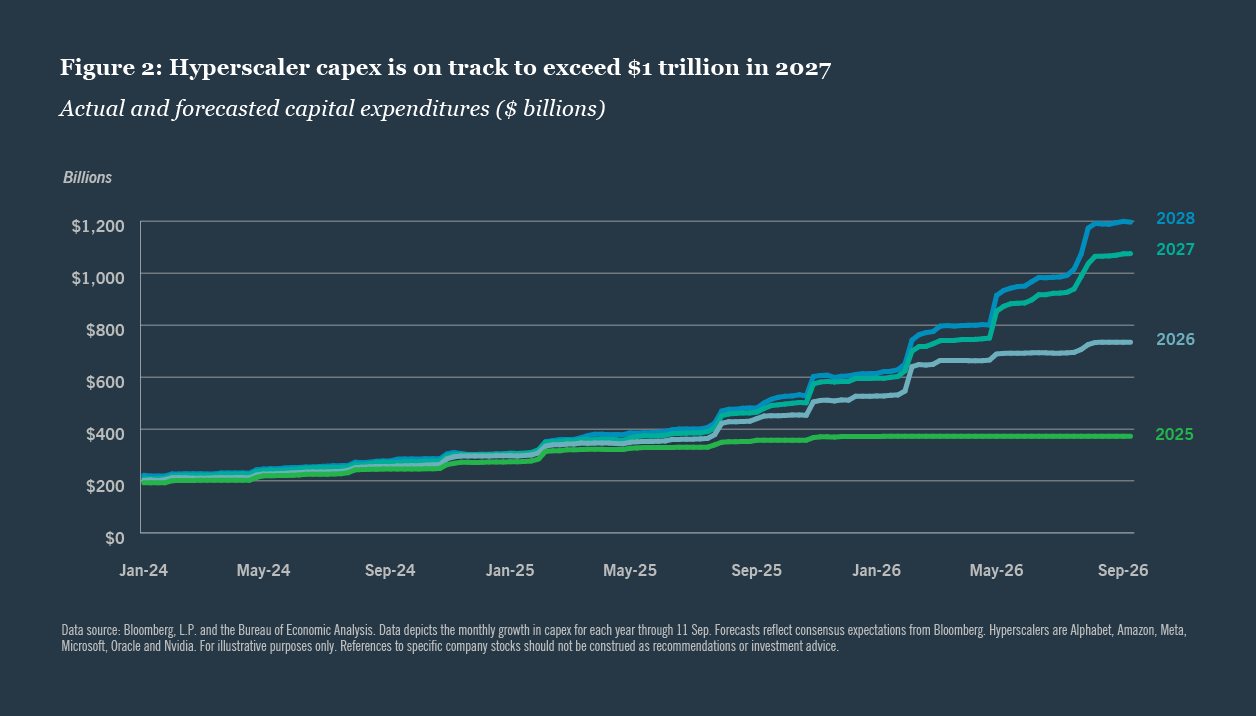
Surging hyperscaler capital expenditures remain a primary market driver across asset classes. This shows up most visibly in equities, where many are rightfully concerned about growing index concentration, but AI-related debt financing is also a powerful tailwind across public and private fixed income markets. We see no signs of AI capex slowing; in fact, it is projected to grow strongly over the coming years (Figure 2).
But capex growth alone is not an investment theme, and we expect AI selectivity to grow in importance. We increasingly see opportunities extending beyond first-order beneficiaries into industrials, power equipment, infrastructure, health care and other AI-adjacent areas. We also see growing risk for companies that cannot demonstrate a credible path to monetizing AI. Increased AI infrastructure spending pressures margins and returns on invested capital when it doesn’t translate into meaningful revenue growth.
Growing scrutiny, and hostility, around AI trends generally and data center buildout specifically is also clouding the outlook. For direct hyperscaler investments, we favor facilities that rely on sustainable power, avoid water stress issues and engage meaningfully with community feedback — all factors tied to longevity and profitability.
- Cash isn’t a strategy: putting sidelined capital to work
In conversations with clients, we’re hearing that valuation concerns, worries about global economic and geopolitical trends and uneasiness about extending duration are pushing many individual investors toward high cash levels. Some institutional investors are delaying new capital commitments or extending due diligence timelines for similar reasons.
But in our view, the cost of waiting outweighs any potential benefit, and the need for sustainable income and long-term growth hasn’t changed. Despite Treasuries starting to offer better relative value, we see ample opportunities to put cash to work. Rising yields have created challenges for bond markets, but they’ve also created better entry points, with senior loans and securitized assets looking particularly attractive. U.S. municipal bonds also stand out given their yields and fundamentals. We also see opportunity in customized long/short mandates and other de-risking strategies designed to manage volatility exposure.
- Alternative credit and private markets: separating headlines from fundamentals
Negative headlines around private credit have faded in recent months, but concerns persist that the market is overbought or that deal structure quality is slipping. Some deals do rely on excess leverage or suffer from insufficient cash flows, which only reinforces the importance of deal structure, strong covenants and careful selectivity. We’re also seeing more manager dispersion, which reflects these same trends.
Core middle market direct lending in the U.S. and Europe continues to show healthy fundamentals, including low default and non-accrual rates. We see particular opportunity in “old economy” lending, such as light manufacturing, building services and landscaping, which offers diversification away from AI themes. On the investment grade side, rising energy demand creates opportunities in utility operating companies, new power plants and expanding transmission infrastructure. We also see opportunity across other alternative credit segments, including collateralized loan obligations, real estate and infrastructure debt and C-PACE financing.
For private equity, investor interest appears to be growing, deal flow is picking up and overall market quality has improved over the last year. As with debt markets, selectivity remains critical; we see the best opportunities in equity secondaries, particularly single-asset deals.
- Municipals: a technical and fundamental bright spot
Rising bond yields have pressured most global fixed income. But we see the rise in municipal yields as part of the broader macro dynamic around higher energy prices and inflation, not a reflection of municipal fundamentals, as state and local tax collections show continued growth over the last year. Demand for municipals has also been persistent, balancing still-elevated supply. As yields have increased and municipal valuations have cheapened, municipal yield curves are steeper than Treasuries, making this one area where taking on some duration risk may make sense.
- The private real estate rebound continues to build
Private real estate continues to offer a compelling entry point following a reset in values and fundamentals that began around the start of last year. We think real estate credit looks particularly attractive. The MSCI Global Quarterly Property Index has now enjoyed nine consecutive quarters of positive total returns, with the last seven each notching modest value gains. Elevated interest rates could delay the return of more significant capital growth, but real estate is fundamentally an income-driven asset class. On the income side, a sharp slowdown in new supply is helping occupancies improve across property types, a pattern that has typically preceded stronger periods of rent growth. In the following section of our outlook, we offer specific areas within real estate markets where we see the best opportunities.
Continue reading




Global Investment Committee

Contact us

You are on the site for: Financial Professionals and Individual Investors. You can switch to the site for: Institutional Investors or Global Investors
Endnotes
Sources
All market and economic data from Bloomberg, FactSet and Morningstar
This material is not intended to be a recommendation or investment advice, does not constitute a solicitation to buy, sell or hold a security or an investment strategy, and is not provided in a fiduciary capacity. The information provided does not take into account the specific objectives or circumstances of any particular investor, or suggest any specific course of action. Investment decisions should be made based on an investor’s objectives and circumstances and in consultation with his or her financial professionals.
The views and opinions expressed are for informational and educational purposes only as of the date of production/writing and may change without notice at any time based on numerous factors, such as market or other conditions, legal and regulatory developments, additional risks and uncertainties and may not come to pass. This material may contain “forward-looking” information that is not purely historical in nature.
Such information may include, among other things, projections, forecasts, estimates of market returns, and proposed or expected portfolio composition. Any changes to assumptions that may have been made in preparing this material could have a material impact on the information presented herein by way of example. Performance data shown represents past performance and does not predict or guarantee future results. Investing involves risk; principal loss is possible.
All information has been obtained from sources believed to be reliable, but its accuracy is not guaranteed. There is no representation or warranty as to the current accuracy, reliability or completeness of, nor liability for, decisions based on such information and it should not be relied on as such. For term definitions and index descriptions, please access the glossary on nuveen.com. Please note, it is not possible to invest directly in an index.
Important information on risk
All investments carry a certain degree of risk and there is no assurance that an investment will provide positive performance over any period of time. Equity investing involves risk. Investments are also subject to political, currency and regulatory risks. These risks may be magnified in emerging markets. Diversification is a technique to help reduce risk. There is no guarantee that diversification will protect against a loss of income. Debt or fixed income securities are subject to market risk, credit risk, interest rate risk, call risk, tax risk, political and economic risk, and income risk. As interest rates rise, bond prices fall. Investing in municipal bonds involves risks such as interest rate risk, credit risk and market risk, including the possible loss of principal. The value of the portfolio will fluctuate based on the value of the underlying securities. There are special risks associated with investments in high yield bonds, hedging activities and the potential use of leverage. Portfolios that include lower rated municipal bonds, commonly referred to as “high yield” or “junk” bonds, which are considered to be speculative, the credit and investment risk is heightened for the portfolio. Credit ratings are subject to change. AAA, AA, A, and BBB are investment grade ratings; BB, B, CCC/CC/C and D are below-investment grade ratings. As an asset class, real assets are less developed, more illiquid, and less transparent compared to traditional asset classes. Investments will be subject to risks generally associated with the ownership of real estate-related assets and foreign investing, including changes in economic conditions, currency values, environmental risks, the cost of and ability to obtain insurance, and risks related to leasing of properties. Investors should be aware that alternative investments including private equity and private debt are speculative, subject to substantial risks including the risks associated with limited liquidity, the use of leverage, short sales and concentrated investments and may involve complex tax structures and investment strategies. Alternative investments may be illiquid, there may be no liquid secondary market or ready purchasers for such securities, they may not be required to provide periodic pricing or valuation information to investors, there may be delays in distributing tax information to investors, they are not subject to the same regulatory requirements as other types of pooled investment vehicles, and they may be subject to high fees and expenses, which will reduce profits. Alternative investments are not appropriate for all investors and should not constitute an entire investment program. Investors may lose all or substantially all of the capital invested. The historical returns achieved by alternative asset vehicles is not a prediction of future performance or a guarantee of future results, and there can be no assurance that comparable returns will be achieved by any strategy. Responsible investing incorporates Environmental Social Governance (ESG) factors that may affect exposure to issuers, sectors, industries, limiting the type and number of investment opportunities available, which could result in excluding investments that perform well.
Nuveen, LLC provides investment services through its investment specialists.
This information does not constitute investment research as defined under MiFID.
Not registered yet? Register