Contact us
Contact Nuveen
Thank you for your message. We will contact you shortly.

Traditional distinctions between developed and emerging markets are blurring. Political, fiscal and institutional risks once reserved for emerging economies increasingly apply to developed markets, while many EM countries have strengthened their fundamentals — expanding the opportunity set for fixed income investors.
Key takeaways:
- Stage of development no longer predicts risk. Fiscal discipline, central bank credibility and institutional strength vary as much within markets as between them.
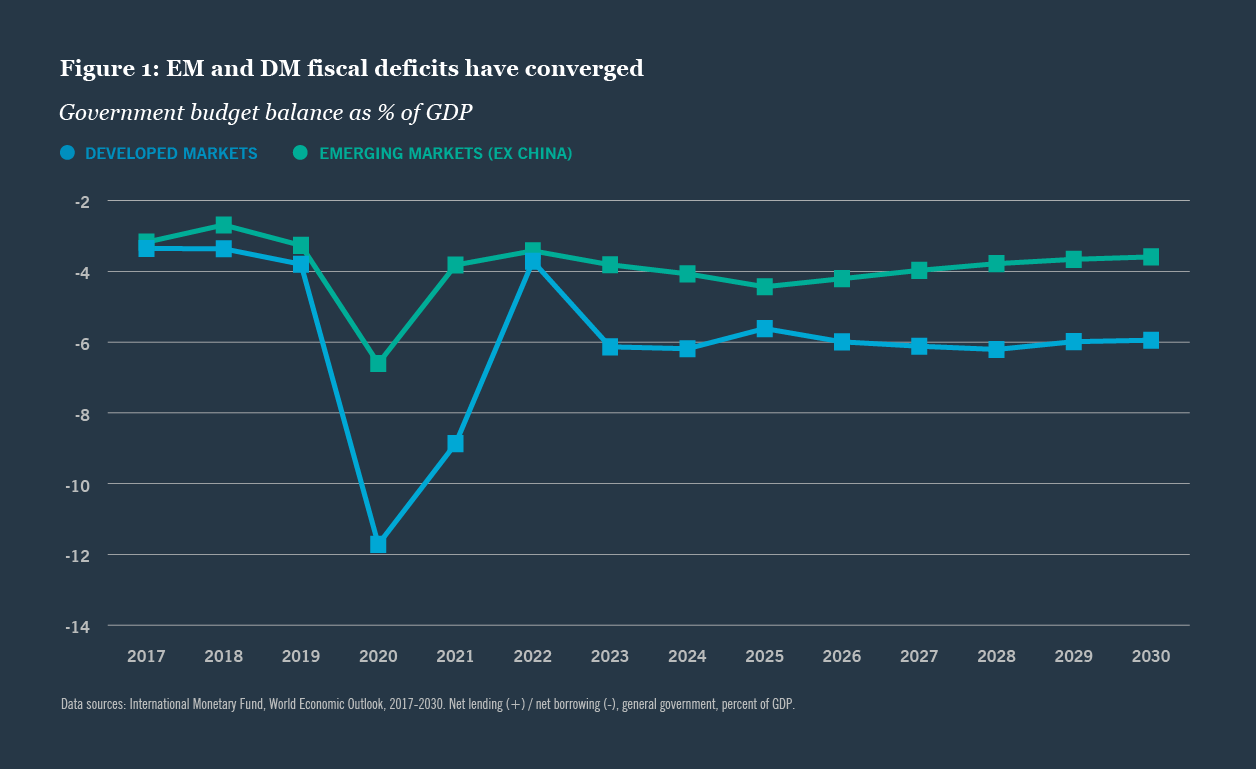
- Fiscal discipline has shifted. Many emerging markets stabilized their debt post-pandemic, while developed market deficits remain structurally elevated.
- EM offers compelling value. Emerging markets sovereign bonds may provide attractive additional yield over similarly rated developed market securities with comparable fundamentals.
- EM corporate debt is a core market. Market size exceeds both EM sovereigns and U.S. high yield, offering enhanced diversification potential without adding significant tracking error.
- Risk is increasingly issuer-driven. Corporate balance sheets matter more than sovereign labels, enabling differentiation by credit quality rather than geography.
Traditional boundaries are blurring
For decades, global fixed income portfolios were constructed around a simple distinction: developed markets offered stability and institutional credibility, while emerging markets offered a yield premium alongside higher political, fiscal and currency risk. That framework is increasingly being challenged.
Today, fiscal trajectories, institutional credibility and policy stability vary as much within developed and emerging markets as between them. Political risk, fiscal deficits and policy uncertainty — once viewed as predominantly EM characteristics — are increasingly evident across major developed economies. Meanwhile, many emerging markets have strengthened balance sheets, improved policy frameworks and demonstrated greater responsiveness to market discipline.
The result is a growing convergence that calls for a more unified, risk-first approach to global fixed income allocations.
Fiscal and institutional divergence is no longer geographic
The post-pandemic period has accelerated a divergence in fiscal trajectories. Developed market deficits remain structurally elevated, with aggregate shortfalls projected to remain around 4%-5% of GDP through the end of the decade (Figure 1). Rising debt burdens, growing reliance on fiscal support and political resistance to consolidation have heightened concerns over long term debt sustainability.
By contrast, many emerging markets, particularly outside China, have been forced by market discipline to adjust more quickly. Earlier monetary tightening, healthier external balances and greater fiscal restraint have left several EM sovereigns entering the next phase of the cycle from a position of relative stability.
This doesn’t suggest that emerging markets are uniformly stronger, nor that developed markets are uniformly weaker. Rather, risk is no longer well captured by geography alone. Dispersion increasingly blurs traditional market classifications.
EM corporates have become a core global credit market
One of the most underappreciated consequences of this shift has been the expansion and diversification of the emerging markets corporate and quasi sovereign debt universe.
What began as a predominantly sovereign market has evolved into a broad, deep and increasingly corporate-led opportunity set. The EM corporate hard currency market has grown to approximately $2.6 trillion, exceeding the EM sovereign universe and rivaling — in some measures surpassing — the U.S. high yield market.1
This evolution materially changes the role of EM in global portfolios.
First, risk in EM is no longer primarily sovereign. Corporate issuers now dominate, allowing investors to express country, sector and thematic views with greater precision and less reliance on sovereign balance sheets.
Second, scale matters. At its current size and depth, EM corporate debt is no longer a peripheral allocation. It increasingly competes with developed markets credit on both yield and quality, particularly when adjusted for fundamentals. EM hard currency offers nearly 100 basis points of yield advantage as of 31 December 2025 over similarly rated DM securities.2
Dollar diversification is becoming a tailwind
Global investors are navigating a changing currency regime. While the U.S. dollar remains the world’s dominant reserve currency, its status is gradually declining. Central banks and institutional investors are increasingly diversifying away from dollar-based exposures, driven by geopolitical fragmentation, fiscal uncertainty and risk management considerations.
Importantly, diversification is occurring through market participants hedging U.S. dollar exposure. That dynamic creates a persistent downward pressure on the dollar over time – a material tailwind for emerging markets.
Dollar weakness directly improves EM debt sustainability by reducing the real burden of servicing external obligations. It also enhances competitiveness and supports growth, particularly for export-oriented economies. While EM local currency debt may benefit most directly, EM hard currency may also gain as improving balance sheet dynamics reduce default risk and compress spreads.
Rethinking sovereign risk: cohorts over countries
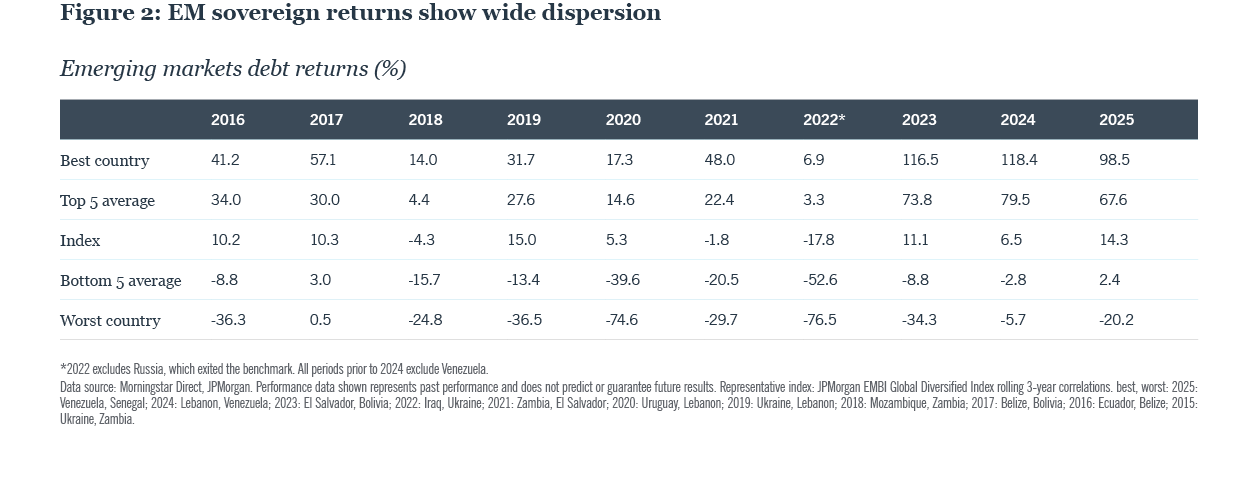
As traditional DM and EM classifications lose relevance, investors may shift from geographic frameworks to cohort-based analysis. Under Nuveen’s distinct approach, sovereigns — whether classified as developed or emerging — can be evaluated through a unified lens focused on fundamental characteristics of fiscal sustainability, institutional quality and policy credibility (Figure 2).
Within this framework, several distinct cohorts emerge:
- Steady countries: Strong institutions, manageable financing needs and credible policy frameworks, regardless of income level. This cohort represents 22 countries and 58 issuers — nearly one-third of the EMBI Global Diversified Index on a country basis and over half by market capitalization.3
- Reformers: Structural improvements and policy credibility driving fundamental gains and ratings momentum. This cohort spans 11 countries in EMBI and 6 in the Corporate EMBI, demonstrating the expanding opportunity set.4
- Laggards: Require structural reform and face deteriorating fiscal or political outlooks and rising risk premia. This category increasingly includes certain DM economies with unaddressed fiscal challenges alongside traditional EM concerns.
- Frontier markets: Early-stage growth potential and diversification benefits, alongside higher volatility.
- Crisis-prone issuers: Where political or economic instability dominates return outcomes.
Nuveen’s approach cuts across geographic regions, income levels and credit ratings. It’s dynamic, evolving as country fundamentals change. Most importantly, it treats developed and emerging markets through the same lens, recognizing that institutional quality and policy credibility matter more than just geography.
Corporates and infrastructure offer insulation from sovereign volatility
The convergence between emerging and developed markets is particularly evident in corporate and infrastructure credit. Global infrastructure financing — spanning energy, transportation, telecommunications and utilities — increasingly cuts across traditional market boundaries.
Quasi-sovereign entities and well-capitalized corporates often exhibit stronger credit profiles than their sovereign sponsors, supported by regulated revenues, contractual cash flows and strategic importance. In emerging markets, this allows investors to access growth and income while reducing exposure to sovereign balance sheet risk.
Similarly, sector-specific opportunities — from exporters benefiting from currency depreciation to technology and telecom providers supporting digital infrastructure — offer ways to express macro views through issuer selection rather than country allocation alone.
Portfolio implications: integration, not segmentation
The convergence between developed and emerging markets represents a structural shift, not a cyclical anomaly. Allocation frameworks built around rigid geographic segmentation risk becoming increasingly inefficient.
Rather than treating EM as a separate sleeve defined by geography, investors may be better served by applying a unified analytical framework across the entire opportunity set — assessing fiscal sustainability, institutional credibility, monetary policy independence and external vulnerabilities on a consistent basis.
This approach supports :
- Broader hard currency mandates spanning sovereigns and corporate.
- Greater use of currency diversification as a risk management tool.
- Increased emphasis on issuer-level and cohort based selection
- More resilient portfolios capable of navigating fiscal and geopolitical uncertainty
Bottom line: a new map for navigating global fixed income
The blurring of lines between emerging and developed markets is reshaping the global fixed income landscape. Opportunities are expanding, but they are increasingly defined by fundamentals rather than labels.
In a world where fiscal credibility and institutional strength no longer align neatly with geography, the old map no longer serves. A new one is required.
Related articles

Tax-loss harvesting: Upgrade portfolios amidst volatility

The Fed dishes a dose of tightening

Smaller trades are at a pricing disadvantage
Contact us

You are on the site for: Financial Professionals and Individual Investors. You can switch to the site for: Institutional Investors or Global Investors
Endnotes
1 Data source: JPMorgan, 31 Oct 2025.
2 Data sources: JPMorgan; Bloomberg, L.P., 30 Nov 2025.
3 Data source: JPMorgan, Nuveen, 31 Dec 2025. JPMorgan Emerging Markets Bond Index Global Diversified (EMBI).
4 Data source: JPMorgan, Nuveen, 31 Dec 2025. JPMorgan Emerging Markets Bond Index Global Diversified (EMBI) and JPMorgan Corporates Emerging Markets Bond Index.
This material is not intended to be a recommendation or investment advice, does not constitute a solicitation to buy, sell or hold a security or an investment strategy, and is not provided in a fiduciary capacity. The information provided does not take into account the specific objectives or circumstances of any particular investor, or suggest any specific course of action. Investment decisions should be made based on an investor’s objectives and circumstances and in consultation with his or her financial professionals.
The views and opinions expressed are for informational and educational purposes only as of the date of production/writing and may change without notice at any time based on numerous factors, such as market or other conditions, legal and regulatory developments, additional risks and uncertainties and may not come to pass. This material may contain “forward-looking” information that is not purely historical in nature. Such information may include, among other things, projections, forecasts, estimates of market returns, and proposed or expected portfolio composition. Any changes to assumptions that may have been made in preparing this material could have a material impact on the information presented herein by way of example. Performance data shown represents past performance and does not predict or guarantee future results. Investing involves risk; principal loss is possible.
All information has been obtained from sources believed to be reliable, but its accuracy is not guaranteed. There is no representation or warranty as to the current accuracy, reliability or completeness of, nor liability for, decisions based on such information and it should not be relied on as such. For term definitions and index descriptions, please access the glossary on nuveen.com. Please note, it is not possible to invest directly in an index.
Important information on risk
Investing involves risk; principal loss is possible. Debt or fixed income securities are subject to market risk, credit risk, interest rate risk, call risk, derivatives risk, dollar roll transaction risk, and income risk. As interest rates rise, bond prices fall. Foreign investments involve additional risks, including currency fluctuation, political and economic instability, lack of liquidity, and differing legal and accounting standards. These risks are magnified in emerging markets.
Nuveen, LLC provides investment solutions through its investment specialists.
This information does not constitute investment research as defined under MiFID.
Not registered yet? Register