Contact us
Contact Nuveen
Thank you for your message. We will contact you shortly.
Benefits 2.0
Securing stability through flexibility: benefits insights from the sports, media and entertainment industry

The sports, media and entertainment sector is undergoing rapid change, from the erosion of traditional media to the rise of streaming. Benefits need to provide stability and reassurance for workers, especially in a sector where many freelancers or contractors face uncertain conditions.
Findings from Economist Enterprise’s 2025 Benefits 2.0 survey of US sports, media and entertainment workers point to several areas where benefits can be strengthened to better meet worker needs and enhance stability in a shifting job market:
- Inclusive benefits that work across permanent, freelance and project-based roles;
- Portable benefits that move with workers, supporting mobility and career progression;
- Retirement support that helps improve engagement with savings plans; and
- Caregiving support that expands opportunities for women and the “sandwich generation.”
An industry at the crossroads
The media industry is in transition, with newsrooms cutting staff and relying more on freelancers.1 At the same time, disruption from digital publishers and streaming platforms is reshaping the business models of major companies. Layoffs are rising: in 2025 cuts in the entertainment and media industry rose by 18% compared with 2024, with over 17,000 jobs lost.2 “The media field has been challenging for a number of years,” says Andre Scheluchin, head of people at Business Insider. “A lot of companies, including us, have had several rounds of layoffs, and a lot of people are struggling to access benefits at all.”
This trend is unfolding alongside changes in the nature of work. Freelance work has surged: US businesses have increased such hiring by 260% in recent years.3 Creative fields are among the most freelance-intensive parts of the economy,⁴ and creative services professionals—including artists, video producers, writers, performers and sound specialists—make up 22% of independent workers.5
Upgrading static benefits for dynamic workforces
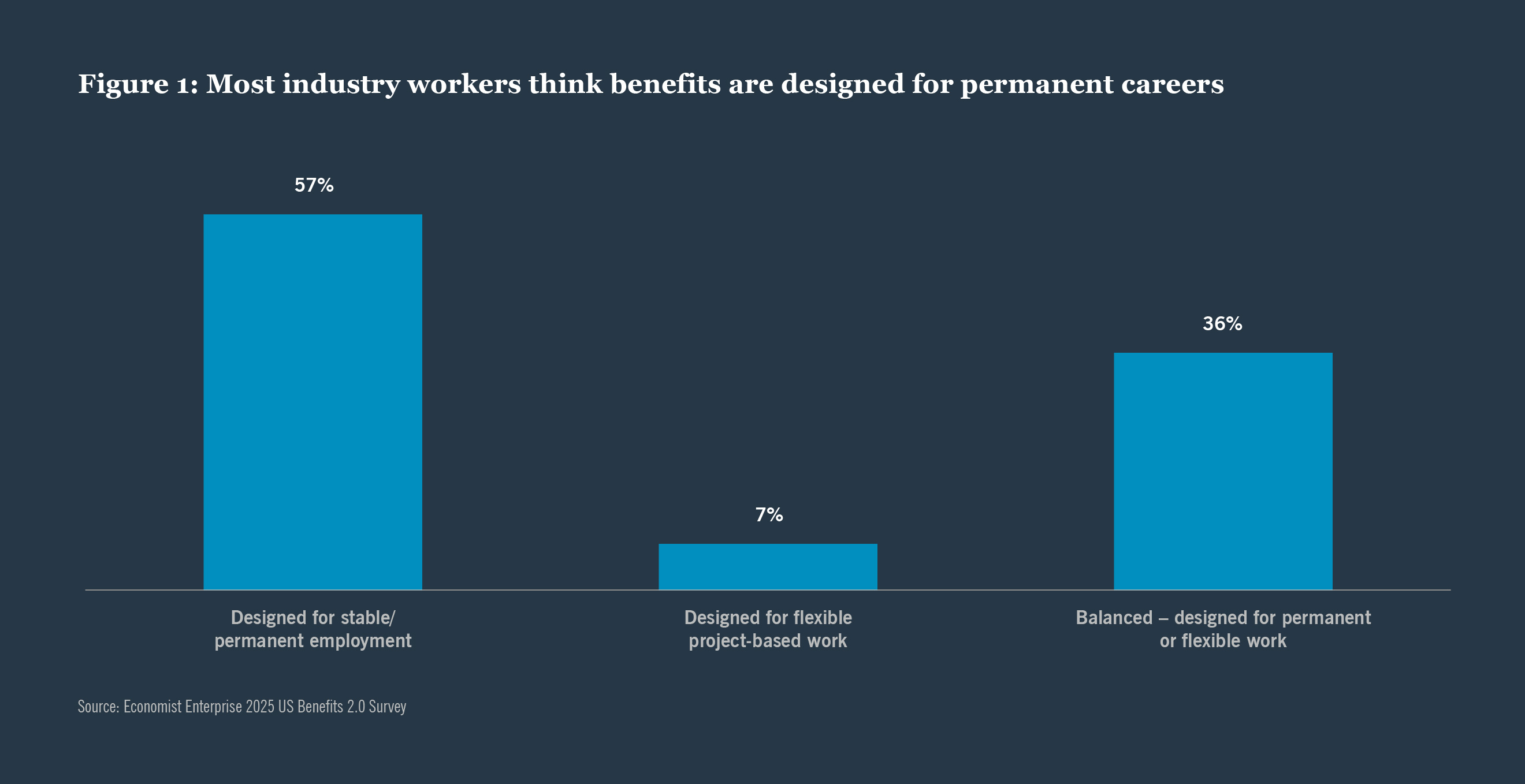
However, benefits systems have not kept pace. While more than a third of workers (36%) say benefits are now designed to support both stable and flexible work, most (57%) still see them as designed for permanent roles (see figure 1). For instance, gig and contract workers often have limited access to traditional benefits, which are still largely structured for permanent employment.
At the same time, most workers express confidence in their benefits: 71% say their employer’s benefits demonstrate genuine care, suggesting that the challenge is less about trust and more about fit. As a result, even where benefits are valued, they are often less effective in attracting and retaining talent in a projectbased industry. “We have quite a few contract employees, so benefits aren’t as much of a selling point for them, because they’re not eligible,” says Jillian Peterson, a human resources manager with FIFA.
In a landscape where job stability is no longer guaranteed, benefits must evolve. Portable benefits, such as retirement funds or savings accounts that move with workers between roles, offer a solution, with 37% saying these would increase their confidence to change jobs. This matters: more than 60% of media and entertainment workers planned to leave their roles in 2024.⁶ Meanwhile, 54% of workers said that access to portable benefits would lead them to expect greater flexibility and relevance in their employer’s benefits overall, pointing to a broader shift in what workers value.
This shift is already visible in changing employee expectations, with workers in sports and entertainment increasingly seeking more meaningful, practical benefits, according to the head of industry engagement at Morgan Stanley at Work.⁷ Financial wellness support, such as education around retirement planning, could make a major difference. At the moment, employees in sports, media and entertainment are less likely to engage with their retirement benefits. Only 26% of those with a retirement plan actively review and adjust it, compared with 38% in other industries. More personalized support that responds to the needs and lifestyles of workers in the sector could drive stronger engagement.
Mental health at the center of workforce risk
Mental health support should be a priority. More than 80% of journalists in the US reported burnout or chronic stress in 2025, driven by economic insecurity, workplace culture and limited access to mental healthcare.⁸ A study of local sports broadcasters found that many cited feeling overworked and underpaid as a reason for leaving the industry.⁹ Across creative industries, 64% have considered leaving their roles due to mental health concerns, with 32% already taking steps to do so.10 Alarmingly, nearly a third reported having considered suicide in the past year.
Healthcare costs, financial strain and retirement insecurity likely exacerbate these pressures. According to our survey, 40% of workers have delayed or skipped medical care due to the cost, and 74% have dipped into emergency savings for healthcare or care expenses. Among those who expect to delay retirement, 41% cited health expenses as a top reason, while 24% emphasized Social Security eligibility (compared with 17% in other industries), highlighting concerns about how well the system supports non-traditional careers.
In addition to mental health-focused benefits, flexible working arrangements can play a key role in addressing these challenges. Remote and hybrid work models are linked to lower burnout and improved mental well-being.11 “I’ve seen less burnout in companies that have been open to continuing some sort of hybrid work model since covid,” says FIFA’s Ms Peterson. “Burnout happens faster when forcing people back into the office five days a week.”
Strong, but uneven, caregiving support
For caregivers, flexibility is often the difference between staying in work and stepping back. Employers in the sector appear to offer relatively strong caregiving support: just 17% of workers had to leave a job or reduce their hours to provide care over the past five years, compared with 30% in other industries, and only 20% reported difficulty accessing or using employer caregiving benefits versus 40% elsewhere.
However, this may not reflect benefits alone. Project-based work and more flexible schedules can make it easier for some workers to step in and out of roles or adjust their working patterns around caregiving responsibilities. These perks are particularly relevant in a sector with a median age of 38, placing many workers in the “sandwich generation,” caring for both children and elderly.12
Yet this flexibility is uneven. In arts, design, entertainment, sports and media occupations, women—who are more likely to have caregiving responsibilities—are also more likely to work part time, which can limit access to employer-provided benefits.13 At the same time, some large media companies are now requiring workers to return to the office,14 which could increase caregiving strain as well as stress and burnout.
AI and the future of workforce development
Artificial intelligence (AI) will further reshape workforce needs and expectations. “AI is doing a lot of the things that entry-level people would normally be doing as they develop their careers, so we’re likely going to see a greater need for career development benefits to better develop those people into our future leaders,” says Mr Scheluchin at Business Insider.
Workers in creative industries are increasingly concerned about the impact of generative AI on both job security and compensation, among other aspects.15 At the same time, 39% say training on how to use AI would make them more likely to use such tools to manage their benefits. This makes career development benefits critical to helping workers adapt and remain competitive.
Benefits strategies must evolve with the workforce. Offering more personalized and flexible benefits, maintaining access to remote and hybrid work, investing in career development and expanding mental health support will be key to improving well-being and sustaining the workforce.
Related articles

Insights for sports, media and entertainment plan sponsors

Retirement decisions rarely revisited

Where portable benefits matter most
Contact us

References
1 PwC, “Entertainment and media employees are losing confidence in their industry”, January 2024, https://www.pwc.com/gx/en/ industries/tmt/entertainment-media-declining-employee-confidence.html
2 The Wrap., “Entertainment and Media Layoffs Up 18% With Over 17,000 Jobs Slashed in 2025”, December 2025, https://www. thewrap.com/industry-news/business/entertainment-media-layoffs-2025-analysis/
3 Entrepreneur, “Why a 260% Jump in Freelance Hiring Signals Changing Times in North America”, March 2025, https://www. entrepreneur.com/leadership/why-the-260-jump-in-freelance-hiring-signals-a-major-shift/487146
4 Upwork, “Freelance Forward Economist Report, December 2021, https://www.upwork.com/research/freelance-forward-2021
5 Fiverr, “Freelance Economy Grows Amid Workforce and Economic Volatility, Expanding Across Every Major U.S. City”, March 2025, https://investors.fiverr.com/news-releases/news-release-details/freelance-economy-grows-amid-workforce-and-economic-volatility
6 PwC, “Entertainment and media employees are losing confidence in their industry”, January 2024, https://www.pwc.com/gx/en/ industries/tmt/entertainment-media-declining-employee-confidence.html
7 Morgan Stanley, “How Financial Wellness Is Reshaping Employee Retention in the Sports & Entertainment Industry”, https://www. morganstanley.com/insights/articles/retaining-sports-and-entertainment-employees?cid=SM_CORP_LINKEDIN_morgan-stanleywealth-management_20251111&linkId=876718516
8 Editor & Publisher, “National survey finds widespread burnout and economic insecurity driving mental health crisis in US journalism”, January 2026, https://www.editorandpublisher.com/stories/national-survey-finds-widespread-burnout,259781
9 Kevin Hull, “Loved It, Miss It, Would Never Go Back: Why U.S. Local Television Sports Broadcasters are Leaving the Industry”, IACS, Volume 13, Issue 2, https://journals.sagepub.com/doi/10.1177/21674795241234822
10 Production Expert, “The Passion Trap: Why Creative Industries Burn People Out”, March 2026, https://www.production-expert.com/ production-expert-1/the-passion-trap-why-creative-industries-burn-people-out
11 UC TODAY, “60% of People Have Better Mental Health Working Remote”, April 2020, https://www.uctoday.com/unifiedcommunications/60-of-people-have-better-mental-health-working-remote/
12 U.S. Bureau of Labor Statistics, “Labor Force Statistics from the Current Population Survey”, https://www.bls.gov/cps/cpsaat18b.html
13 Data USA, “Arts, Design, Entertainment, Sports & Media Occupations”, https://datausa.io/profile/soc/arts-design-entertainmentsports-media-occupations
14 Business Insider, “The state of media RTO: Here’s what companies from Paramount to Netflix are telling workers heading into 2026”, December 2025, https://www.businessinsider.com/remote-work-media-companies-rto-wfh-paramount-nbcu-disney-netflix-2025-12
15 Queen Mary University of London, “Perceptions” https://www.qmul.ac.uk/centre-creative-collaboration/projects/creaatif/survey/ survey-key-findings/perceptions/
Not registered yet? Register