Contact us
Contact Nuveen
Thank you for your message. We will contact you shortly.

Asset managers, recordkeepers, and policymakers are increasingly interested in the potential benefits of adding private market assets into retirement plans, while the Department of Labor’s recent communications have added further impetus. But within the ERISA universe, change moves at a slow pace, and the potential of private markets is countered by their inherent complexities, potential costs, and the conservatism of plan sponsors and fiduciaries. To examine these differing interests we spoke to Brian Perkins, Chief Investment Officer at NFP, and Maureen Mendoza, a financial advisor at UBS.
Key takeaways
- Private markets could offer compelling return and diversification benefits, but significant structural hurdles remain before widespread 401(k) adoption is realistic.
- The gap between what private asset classes can theoretically offer and what current products and regulatory structure can practically deliver is a central challenge.
- Advisors and fiduciaries are divided on whether 401(k) plans are even the right home for alternatives, but both camps agree that participant education and fee transparency must come first.
The potential of privates
The argument for including private assets in defined contribution plans is one of diversification, which is an important aim of asset allocation for retirement portfolios. Brian puts it plainly, saying “Public markets are concentrated. The Magnificent Seven stocks in the S&P 500 represent as much as 35% of the Index, while 87% of companies with revenue greater than $100m are private. For advisors trying to build genuinely diversified portfolios, the public equity universe is only part of the economic story — and a shrinking part at that.”1
The performance of private markets is also a part of the drive, as Brian adds, “Over the last 20 years, private markets have outperformed their public market counterparts,” and for retirement savers with time horizons measured in decades, that kind of sustained outperformance could meaningfully improve outcomes.2 The goal is straightforward, “to build an investment program that can lead to better retirement outcomes for participants.” And while the right approach could be a more blended portfolio, as Brian says, targeting “attractive returns, diversification, non-linear correlation with traditional asset classes,” in practice, the execution is more complicated.
For Maureen, her position is not that alternatives are inherently unsuitable for retirement planning, but whether the 401(k) is the right vehicle, as she see it, “I absolutely think that alternative investments could have a meaningful place in retirement portfolios, as this allows for diversification at a much more efficient cost than is possible with an allocation to a hedge fund or infrastructure or other private asset. But I’m not convinced that the 401(k) is that place.”
There are a lot of questions that haven’t been answered yet in a meaningful manner — the liquidity question, the expense question, and why do our participants really need this? Is this going to move the needle in our participants’ portfolios?”
A myriad of hurdles
“Over the last 18 to 24 months, there has been much more chatter and much more excitement,” Maureen acknowledges, “But taking off the alternative investment hat and just looking as a plan fiduciary, it is not the lack of interest, but a lack of knowledge and understanding that I find concerning.”
Her hesitation is rooted in a fundamental question about what alternatives offer once they are restructured to fit the 401(k) format. “Are we trying to fit a square peg into a round hole? Part of the return built into alternative investments is the illiquidity premium. So, if we’re taking an illiquid investment and trying to make it liquid, are we losing what the true alternative investment is?” If the sleeve must remain small enough to preserve the planlevel liquidity requirements of 401(k) type vehicles, she argues, “we’re watering it down and adding cash drag.”
Brian identifies several other drawbacks as well as liquidity constraints, namely valuation methodology, fee complexity, and product readiness. “It is difficult to build solutions with an asset class that is typically operated with limited liquidity — traditional drawdown vehicles could be upwards of seven years,” he explains. That kind of lockup is fundamentally incompatible with a participant-directed retirement account that needs daily valuations.
The unanswered questions, Maureen adds, remain too significant to move forward with confidence. “There are a lot of questions that haven’t been answered yet in a meaningful manner — the liquidity question, the expense question, and why do our participants really need this? Is this going to move the needle in our participants’ portfolios?”
“Are we trying to fit a square peg into a round hole? Part of the return built into alternative investments is the illiquidity premium. So, if we’re taking an illiquid investment and trying to make it liquid, are we losing what the true alternative investment is?”
On the fee question, Maureen asks, “Can you really show me that participants are better off paying an extra fee for a managed account compared to a cheaper target date fund?
Fees also remain a significant point of contention for Brian, beyond the initial management expenses. “The complexity of the fees is one area we need to work on, not only just manager expenses, but we have performance fees, valuation methodology, and how these securities are being marked is a significant consideration.” In a fiduciary environment where every basis point is scrutinized, these unanswered questions are central to the case for or against inclusion.
The plan sponsor committee knowledge gap compounds the problem. “Many advisors engage with investment committees that do not have a lot of experience in private markets,” Brian observes. “Their experience is really just with the core menu of public equity, public fixed income, target date funds, stable value.” Introducing private markets into that environment requires not just new products, but an entirely new educational framework for plan sponsors and advisors alike.
The initial products for private market investments were largely designed for endowments and other institutional and wealth investors with different needs to retirement participants. Brian says, “They weren’t built to operate within the 401(k) participantdirected framework that needs daily valuations and daily liquidity.” The result is a product ecosystem that is, in his words, “still in the incubation phase.” The DOL’s recently proposed rules offer some framework for evaluating these solutions, which Brian welcomes, but he is measured in his optimism.
For Brian, this presents a chance for advisors to do what they do best, namely help sponsors find the right investments, “Manager selection is paramount in any asset class, but especially in private markets because there’s a very wide dispersion in portfolio construction and outcomes. What’s happening in private credit is really an opportunity to educate our clients on this evolving landscape.”
What’s happening in private credit is really an opportunity to educate our clients on this evolving landscape.”
Slow but steady progress
Beyond product structure and fees, there is the question of whether participants are ready for this conversation. For Maureen the issue is just getting participants into their plans, saying, “We need to encourage people to save. Participant behavior studies show that participants have better retirement outcomes with a simplified investment portfolio and professional guidance. We will see engagement drop if we have too much complexity. Simple, straightforward, easy to understand, accessible investment options — that’s the bottom line.”
Brian agrees, adding, “We want to make sure that we’re using the right vehicles, the right products, in a framework that provides a transparent solution that has the necessary liquidity needs at the participant and plan level.”
Simple, straightforward, easy to understand, accessible investment options — that’s the bottom line.
Both Brian and Maureen agree that this is not something that will happen immediately. Brian draws a deliberate parallel to the rollout of retirement income solutions, saying. “It’s similar, where the vehicles are not widely available at all record keepers. We’re going to see a lot of these solutions in a similar state and potentially recordkeeper dependent.” Progress will come, but “it’s going to be slow, incremental improvements as private market vehicles collaborate with institutions that build CITs and retirement products.”
For Maureen, “If we’re adding a new fund to our lineup, the manager has to have at least a three-year track record. While there’s a lot of excitement to get privates assets into retirement portfolios quickly, I don’t think anything happens at speed within the ERISA universe, and we owe it to our participants as fiduciaries to really look at the data before making any decisions.”
For advisors navigating this space, the imperative is clear: get educated, and keep the participant’s outcome at the center of every decision. Brian has put that into practice at NFP, building a private markets fiduciary education deck to help both advisors and plan sponsors get up to speed. As he concludes, “Private markets are highly likely to come to defined contribution plans. Advisors that want to continue to be productive, that want to continue to be successful, need to understand this asset class — the benefits, the drawbacks, considerations, and how and if they can be integrated within their client’s framework.” The questions being asked today will shape the retirement landscape for decades to come, and for Maureen the focus has to remain on the participant, saying “The onus is on us to ensure we are acting in the best interest of our plan participants. Every decision needs to be guided with their retirement success in mind.”
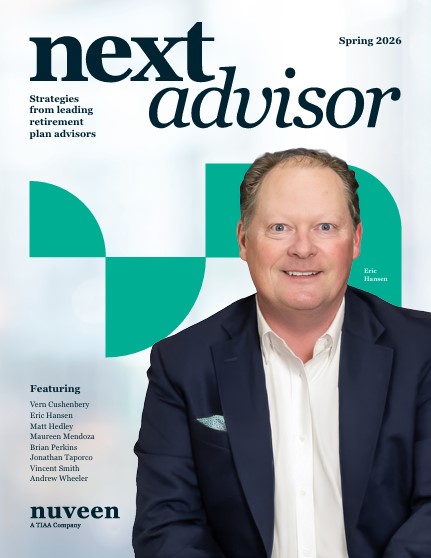
Download the full PDF
Continue reading





Contact us

Endnotes
1CNBC. Apollo. 2026
2American Investment Council. 2025
Any guarantees are backed by the claims-paying ability of the issuing company.
Nuveen, and the third-party advisors featured throughout this publication, or any of their affiliates
or subsidiaries are not affiliated with or in any way related to each other. This material is prepared
by everyone included in the publication and the views of the third-party advisors do not necessarily
represent the views of Nuveen, its affiliates, or other Nuveen staff
This material, along with any views and opinions expressed within, are presented for informational
and educational purposes only as of the date of production/writing and may change without notice
at any time based on numerous factors, such as changing market, economic, political, or other
conditions, legal and regulatory developments, additional risks and uncertainties and may not come
to pass. There is no promise, representation, or warranty (express or implied) as to the past, future, or
current accuracy, reliability or completeness of, nor liability for, decisions based on such information,
and it should not be relied on as such. This material should not be regarded by the recipients as a substitute for the exercise of their own judgment. It is important to review your investment objectives,
risk tolerance and liquidity needs before choosing an investment style or manager.
Important information on risk
Past performance is no guarantee of future results. All investments carry a certain degree of risk, including the possible loss of principal, and there is no assurance that an investment will provide positive performance over any period of time. Certain products and services may not be available to all entities or persons. There is no guarantee that investment objectives will be achieved. See the applicable product literature for details.
Nuveen, LLC provides investment solutions through its investment specialists
Not registered yet? Register