Contact us
Contact Nuveen
Thank you for your message. We will contact you shortly.

Section 2: The economy and markets
Key points to know
Synchronizing (and improving) global growth. The expansion across major economies shows little sign of slowing. The U.S. economy grew at a healthy pace of 2.2% in 2025, and we forecast a similar pace this year. The labor market has stabilized somewhat, with the unemployment rate flat in recent months. Business investment, especially in tech, is providing a substantial tailwind, and productivity growth is running at its best rates since the global financial crisis.
The positive outlook extends beyond the U.S. as well. Increased government spending supports our forecast for a pickup in European growth as well this year, with the UK, Japan, and China also contributing positively. Overall, global recession risks have receded, and the growth outlook has brightened.
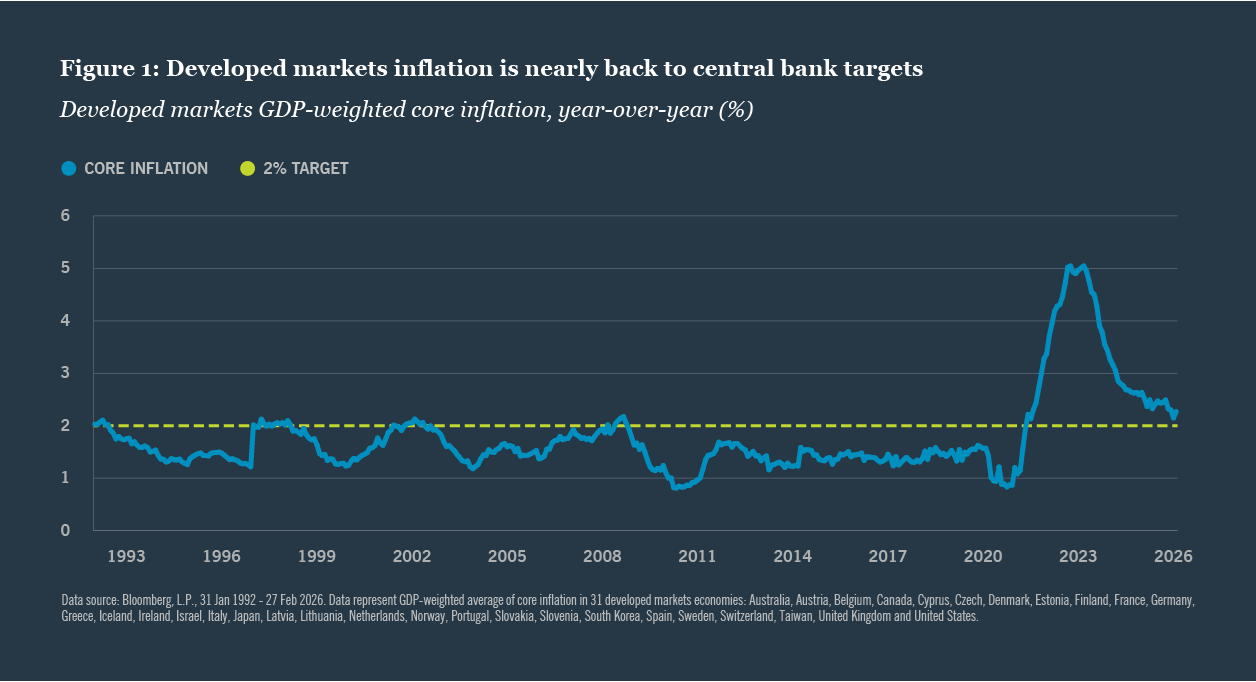
Inflation is cooling, for now. Though U.S. core PCE inflation ended 2025 at a still-high 3.0%, in line with our forecast, the global picture is still mostly encouraging. Our developed markets core inflation tracker – covering 31 countries on a GDP-weighted basis – puts global core inflation at 2.27% year-over-year, close to the 2% target used by most central banks and the lowest level since 2021 (Figure 1).
Even in the U.S., the outlook remains constructive. The one-off tariff impact that pushed goods prices higher last year should drop out by mid-year. Stickier categories like housing continue to improve. We forecast a modest deceleration in U.S. core PCE inflation this year, with the eurozone and UK also moving closer to their respective central bank targets.
Geopolitical risks intensify. The biggest risk clouding the outlook is ongoing conflict in the Middle East. While the situation remains fluid, we have begun to quantify the likely impacts. Uncertainty could chill business investment, but we expect any such downturn to be modest. The larger risk is that oil prices remain elevated or rally even further. At current levels, we estimate that higher oil prices would likely add roughly 0.9% to U.S. headline inflation this year. Though core inflation excludes energy prices directly, oil’s role as a pervasive economic input means we expect U.S. core inflation to be pressured around 0.4% higher this year.
Meanwhile, by compressing real incomes and weighing on consumption, we pencil-in an oil-related drag on U.S. GDP of around 0.3% this year. That is a relatively small magnitude, however, because a) U.S. consumers spend less on energy than in previous decades, and b) the U.S. energy producing sector should benefit from the move higher in prices, offsetting some of the headwind.
What does all this mean for policy and rates?
For global central banks, a negative supply shock is unwelcome, but the overall outlook remains solid enough to keep the focus on domestic considerations. In the U.S., we continue to expect two additional rate cuts totaling 50 basis points in 2026, though risks are skewed toward a slower pace that could push the second cut into 2027. The Bank of Japan is likely to hike at least once more in 2026, while the European Central Bank may pivot toward a rate increase by year-end.
Fiscal policies are likely to matter just as much, or more, for interest rates, and we expect deficits to remain wide across developed economies this year and over the medium-term, pressuring term premiums higher and keeping long-end rates elevated. We forecast the 10-year Treasury yield to end 2026 at around 4.00%, as fiscal dynamics offset modest downward pressures from lower inflation and rate cuts.
Continue reading




Global Investment Committee

Contact us

You are on the site for: Financial Professionals and Individual Investors. You can switch to the site for: Institutional Investors or Global Investors
Endnotes
Sources
All market and economic data from Bloomberg, FactSet and Morningstar.
This material is not intended to be a recommendation or investment advice, does not constitute a solicitation to buy, sell or hold a security or an investment strategy, and is not provided in a fiduciary capacity. The information provided does not take into account the specific objectives or circumstances of any particular investor, or suggest any specific course of action. Investment decisions should be made based on an investor’s objectives and circumstances and in consultation with his or her financial professionals.
The views and opinions expressed are for informational and educational purposes only as of the date of production/writing and may change without notice at any time based on numerous factors, such as market or other conditions, legal and regulatory developments, additional risks and uncertainties and may not come to pass. This material may contain “forward-looking” information that is not purely historical in nature.
Such information may include, among other things, projections, forecasts, estimates of market returns, and proposed or expected portfolio composition. Any changes to assumptions that may have been made in preparing this material could have a material impact on the information presented herein by way of example. Performance data shown represents past performance and does not predict or guarantee future results. Investing involves risk; principal loss is possible.
All information has been obtained from sources believed to be reliable, but its accuracy is not guaranteed. There is no representation or warranty as to the current accuracy, reliability or completeness of, nor liability for, decisions based on such information and it should not be relied on as such. For term definitions and index descriptions, please access the glossary on nuveen.com. Please note, it is not possible to invest directly in an index.
Important information on risk
All investments carry a certain degree of risk and there is no assurance that an investment will provide positive performance over any period of time. Equity investing involves risk. Investments are also subject to political, currency and regulatory risks. These risks may be magnified in emerging markets. Diversification is a technique to help reduce risk. There is no guarantee that diversification will protect against a loss of income. Debt or fixed income securities are subject to market risk, credit risk, interest rate risk, call risk, tax risk, political and economic risk, and income risk. As interest rates rise, bond prices fall. Investing in municipal bonds involves risks such as interest rate risk, credit risk and market risk, including the possible loss of principal. The value of the portfolio will fluctuate based on the value of the underlying securities. There are special risks associated with investments in high yield bonds, hedging activities and the potential use of leverage. Portfolios that include lower rated municipal bonds, commonly referred to as “high yield” or “junk” bonds, which are considered to be speculative, the credit and investment risk is heightened for the portfolio. Credit ratings are subject to change. AAA, AA, A, and BBB are investment grade ratings; BB, B, CCC/CC/C and D are below-investment grade ratings. As an asset class, real assets are less developed, more illiquid, and less transparent compared to traditional asset classes. Investments will be subject to risks generally associated with the ownership of real estate-related assets and foreign investing, including changes in economic conditions, currency values, environmental risks, the cost of and ability to obtain insurance, and risks related to leasing of properties. Investors should be aware that alternative investments including private equity and private debt are speculative, subject to substantial risks including the risks associated with limited liquidity, the use of leverage, short sales and concentrated investments and may involve complex tax structures and investment strategies. Alternative investments may be illiquid, there may be no liquid secondary market or ready purchasers for such securities, they may not be required to provide periodic pricing or valuation information to investors, there may be delays in distributing tax information to investors, they are not subject to the same regulatory requirements as other types of pooled investment vehicles, and they may be subject to high fees and expenses, which will reduce profits. Alternative investments are not appropriate for all investors and should not constitute an entire investment program. Investors may lose all or substantially all of the capital invested. The historical returns achieved by alternative asset vehicles is not a prediction of future performance or a guarantee of future results, and there can be no assurance that comparable returns will be achieved by any strategy. Responsible investing incorporates Environmental Social Governance (ESG) factors that may affect exposure to issuers, sectors, industries, limiting the type and number of investment opportunities available, which could result in excluding investments that perform well.
Nuveen, LLC provides investment advisory services through its investment specialists.
This information does not constitute investment research as defined under MiFID.
Not registered yet? Register