Contact us
Contact Nuveen
Thank you for your message. We will contact you shortly.

Although we see ample opportunities to add income across sectors, we are also cognizant of rich valuations. This dynamic is not unique to fixed income markets — from equities to commodities to credit spreads, valuations are near historical highs. Tight credit spreads alone do not warrant reducing risk, and full valuations can persist for several years before correcting. However, the current landscape does argue for a nuanced approach to risk taking.
One way to reconcile the positive economic outlook with potentially full valuations is to dig deeper. Investors have thoroughly picked over the conventional, liquid credit markets, making opportunities harder to find. Inflows into fixed income funds have been strong this year: almost 7% of AUM for high grade funds through the end of October, 4% for high yield, and 12% for broadly syndicated senior loans.1 With these inflows chasing the same opportunities, credit spreads have tightened.
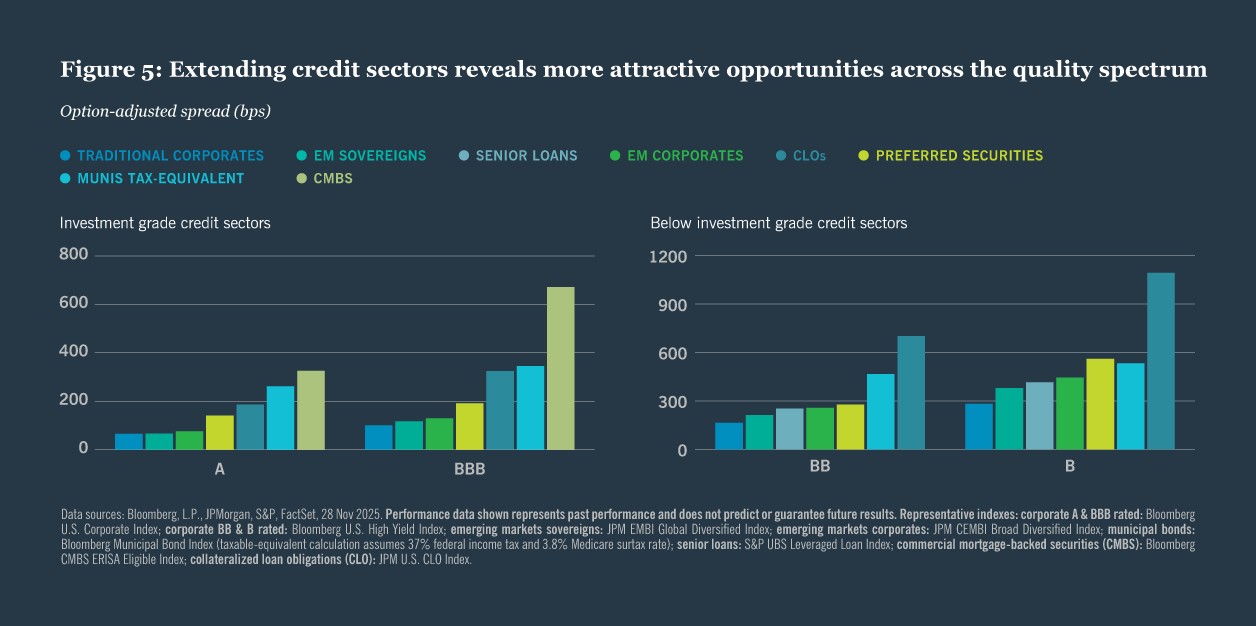
We believe the best opportunities are in areas where investors benefit from complexity, illiquidity and geographic premiums in addition to taking credit risk (Figure 5). Less-liquid credit segments offer higher yields and potentially higher returns, to compensate for illiquidity. Given our constructive macroeconomic outlook and the full valuations across traditional credit, we think this is an attractive tradeoff.
For a given credit rating, investors may significantly increase portfolio income by adding relatively less-liquid credit (Figure 5). For example, in the single A bucket, corporate debt offers spreads around 66 basis points (bps). Less-liquid securitized products like collateralized loan obligations (CLO) or commercial mortgage-backed securities (CMBS) offer credit spreads of approximately 186 bps and 326 bps, respectively — for similar credit risk. Further down the ratings spectrum, the pickup can be even more attractive. BB-rated corporate bonds trade around 165 bps, compared with 257 bps for BB-rated emerging markets corporates, or above 700 bps for BB-rated CLOs.
Actions to consider
- Target the less liquid segments of CLOs, CMBS and emerging markets debt.
- Capture incremental yield by moving beyond conventional credit sectors into preferreds and municipals.
Continue reading








Contact us

You are on the site for: Financial Professionals and Individual Investors. You can switch to the site for: Institutional Investors or Global Investors
Not registered yet? Register