Participant perspectives: the active role plan sponsors can play

The 401(k) has become the dominant retirement savings vehicle for American workers, with more than $8 trillion held across 725,000 plans serving 80 million active participants.1 Yet a significant share of those participants reach the moment of transition, from building savings to living off them, without the knowledge or tools to make the money last. To find out where the gaps are and how plan sponsors can close them, Nuveen and the TIAA Institute surveyed more than 2,100 401(k) participants in the fall of 2025. The findings point to a clear opportunity: participants are underserved, they know it, and they are asking their employers to step up.
For the full findings of our latest participant sentiment research, visit nuveen.com/participant-perspectives
Key takeaways
- The employee knowledge gap is concentrated where it hurts most. Participants answered just 32% of retirement-fluency questions correctly, on average, and scored lowest on withdrawals and long-term care, precisely the decisions that dominate the transition to retirement.
- Guidance from employers has become an expectation. Among participants who have thought about withdrawals, 94% want employer resources to help them plan, and roughly half now see providing that guidance as an outright employer responsibility.
- Offering tools doesn’t help if participants don’t know how to use them. Tools measurably lift participant confidence, but too few participants know they exist. Closing the gap depends on how sponsors promote resources and how they build the plan, as much as on what they offer.
The knowledge gap is real and measurable
The second edition of the participant perspectives survey assessed retirement fluency with 15 questions across five topics: Social Security, Medicare, saving for retirement, making withdrawals and long-term care. On average, participants answered just 32% correctly. They fared best on Social Security, Medicare and saving, at around a third correct, and worst on long-term care and withdrawals, where scores fell to roughly 25%. Those lowest-scoring categories are exactly the ones that matter most at the point of transition to retirement.
Retirement readiness requires participants to make several important decisions that many have never faced before, including when to claim Social Security, how to draw down savings, and how to plan for health care and long-term care, all without knowing how long retirement will last. Retirement fluency and longevity literacy are the foundation for getting those decisions right, and a lack of understanding of longevity compounds the problem. Only one-third of participants correctly identified how long a 65-year-old typically lives; 44% underestimated it, and 14% simply didn’t know. Poor fluency can lead directly to suboptimal decisions: claiming Social Security too early, underestimating healthcare and long-term care costs, or drawing down savings at an unsustainable rate. For sponsors, that gap is both a clear opportunity and, as the survey makes plain, a clear expectation to meet.
Withdrawal planning is increasingly viewed as an employer responsibility
Among participants who have given some or significant thought to retirement withdrawals, 94% say it’s important for their employer to provide planning resources, and 59% call it “very important.” Nearly half, 49%, consider that guidance an outright employer responsibility rather than a value-added service.
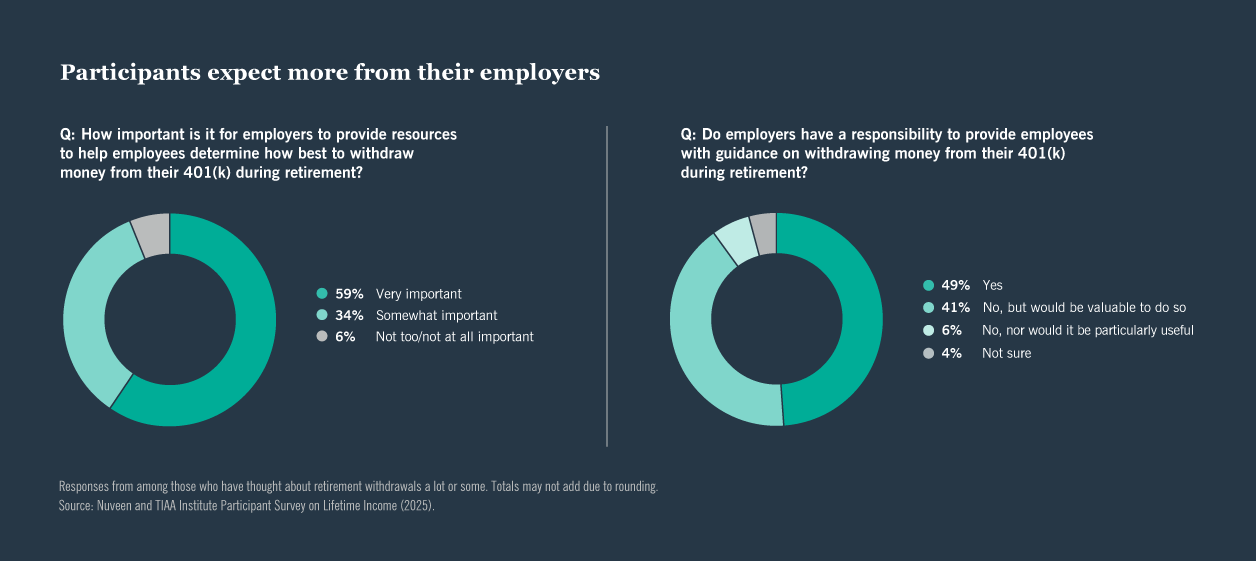
The more employees think about their retirement income, the more support they want from their employers. For participants who have thought about withdrawals “a lot,” 73% say employer resources are very important and 61% consider them an employer responsibility. The more deeply a participant engages with the challenge of retirement income, the more firmly they look to their employer for help. This is a signal worth taking seriously: participants expect sponsors to support their understanding of how to generate lifetime income, or at least to bridge the gap between working and drawing on savings. Only one in four participants is very confident they will retire when they wish, with the lifestyle they want, and a further quarter is not confident.
Tools change behavior, but only when participants use them
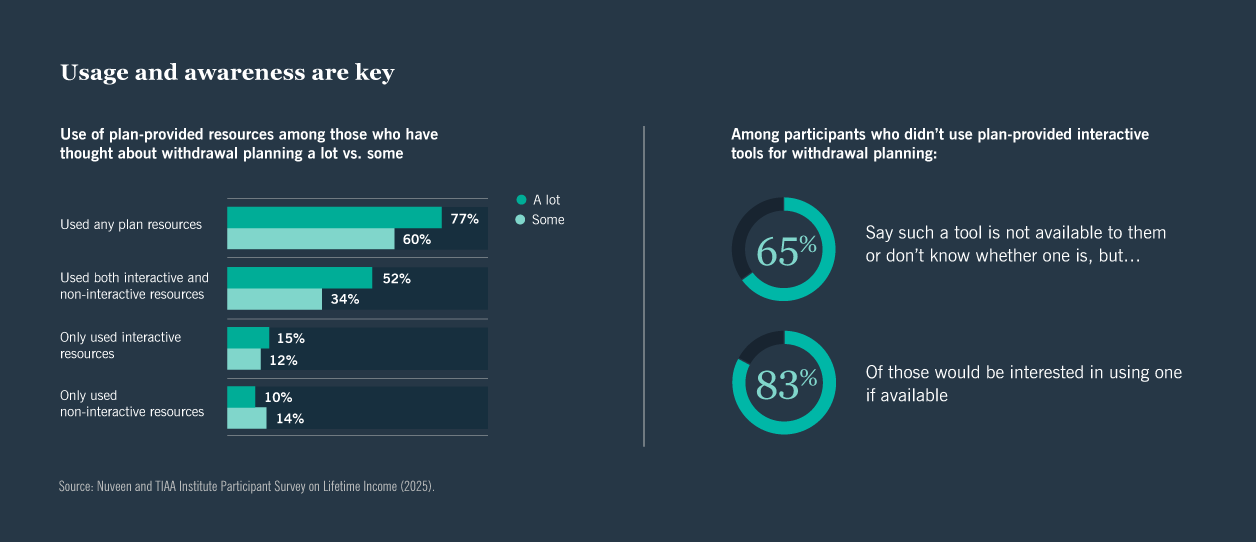
Participants who use retirement planning resources reported higher levels of confidence: and among participants who have thought about withdrawals and used both interactive and non-interactive resources, 53% are very confident they will choose the best withdrawal strategy at retirement. That figure falls to about 40% for those who used only one type, and to 28% for those who used neither.
Interactive tools stand out. Fifty-two percent of users rated them “very helpful” and 46% “very engaging,” outpacing non-interactive resources on both counts (43% and 38%). Trust ran high across both formats, and for the most engaged participants, those who had thought about withdrawals “a lot,” the ratings were dramatically higher still: 76% found interactive tools very helpful and 70% very engaging.
The problem is reach. Too many participants don’t know these resources exist, and too few use them. Among withdrawal planners who hadn’t used planprovided interactive tools, 65% said such a tool either isn’t available or they don’t know whether it is, and of that group, 83% said they’d use one if it were. Sponsors should therefore evaluate not just what they offer, but how easily participants can find, access, and understand it. A communications strategy that actively promotes tool availability, segmented by career stage and delivered at moments of relevance, is as important as the tools themselves.
Meeting participants where they are
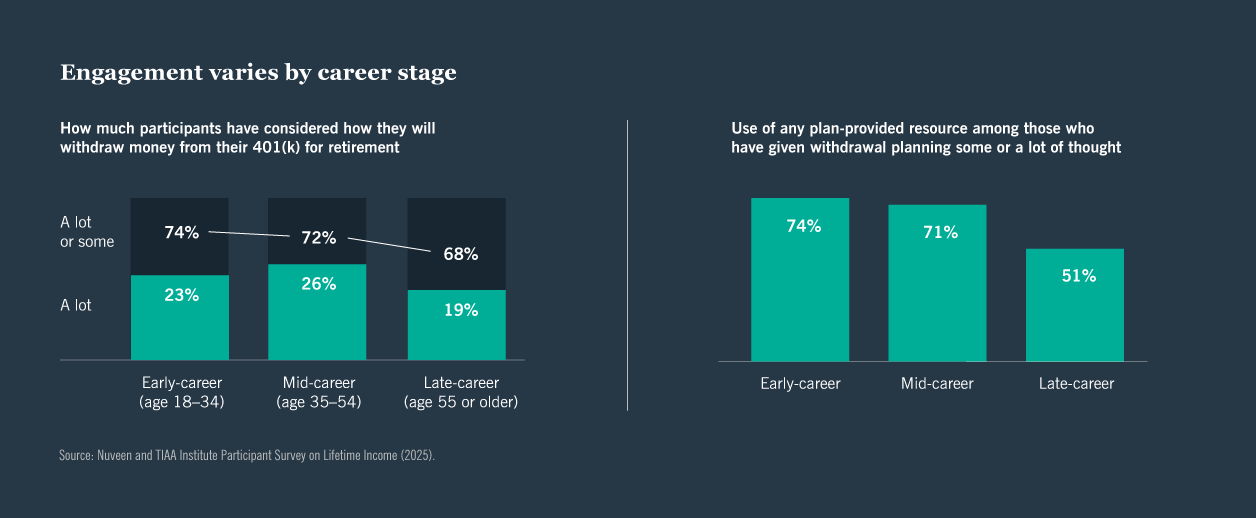
One of the survey’s most important findings concerns late-career participants, the very employees who should be most engaged. Only 19% of those aged 55 and older have given a lot of thought to how they’ll withdraw income in retirement, the lowest share of any career stage. Mid-career participants (35–54) led at 26%, with early-career workers (18–34) close behind at 23%. Even among late-career participants who expect their 401(k) to be their most important source of retirement income, only 23% have thought “a lot” about withdrawals.
But plan sponsors may need to proactively engage participants, instead of waiting for participants to ask. Late-career workers are disengaged partly because they don’t know what’s available and the plan hasn’t reached them in ways that feel urgent or relevant. Interactive tools, because they incorporate individual inputs like age, savings and income goals, are especially well-suited to making planning feel personal and actionable. Sponsors should tailor communications and promotion to this cohort rather than assume that proximity to retirement drives self-directed engagement.
Three ways sponsors can close the gap
The findings converge on three areas where plan sponsors can meaningfully narrow the distance between what participants need and what they have.
- Expand the scope of retirement education. Most plan education focuses on contribution rates, fund selection and the mechanics of saving. Participants need content that spans the full arc of retirement: Social Security, Medicare enrollment, long-term care and, most critically, how to convert a 401(k) balance into a sustainable income stream. Education that ends at retirement’s doorstep leaves participants without a map for the journey ahead.
- Make resources discoverable and promote them actively. Resources participants don’t know about don’t benefit them. Sponsors should pair tools with strong communications, such as proactive outreach, in-plan notifications and messaging calibrated to career stage.
- Let plan design do what communication alone cannot. For the majority who haven’t engaged deeply with withdrawal planning, welldesigned defaults may accomplish more than any outreach. Lifetime income solutions embedded within target date structures offer a way to put guaranteed income within reach. Sponsors should ask whether their current design adequately serves participants who need the plan to work in the background, not only when they choose to engage.
Participants want to retire well, but what holds them back is when the tools, knowledge and plan design capable of helping them do not arrive in time or in a form they can act on. Sponsors control those levers, and as the survey shows, participants increasingly expect them to use them, treating lifetime income readiness as a core part of what a well-run plan provides.
Continue reading



Contact us

















- +44 20 3727 8000
- 201 Bishopsgate, London, United Kingdom
Sources
1 EBSA, 2025.
Before investing, carefully consider fund investment objectives, risks, charges and expenses. For this and other information that should be read carefully, please request a prospectus or summary prospectus from your financial professional or Nuveen at 800.257.8787 or visit nuveen.com.
This material is not intended to be a recommendation or investment advice, does not constitute a solicitation to buy, sell or hold a security or investment strategy and is not provided in a fiduciary capacity. The information provided does not take into account the specific objectives or circumstances of any particular investor, or suggest any specific course of action. Investment decisions should be made based on an investor’s objectives and circumstances and in consultation with their financial advisors. Financial professionals should independently evaluate the risks associated with products or services and exercise independent judgment with respect to their clients. This material, along with any views and opinions expressed within, are presented for informational and educational purposes only as of the date of production/writing and may change without notice at any time based on numerous factors, such as changing market, economic, political, or other conditions, legal and regulatory developments, additional risks and uncertainties and may not come to pass. There is no promise, representation, or warranty (express or implied) as to the past, future, or current accuracy, reliability or completeness of, nor liability for, decisions based on such information, and it should not be relied on as such. This material should not be regarded by the recipients as a substitute for the exercise of their own judgment. For index definitions, please visit the glossary on Nuveen.com. Please note it’s not possible to invest in an index directly.
Important information on risk
Past performance is no guarantee of future results. All investments carry a certain degree of risk, including the possible loss of principal, and there is no assurance that an investment will provide positive performance over any period of time. Certain products and services may not be available to all entities or persons. There is no guarantee that investment objectives will be achieved. See the applicable product literature for details.
Investors should be aware that alternative investments are speculative, subject to substantial risks including the risks associated with limited liquidity, the potential use of leverage, potential short sales, currency exchange rates, and concentrated investments and may involve complex tax structures and investment strategies. Alternative investments may be illiquid, there may be no liquid secondary market or ready purchasers for such securities, they may not be required to provide periodic pricing or valuation information to investors, there may be delays in distributing tax information to investors, they are not subject to the same regulatory requirements as other types of pooled investment vehicles, and they may be subject to high fees and expenses, which will reduce profits.