
Welcome to our second article in The Real Advantage Series , Nuveen's thought leadership series designed with investors like you in mind. We've taken the questions we hear most from our clients and turned them into in-depth insights across real estate, farmland, and timberland — asset classes where Nuveen has long been a trusted voice. New perspectives will be added throughout the year, so check back often and keep exploring.
In this article Nuveen Real Estate's research experts examine the strategic case for geographic diversification within real estate allocations. Drawing on proprietary research across the three principal investable regions — the United States, Europe, and Asia-Pacific — the piece explores how expanding beyond a single domestic market can reduce portfolio volatility, improve risk-adjusted returns, and unlock a broader global opportunity set. It also candidly addresses the complexities that come with building a globally diversified real estate portfolio, from currency risk and liquidity considerations to varying risk premiums across markets and sectors.
Key takeaways:
- A domestic-only real estate strategy carries meaningful concentration risk given how few countries dominate the global investable universe.
- Diversification benefits within a single country plateau quickly, while expanding across regions continues to reduce portfolio volatility.
- Adding international allocations improves risk-adjusted returns, even when those markets modestly underperform on a standalone basis.
- Low cross-regional correlation is the true driver of diversification benefits.
- Understanding what industries drive a city's economy is just as important as historical returns when building a diversified portfolio.
- Currency risk, tax complexity, and local expertise requirements make partnering with a globally experienced manager essential.
The case for thinking beyond home markets
Real estate has secured its place in most institutional portfolios, yet the asset class remains frequently misunderstood, particularly when viewed through the lens of investors more accustomed to liquid financial markets. Real estate’s fixed, physical nature demands deep geographical knowledge spanning local politics, regulation, building technology and demand preferences. Long transaction timelines and meaningful trading costs reward those who take a long-term view.
These characteristics, often perceived as constraints, are the foundations of real estate’s enduring diversification potential. Part of the asset class’s uniqueness lies in its dual nature: combining bond-like income qualities with equity-like value characteristics. It is this duality that underpins real estate’s diversification characteristics.
This paper explores the strategic case for geographic diversification within real estate allocations, drawing on Nuveen Real Estate’s proprietary research and analysis across the three principal investable regions: the United States, Europe and Asia-Pacific (APAC). It examines both the compelling benefits and the genuine complexities that come with building a globally diversified real estate portfolio, with the aim of helping investors find the balance between optimal diversification and manageable complexity.
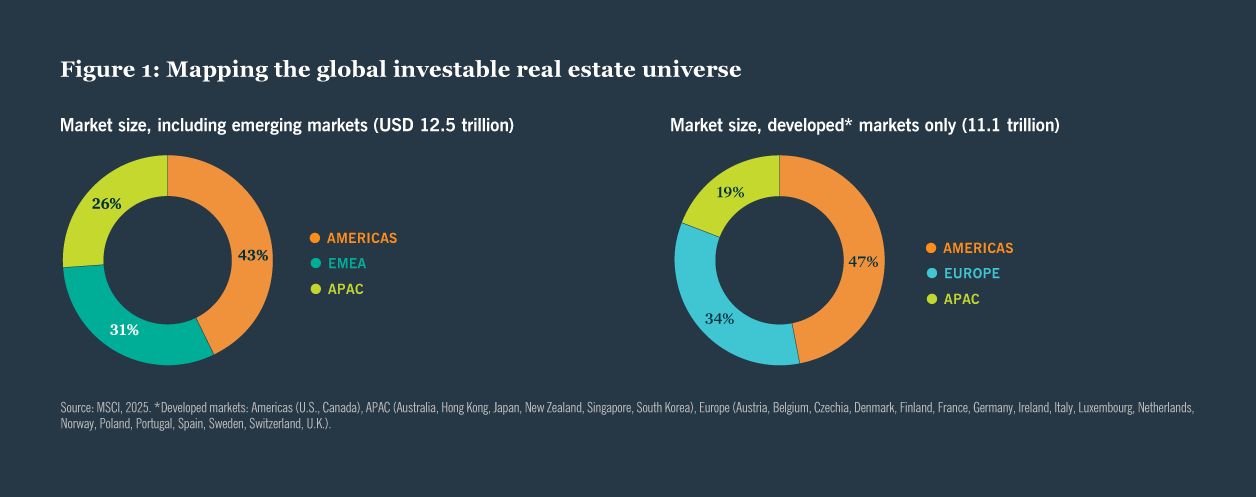
The investable global real estate market is valued at approximately $12.5 trillion, and it is far from homogeneous (Figure 1). Three distinct regional universes define the landscape: the Americas, which account for over 40% of the total market; Europe, Middle East and Africa (EMEA) at approximately 30%; and Asia-Pacific (APAC) at over a quarter. Focusing on developed markets only narrows the universe marginally — from $12.5 trillion to $11.1 trillion — underlining that the bulk of investable stock is concentrated in a relatively small number of mature economies.
About the author

Contact us

















- +44 20 3727 8000
- 201 Bishopsgate, London, United Kingdom