
Listen to this insight
~ 8 minutes long
The bottom of the cycle, when capital values have rebased and market recovery is evident, can be the best time to enter the real estate market as an investor. This is particularly the case for direct investors. Acquiring assets at discounts to intrinsic value that provide both attractive rental income and capital value appreciation can result in the best investment vintages.
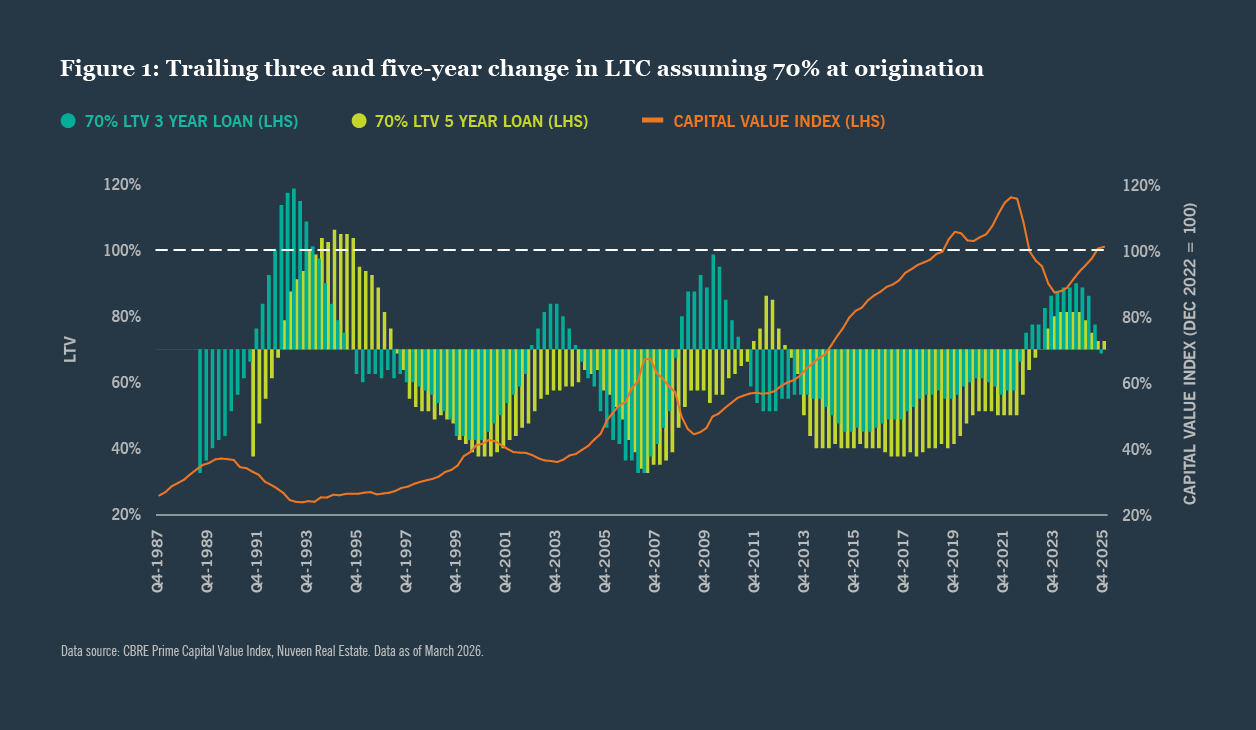
While debt investments do not typically benefit directly from positive capital value growth in the form of enhanced returns, they benefit indirectly as this results in loan-to-value metrics (LTVs) reducing over the course of the loan. For example, Nuveen Real Estate Research analysis using CBRE Europe Prime Capital Value index shows three-year loans originated at the bottom of the cycle during the Global Financial Crisis at 70% LTV would have matured with LTVs at circa 55-60% LTV as asset values increased over that period. This is even more apparent for 70% LTV loans with five-year maturities as they will have reduced the exit LTV to close to 40% (see figure 1). Real estate debt investments can take advantage of this effect without paying extra for the improving return-vs-risk profile. Levered debt strategies stand out at this point in the cycle as the elevated return and risk characteristics become asymmetric over the loan term.
Explaining levered debt
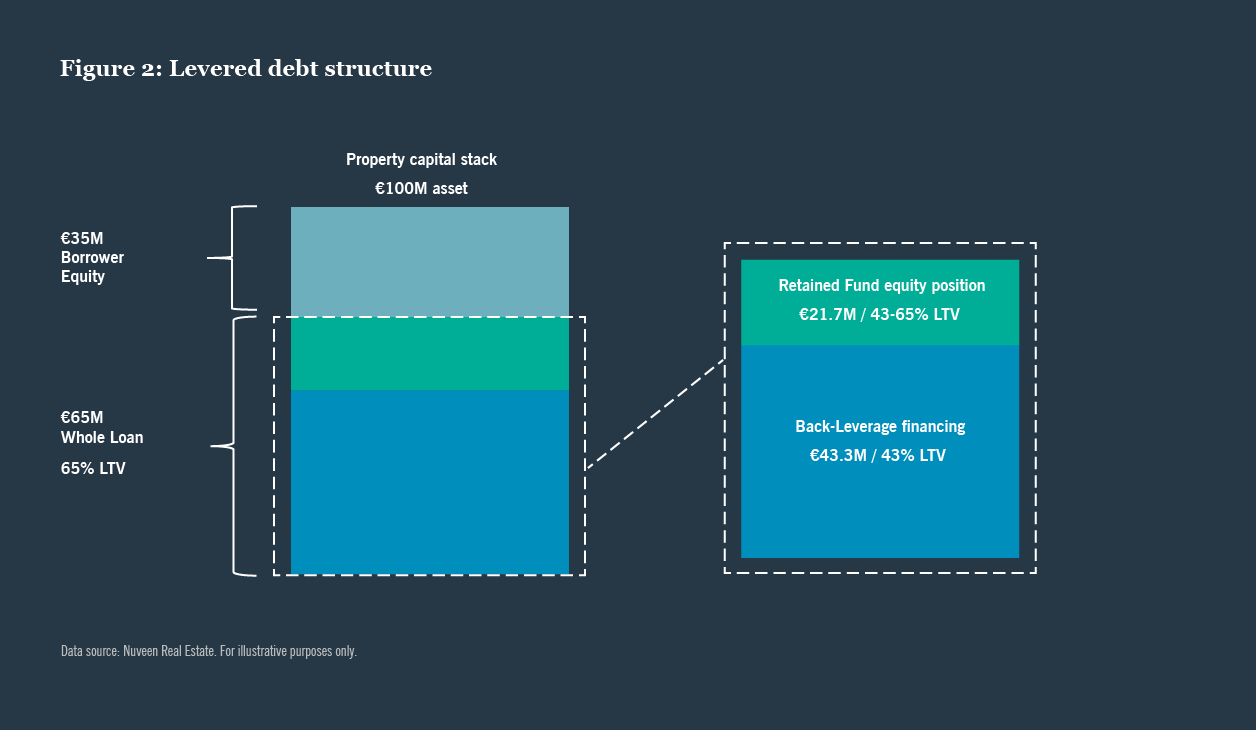
Traditional real estate loan capital structures typically comprise equity and debt components. The equity component is the asset owners’ contribution, while the debt component is the loan secured against the asset. Levered debt structures are different (see figure 2). The equity component remains the asset owner’s contribution, but the loan component is split into back-leverage (which is a loan from a bank to the debt fund) and fund equity (which is debt fund cash). The debt fund providing the loan is now no longer financing the entire loan from its own cash. It uses an additional bank loan as contribution to the loan it provides to the asset owner. This frees up capital for the debt fund to hold more loans and enhances returns as the debt fund is capturing the same level of loan interest payments (minus finance costs payable on the bank loan) with less debt fund cash.
Uncertainty hedging
While the real estate market dynamics appear compelling, the macro backdrop is challenging. Global dynamics, such as oil prices, trade tariffs and supply chain disruptions, are driving volatility and uncertainty. The rise in inflation in most developed markets during 2022 was followed by sharp increases in base rates. This reduced asset valuations, with real estate values rebasing by around 25% in Europe, based on the CBRE Europe Prime Capital Value Index. Entering 2026, inflation appeared under control and markets had already gone through multiple rate cuts with more expected. Unfortunately, the war in the Middle East changed expectations. Market participants are pricing in some potential rate hikes to combat inflationary pressures.
For real estate debt investors, the question is whether investing in the asset class, and in particular through a levered debt strategy during this uncertain outlook, is going to deliver appropriate returns. The main consideration is how rising or reducing base rates will impact levered debt strategy returns.
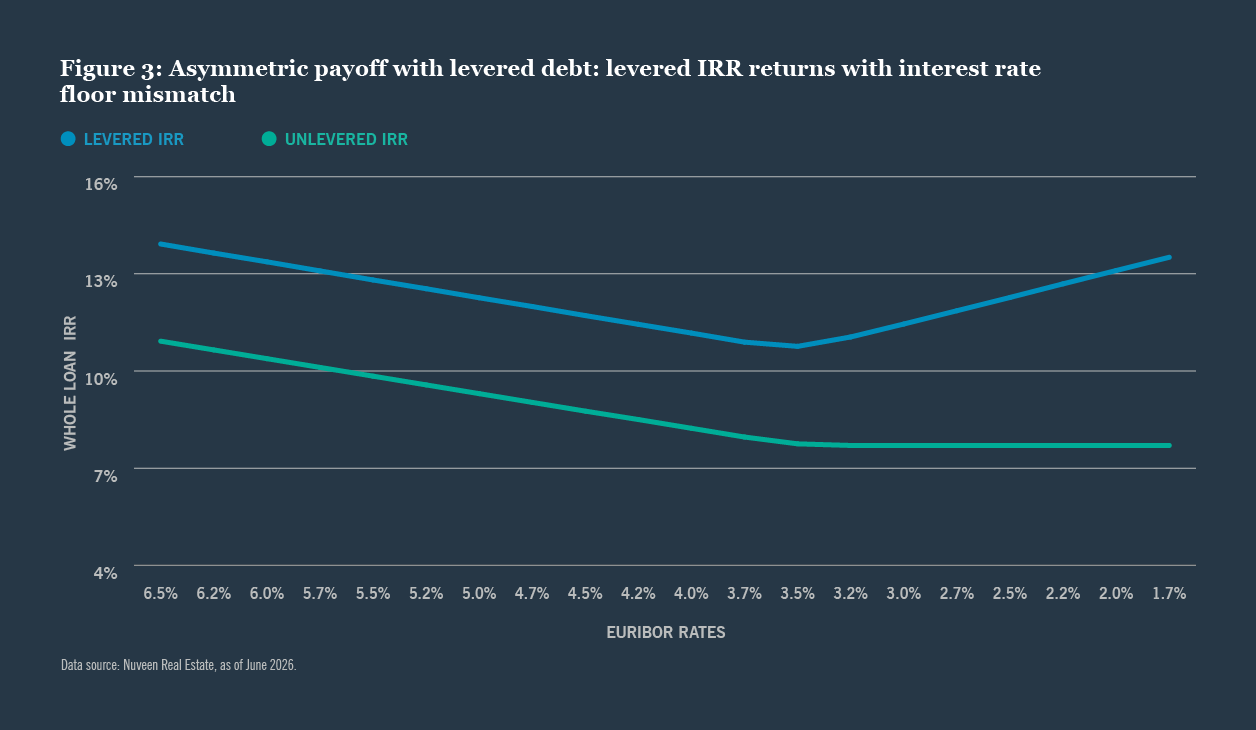
One feature that can be implemented in levered debt strategies is a base interest rate floor for both the whole loan (typically above zero) and the back-leverage (typically at zero), such that the mismatch between those two provides an accretive benefit to returns in a decreasing rate environment (see figure 3). When base rates are high, returns are automatically higher. As base rates come down, debt returns (levered and unlevered) also reduce until we reach the whole loan floor (on the left of figure 3). After this point, reduction in rates actually increases the returns for levered strategies, while returns for unlevered strategies typically plateau (on the right of figure 3).
This feature, combined with the deleveraging as capital values recover, provide attractive and asymmetric return-risk profile for levered debt strategies that are most effective at or near the bottom of the cycle.
Investors are right to be cautious around the global macroeconomic environment. However, with capital values rebased around 25% from the 2022 peaks and some signs of recovery over the last few quarters, investors could benefit from deleveraging in real estate debt, while also taking advantage of the asymmetric return-risk profile offered by levered debt strategies. Historically, loan vintages at or near the bottom of the cycle have tended to produce the most attractive returns (Preqin European Real Estate total returns between 1999 – 2024), and with the structural feature of interest rate floor mismatches for levered strategies, investors can achieve attractive returns regardless of interest rate outlook.
Related articles

Alternatives in a new world order
Five themes reshaping alternative assets — from AI infrastructure and private credit to energy security. Download the Nuveen nPOWERED26 outlook.

Why the case for debt and equity is strengthening together
Why 2026 represents a compelling entry point for both real estate debt and equity investors.

The demand decade: a generational opportunity in U.S. senior housing
The demographic tide is turning - and investors should take notice
About the author

Contact us

Chicago
- +1 312 917 7700
- 333 W Wacker Drive, Chicago, United States of America