
Welcome to our third article in The Real Advantage Series, Nuveen's thought leadership series designed with investors like you in mind. We've taken the questions we hear most from our clients and turned them into in-depth insights across real estate, farmland, and timberland — asset classes where Nuveen has long been a trusted voice. New perspectives will be added throughout the year, so check back often and keep exploring.
In this article, Nuveen Real Estate's research experts examine why 2026 represents a compelling entry point for both real estate debt and equity investors. Drawing on proprietary research and market data, the piece explores how the sharp repricing since mid-2022 has created a rebased starting point offering resilient, well-protected returns for lenders and meaningful upside potential for equity investors. It also addresses the trade-offs between the two strategies and makes the case for combining both to capture the full opportunity.
Key takeaways:
- Capital values have corrected 20-25% from pre-2022 peaks1, creating a rebased starting point for new capital deployment across both debt and equity
- New senior secured loans can now withstand market-wide capital value declines of more than 50% before eroding their equity buffer — the widest cushion since 19892
- Global recovery rates for private real estate debt have averaged 82% between 2000 and 2023, compared with 66% for private small enterprise debt over the same period, with this resilience holding up even during periods of acute stress3
- Real estate equity benefits from limited new supply growth across most property types, strengthening the pricing power and retention potential of existing, well-located assets
- Equity investors capture the upside of improving fundamentals, favorable leasing outcomes and rising exit valuations, while debt investors benefit indirectly through declining LTVs as values recover
Every real estate cycle eventually reaches a moment when the pain of repricing gives way to the promise of recovery. We believe 2026 marks that moment.
Since mid-2022, real estate markets have absorbed a sharp and painful adjustment: rapid interest rate increases, geopolitical disruption, and constrained liquidity drove capital values down 20–25% from their pre-2022 peaks. For owners caught in that repricing, the experience was uncomfortable. But for capital being deployed today, the same reset has created something far more attractive—a rebased starting point from which both real estate debt and equity investors can pursue compelling risk-adjusted returns.
Transaction activity is picking up. Operating fundamentals are stabilizing and, in several sectors, beginning to improve. Lower valuations combined with tighter underwriting standards mean that new lending is inherently better protected than at almost any point in recent history, while new equity commitments are being made at prices that no longer depend on aggressive rent growth assumptions to work. This is not a coincidence—it is the result of a market moving from repricing toward recovery.
This paper makes the case for equity and debt at this point in the cycle. We examine why real estate debt offers resilient, low-volatility returns; why real estate equity is positioned to capture the upside of a recovering market; and why, taken together, current conditions make this a compelling moment to deploy capital into real estate.
Global economies have experienced significant uncertainty since mid-2022, including rising interest rates, multiple conflicts, trade wars and subdued business confidence. All of this has had a dramatic impact on real estate assets, with capital values correcting by approximately 20–25%.1
While challenging for existing owners, this rebasing has created an attractive entry point for new lending. New loans are now structured against current, lower valuations, providing a substantial equity cushion for lenders. New senior secured loans written today could withstand market-wide capital value declines more than 50% before eroding their equity buffer—a greater cushion than seen in any downturn since 1989.2
Regulatory reforms following the Global Financial Crisis (GFC) have reinforced this protection at a structural level, resulting in tightening of average senior loan LTVs from close to 80% pre-GFC to around 55% at the end of 2024, while margins have increased relative to the pre-GFC period. The combination of a lower starting LTV and a rebased valuation base means new loans carry a strong buffer against further market weakness.
Quantifying default risk and recovery post default
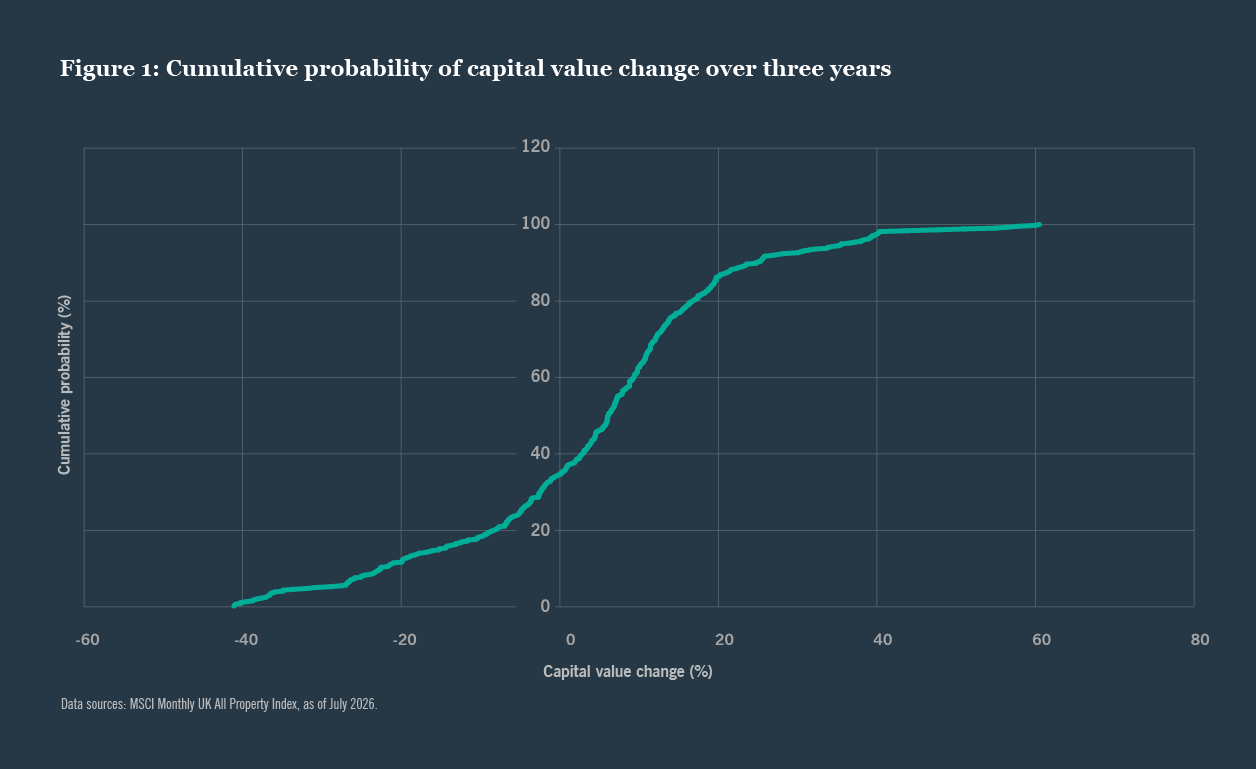
Concerns around defaults in commercial real estate do not reflect reality. Using the MSCI All Property Index, which has data going back to 1987, the probability that a three-year loan with an initial LTV of 65% will default is approximately 4% (Figure 1). This figure likely understates true default risk, since loans can also default for reasons unrelated to a complete erosion of the equity cushion, for example, when the interest coverage ratio falls below a covenant threshold. Fortunately, many lenders build in early indicators of potential distress, giving borrowers the opportunity to rectify a situation before it escalates into default.
In the event of a default, the asset-backed nature of real estate debt translates into stronger recovery outcomes than are typically available elsewhere in credit markets. Global recovery rates for private real estate debt have averaged 82% between 2000 and 2023, compared with 66% for private small enterprise debt over the same period—and this resilience held up even during periods of acute stress such as the GFC.3
Attractive volatility profile
These characteristics produce an asset class with a notably stable return-volatility profile. Nuveen Real Estate research shows that real estate debt offers lower volatility than other real estate segments and broader public and private markets, while still delivering returns comparable to higher-risk asset classes.4 This is driven by debt’s protected position in the capital stack, the steady income generated through structured loan obligations, and the shorter duration of loans relative to other fixed income instruments (which helps mitigate the impact of inflation and interest rate changes). This lower volatility also supports reduced correlation with public fixed income, enhancing portfolio diversification: allocating just 10% of a diversified portfolio to real estate debt can potentially reduce the portfolio’s overall risk profile.5


Contact us

















- +44 20 3727 8000
- 201 Bishopsgate, London, United Kingdom
1 CBRE Prime Capital Value Index, July 2026.
2 Nuveen Real Estate Research, Bayes CRE Lending Report, July 2026.
3 GCD Bank data, July 2026.
4Nuveen Real Estate Research using data from JPMorgan Long Term Capital Market Assumptions and MSCI Quarterly Private Debt Fund Index, July 2026.
5 Nuveen Real Estate Research using data from Bloomberg Treasury index to represent Bonds, MSCI Indices to represent Equities and MSCI Private Real Estate Debt Fund Index to represent Real Estate Debt.