Private markets in Defined Contribution plans: A key development in plan design

A key development in defined contribution plan design
The defined contribution (DC) plan landscape is rapidly evolving, and DC plan sponsors and consultants are navigating meaningful change as they seek to improve retirement outcomes for participants. Investment managers with broad capabilities across asset classes — particularly those with depth in private markets, lifetime income, and multi-asset solutions — are well positioned to deliver meaningful value in this environment. DC plan sponsors and consultants are encouraged to leverage the full breadth of available investment expertise as they work to modernize plan design and enhance outcomes for the participants they serve.
When considering defined contribution investment management, our commitment to the private markets space is longstanding — we were among the first managers to include private real estate within target date funds, with the Nuveen Lifecycle Target Date Series first incorporating direct real estate investments in 2017. This built on a broader heritage of innovation at TIAA, which pioneered direct access to private real estate for individual investors through the creation of the TIAA Real Estate Account in 1995 — providing participants exposure to the income stability, inflation-hedging characteristics and diversification benefits of institutional-quality real estate directly within a retirement plan.
Private markets have long been viewed as incompatible with DC plans, as liquidity constraints, valuation challenges, fee concerns and operational burdens have kept these strategies largely out of reach. That is beginning to change as expectations for DC plan design are evolving. Stakeholders across the industry are evaluating the role private assets can play in potentially improving participant outcomes during the accumulation phase.
Momentum behind private markets adoption is being driven by several structural and regulatory factors that make these strategies more accessible. Meanwhile, product innovation is significantly increasing the potential for private assets to be incorporated into DC plans in ways that were not previously achievable. Yet, DC plan sponsors considering private markets must navigate a range of challenges, from operational complexities to fiduciary considerations. This article outlines what DC plan sponsors need to know, and the practical steps they can take, as they assess whether and how to include private markets in their plan lineups.
Key takeaways
- Supported by positive policy momentum, DC plan sponsors are increasingly looking to private markets to potentially enhance retirement outcomes for participants.
- Private market usage in DC plans should be considered within professionally managed portfolios to help support inclusion on plan menus, participant adoption and regulatory adherence.
- DC plan sponsors should work with consultants to help address private markets-related challenges.
Market and industry tailwinds
The market and industry environment is becoming increasingly conducive to the adoption of private markets within DC plans. Years of evolution in product structures and plan design have brought the industry to an inflection point, leaving many stakeholders optimistic about the next stage of growth.
The ongoing “defined benefit-cation” of DC plans is leading DC plan sponsors to seek elements of defined benefit-like programs, such as guaranteed retirement income and professional management, while also amplifying interest in private assets as a means of enhancing portfolios. At the same time, public policy and the regulatory landscape have become more supportive, offering a clearer path to incorporating private market exposures. These shifts have helped align the interests of participants, DC plan sponsors, asset managers, consultants and other stakeholders across the DC ecosystem, all of whom increasingly recognize the long-term value private strategies may offer.1
- DC plan sponsors seek to provide participants exposure to private investments at scale.
- Participants may benefit from the diversification benefits and attractive risk/return profile.
- Asset managers specializing in private markets want to make their strategies more broadly available.
- Plan fiduciary oversight and control make ERISA plans a logical choice for private assets.
Against this favorable backdrop, private markets present a compelling investment profile. They provide DC plans and their participants with access to a broad global opportunity set of exposures that are less correlated with traditional public markets. And, with private companies now comprising a substantial portion of the global investable universe, participants stand to benefit from a more complete representation of economic growth.
In addition, private asset classes can offer a range of meaningful portfolio advantages that include enhanced volatility management, the potential for differentiated alpha and resilience in inflationary environments. Together, these features highlight why private markets are poised to become a relevant component of modern DC plan design.

Supportive product innovation
Ongoing product development is expanding the potential for DC plans to incorporate private market strategies. Professionally managed solutions, particularly multi‑asset managed accounts and target date funds, are expected to serve as the primary vehicles capable of integrating private assets at scale. These structures can deliver broad market exposure, helping ensure participants access a large and diversified pool of private market investments as part of a cohesive portfolio rather than through isolated choices.
A key enabler of the progress is the growing use of collective investment trusts (CITs), which offer operational flexibility, potentially lower costs and negotiable fee arrangements. At the same time, the industry is advancing toward improved liquidity mechanisms and more timely valuations, addressing two of the traditional barriers that have limited private markets’ applicability in DC settings.
Importantly, the direction of innovation emphasizes professionally managed, integrated solutions rather than standalone products. This approach avoids placing the burden on participants to decide whether — and how — to allocate to complex private asset strategies. Instead, it embeds private markets within diversified, expertly managed portfolios that support long‑term retirement outcomes.
Addressing the challenges
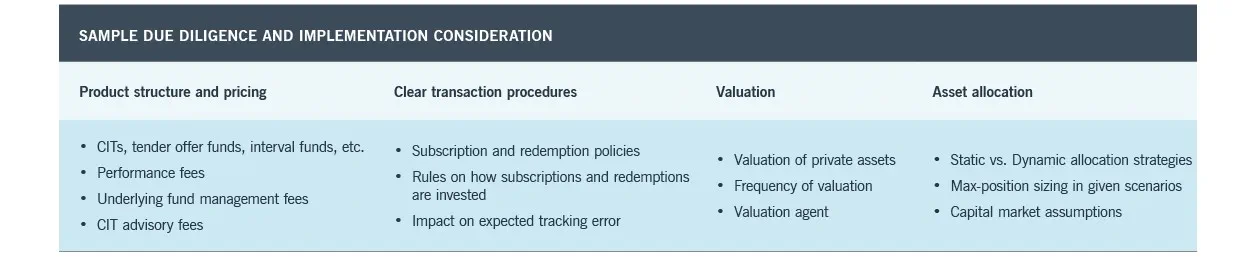
As private markets gain traction in DC plans, DC plan sponsors face a new set of implementation and due diligence challenges. Key considerations include understanding product structure and pricing, ensuring clear and efficient transaction procedures and evaluating how private assets are valued within a DC framework.
Sponsors must also assess how the strategies fit into their broader asset allocation models, recognizing that private market exposures behave differently from traditional public market investments. Together, these factors require a thoughtful approach to evaluating readiness, operational capabilities and long‑term appropriateness for participants.
Given the added complexity, close collaboration with consultants is essential. Consultants can support sponsors in assessing, selecting and monitoring participant investment options that incorporate private market allocations. They also play a central role in conducting due diligence on private markets managers, evaluating plan design implications and developing effective education strategies for both DC plan sponsors and participants. In addition, consultants help ensure that any changes align with evolving regulatory requirements and fiduciary standards. This partnership will be crucial as sponsors explore ways to integrate private markets responsibly and effectively into their plans.
Nuveen’s relevant private markets experience
- $315B in alternatives, including $25.4B in U.S. DC private markets.2
- Top 5 real estate and private debt investor globally.3
- #1 largest manager of farmland assets worldwide.4
- 50+ years as an active private debt investor.5
- One of the first to include private real estate in target date funds nearly a decade ago.6
Nuveen is positioned to help DC plan sponsors and consultants navigate this evolving landscape, with particular depth in private markets, lifetime income, and multi-asset solutions — areas where we believe we can deliver meaningful value for DC participants. We remain committed to helping DC plan sponsors and consultants leverage the full breadth of our expertise as they seek to improve retirement outcomes.
Related articles

Exploring private market investments for today’s 401(k)s

The next frontier for defined contribution: embedding private assets

Unlocking the potential of private investments in DC plans
Contact us

















- +44 20 3727 8000
- 201 Bishopsgate, London, United Kingdom
Endnotes
1 Source: Cerulli Associates and DCALTA, “Unlocking the Potential of Private Investments in Defined Contribution Plans,” September 2025.
2 As of 30 Dec 2025. Total private markets AUM sourced via internal Nuveen systems.
3 Top 5 real estate manager globally: Pensions & Investment Real Estate Managers Special Report, Nov 2025. Ranking included 63 real estate managers and ranked them by total worldwide real estate assets as of 30 Jun 2025. Top 5 private debt manager globally: Rankings published in Private Debt Investor Magazine’s Global Investor 75, March 2025. Private Debt Investor’s research and analytics team carried out primary and secondary research on more than 100 institutions to produce rankings on the world’s largest institutional private debt investors based on the market value of private debt portfolios. Nuveen submitted data to the research and analytics team. There were no fees paid in connection with this recognition.
4 Pensions & Investment Real Estate Managers Special Report, Nov 2025. Rankings based on total worldwide farmland assets under management as of 30 Jun 2025 as reported by each responding asset manager; updated annually.
5 Nuveen’s private capital investing team (inclusive of TIAA’s private credit and private equity investing teams) started investing in leveraged buyouts (LBOs) in 1969.
6 The Nuveen Lifecycle Target Date Series (formerly the TIAA-CREF Lifecycle Fund Series) first included direct real estate investments in 2017. See press release titled: “Nuveen enhances target-date fund offering with direct real estate allocation,” April 20, 2017.
Any guarantees are backed by the claims-paying ability of the issuing company. This material is not intended to be a recommendation or investment advice, does not constitute a solicitation to buy, sell or hold a security or investment strategy and is not provided in a fiduciary capacity. The information provided does not take into account the specific objectives or circumstances of any particular investor, or suggest any specific course of action. Investment decisions should be made based on an investor’s objectives and circumstances and in consultation with their financial advisors. Financial professionals should independently evaluate the risks associated with products or services and exercise independent judgment with respect to their clients.
This material, along with any views and opinions expressed within, are presented for informational and educational purposes only as of the date of production/writing and may change without notice at any time based on numerous factors, such as changing market, economic, political, or other conditions, legal and regulatory developments, additional risks and uncertainties and may not come to pass.
There is no promise, representation, or warranty (express or implied) as to the past, future, or current accuracy, reliability or completeness of, nor liability for, decisions based on such information, and it should not be relied on as such. This material should not be regarded by the recipients as a substitute for the exercise of their own judgment.
Important information on risk
Past performance is no guarantee of future results. All investments carry a certain degree of risk, including the possible loss of principal, and there is no assurance that an investment will provide positive performance over any period of time. Certain products and services may not be available to all entities or persons. There is no guarantee that investment objectives will be achieved. See the applicable product literature for details.
Investors should be aware that alternative investments are speculative, subject to substantial risks including the risks associated with limited liquidity, the potential use of leverage, potential short sales, currency exchange rates, and concentrated investments and may involve complex tax structures and investment strategies. Alternative investments may be illiquid, there may be no liquid secondary market or ready purchasers for such securities, they may not be required to provide periodic pricing or valuation information to investors, there may be delays in distributing tax information to investors, they are not subject to the same regulatory requirements as other types of pooled investment vehicles, and they may be subject to high fees and expenses, which will reduce profits.
Nuveen, LLC provides investment solutions through its investment specialists.