
Welcome to our fourth article in The Real Advantage Series, Nuveen's thought leadership series designed with investors like you in mind. We've taken the questions we hear most from our clients and turned them into in-depth insights across real estate, farmland, and timberland — asset classes where Nuveen has long been a trusted voice. New perspectives will be added throughout the year, so check back often and keep exploring.
In this article, Nuveen Real Estate's research experts examine how public and private real estate serve complementary roles in an institutional portfolio. Public REITs deliver higher long-term returns, greater liquidity and broader sector reach; private real estate offers smoother returns, lower equity correlation and core sector exposure. Together, they can produce a more complete commercial real estate allocation than either alone.
Key takeaways:
- Combining public and private real estate has the potential to improve portfolio efficiency, delivering stronger risk-adjusted returns and diversification than stocks and bonds alone.
- Private real estate typically provides smoother returns, supported by appraisal-based valuations, lower equity correlation and core sector concentration.
- Public real estate has historically delivered higher long-term returns and greater liquidity, with REITs tradable daily through public securities and ETFs.
- Each offers different diversification benefits: private real estate has lower equity correlation, while public real estate provides broader access to specialized sectors.
- Listed real estate may signal market inflections earlier, with REIT prices historically moving two to three quarters ahead of private valuations.
- Together they play complementary roles — private real estate's stability and sector exposure combined with public real estate's liquidity and flexibility can create a more complete allocation.
The similarities and differences of public and private real estate
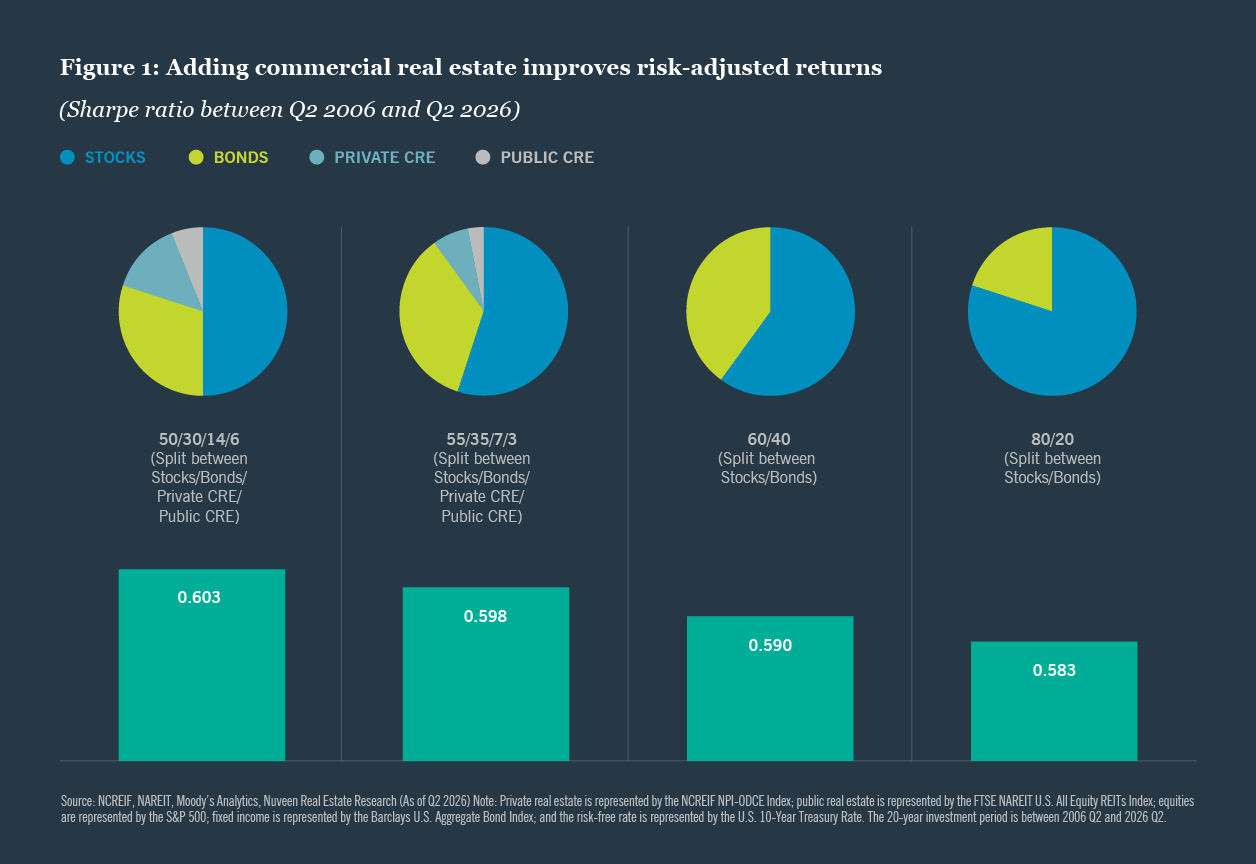
Adding commercial real estate (CRE) to a diversified portfolio has historically improved risk-adjusted returns1. The asset class combines bond-like features and equity-like characteristics; regular income from dividends or distributions typically represents a meaningful share of total return, while the underlying properties have the potential to appreciate in value over time. Despite these similarities, commercial real estate has low long-term correlations with both listed equities and fixed income. Leases also commonly include contractual rent increases, which can support income growth and provide a measure of inflation protection that most traditional bonds do not offer. These growing income streams can contribute to capital appreciation, independent of changes in capitalization rates.
After deciding to allocate to commercial real estate, investors have multiple options to gain exposure. This paper discusses why investors do not have to decide between public and private CRE, making the case for both and highlighting the factors investors need to consider. While public and private CRE vehicles provide exposure to the same underlying asset class, the timing, magnitude and volatility of their returns have differed over time. The analysis shows public real estate has delivered stronger total returns across many long-term periods, supported in part by higher leverage and broader exposure to alternative sectors, but with greater short-term volatility and more frequent drawdowns. Private real estate has generally produced smoother returns because of appraisal-based valuations and a greater concentration in core sectors, but with more limited liquidity.
The analysis examines these differences and makes the case for combining public and private real estate. As Figure 1 shows, representative portfolios that included both forms of commercial real estate generated higher Sharpe ratios than traditional stock-and-bond allocations, illustrating the potential contribution of real estate to portfolio efficiency.
Contact us

















- +44 20 3727 8000
- 201 Bishopsgate, London, United Kingdom
1 Based on the Sharpe ratio of a representative sample of portfolios with various mixes of stocks, bonds, private and public commercial real estate (See Figure 1).