
Section 2: The economy and markets
Key points to know
Global growth should remain stronger than expected
Global economic growth has defied expectations for a tariff-induced slump this year. Throughout 2025, we viewed consensus expectations as overly bearish. After a sharp April drop following “Liberation Day” tariff announcements, consensus U.S. growth expectations have steadily rebounded to near their starting point. While the median recession risk forecast over the next 12 months has moderated slightly, it remains elevated at 30% – double the historical norm of 15%.
Tech investment has dominated headlines and clearly boosted U.S. growth. But consumers have performed equally well despite a softening labor market. Income growth remains healthy, and spending shows no signs of slowing. Lower gas prices have boosted disposable income, while fiscal and monetary policies have become more supportive.
We expect global growth to outperform expectations in the year ahead. In the U.S., euro area and UK, we forecast stronger-than-consensus growth. We also expect sequential improvements in Japan and emerging markets. China presents potential concern – we expect further deceleration, though at a gentle, nondisruptive pace.
Expansive fiscal policy could keep upward pressure on global inflation
Fiscal policy is loosening globally. U.S. budget deficits are historically wide despite low unemployment and strong growth. Using 1990 to 2015 as a template, U.S. fiscal deficits should be near zero today. Instead, they exceed 6% of GDP and are set to widen further. Similar dynamics prevail in Japan and Germany, while uncertainty dominates the UK and France outlooks.
On the plus side, this global fiscal expansion should support economic growth. A potent mix of fiscal initiatives hits in 2026 across multiple markets: tax cuts, increased defense spending, reshoring subsidies and the ongoing (if uneven) transition to renewable energy. But this combination risks keeping inflation well above central bank targets. Tariffs – one fiscal tool that actually raises revenues and improves deficits – carry their own inflationary impact. There is also risk of “crowding out,” where elevated deficits and interest rates divert capital from other worthwhile investments. For example, while U.S. tech hardware and software spending soared 15% year-over-year, the rest of business fixed investment actually contracted.
Interest rate and yield curve trends argue against extending duration
Given our outlook for strong growth and loose fiscal policy, we see limited scope for longer-duration assets to perform well in 2026. Our estimate of the global, GDP-weighted term premium recently touched 90 basis points – its highest since 2014. That increase has been driven by higher rates in the U.S., Germany, France, Japan and UK. We don’t expect major near-term fiscal policy changes, so this upward pressure should persist.
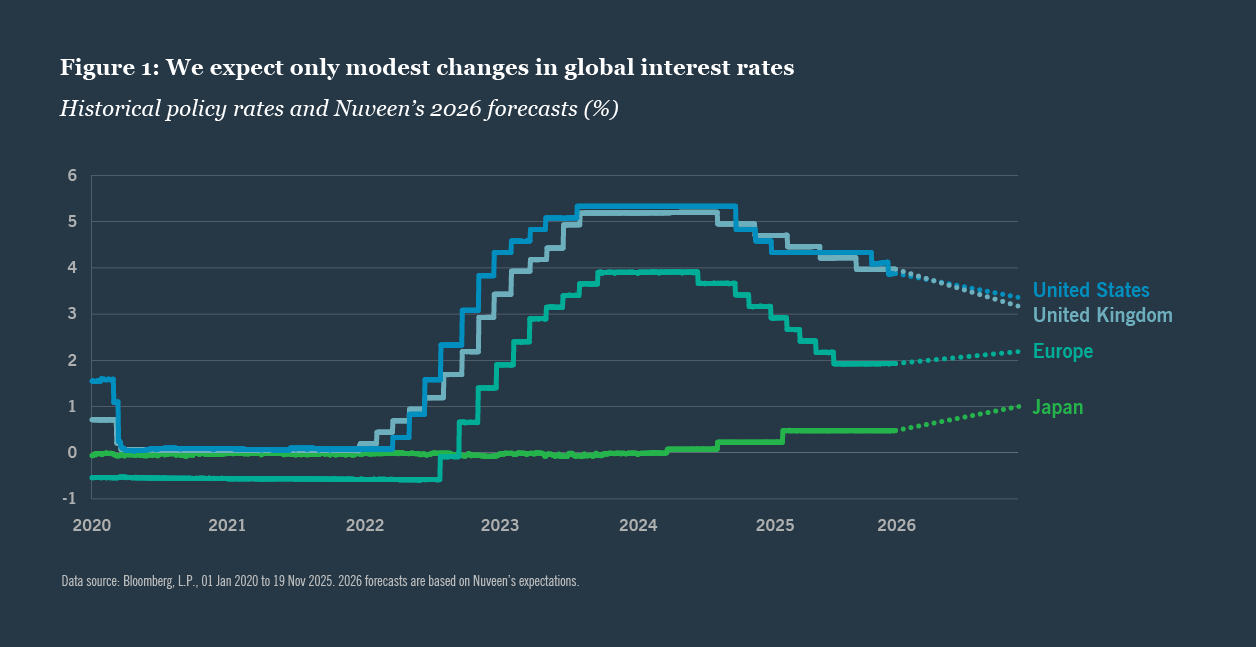
On monetary policy, we see little scope for excitement. We expect the U.S. Federal Reserve and Bank of England to continue cutting rates, but likely by less than markets currently price (Figure 1). Meanwhile, we expect the European Central Bank and Bank of Japan to hike rates by the end of 2026. Neither dynamic – market pricing disappointment or outright rate hikes – is likely to support duration.
Wildcard risks remain ever-present
Despite our positive macroeconomic outlook, persistent risks remain. Geopolitical turmoil could escalate, or new threats could emerge. On trade, we anticipate no fresh tariffs next year, but given 2025’s surprises, we would not rule out fresh shocks in 2026. The U.S. Supreme Court will likely rule on existing tariffs, potentially upsetting the existing framework. We believe other authorities could recreate the tariff regime on surer legal footing, but deployment may take time, and uncertainty could resurface.
Beyond tariffs, Jay Powell’s Fed Chair term ends in the spring. The White House will likely announce his replacement by early 2026, and markets are already pricing in a “new chair premium” – higher odds of a June rate cut than at preceding meetings. Questions about Fed independence could linger, maintaining downward pressure on the dollar.
Continue reading




About the author

Contact us









- +1 312 917 7700
- 333 W Wacker Drive, Chicago, United States of America
Endnotes
Sources
All market and economic data from Bloomberg, FactSet and Morningstar.
This material is not intended to be a recommendation or investment advice, does not constitute a solicitation to buy, sell or hold a security or an investment strategy, and is not provided in a fiduciary capacity. The information provided does not take into account the specific objectives or circumstances of any particular investor, or suggest any specific course of action. Investment decisions should be made based on an investor’s objectives and circumstances and in consultation with his or her financial professionals.
The views and opinions expressed are for informational and educational purposes only as of the date of production/writing and may change without notice at any time based on numerous factors, such as market or other conditions, legal and regulatory developments, additional risks and uncertainties and may not come to pass. This material may contain “forward-looking” information that is not purely historical in nature.
Such information may include, among other things, projections, forecasts, estimates of market returns, and proposed or expected portfolio composition. Any changes to assumptions that may have been made in preparing this material could have a material impact on the information presented herein by way of example. Performance data shown represents past performance and does not predict or guarantee future results. Investing involves risk; principal loss is possible.
All information has been obtained from sources believed to be reliable, but its accuracy is not guaranteed. There is no representation or warranty as to the current accuracy, reliability or completeness of, nor liability for, decisions based on such information and it should not be relied on as such. For term definitions and index descriptions, please access the glossary on nuveen.com. Please note, it is not possible to invest directly in an index.
Important information on risk
All investments carry a certain degree of risk and there is no assurance that an investment will provide positive performance over any period of time. Equity investing involves risk. Investments are also subject to political, currency and regulatory risks. These risks may be magnified in emerging markets. Diversification is a technique to help reduce risk. There is no guarantee that diversification will protect against a loss of income. Debt or fixed income securities are subject to market risk, credit risk, interest rate risk, call risk, tax risk, political and economic risk, and income risk. As interest rates rise, bond prices fall. Investing in municipal bonds involves risks such as interest rate risk, credit risk and market risk, including the possible loss of principal. The value of the portfolio will fluctuate based on the value of the underlying securities. There are special risks associated with investments in high yield bonds, hedging activities and the potential use of leverage. Portfolios that include lower rated municipal bonds, commonly referred to as “high yield” or “junk” bonds, which are considered to be speculative, the credit and investment risk is heightened for the portfolio. Credit ratings are subject to change. AAA, AA, A, and BBB are investment grade ratings; BB, B, CCC/CC/C and D are below-investment grade ratings. As an asset class, real assets are less developed, more illiquid, and less transparent compared to traditional asset classes. Investments will be subject to risks generally associated with the ownership of real estate-related assets and foreign investing, including changes in economic conditions, currency values, environmental risks, the cost of and ability to obtain insurance, and risks related to leasing of properties. Investors should be aware that alternative investments including private equity and private debt are speculative, subject to substantial risks including the risks associated with limited liquidity, the use of leverage, short sales and concentrated investments and may involve complex tax structures and investment strategies. Alternative investments may be illiquid, there may be no liquid secondary market or ready purchasers for such securities, they may not be required to provide periodic pricing or valuation information to investors, there may be delays in distributing tax information to investors, they are not subject to the same regulatory requirements as other types of pooled investment vehicles, and they may be subject to high fees and expenses, which will reduce profits. Alternative investments are not appropriate for all investors and should not constitute an entire investment program. Investors may lose all or substantially all of the capital invested. The historical returns achieved by alternative asset vehicles is not a prediction of future performance or a guarantee of future results, and there can be no assurance that comparable returns will be achieved by any strategy. Responsible investing incorporates Environmental Social Governance (ESG) factors that may affect exposure to issuers, sectors, industries, limiting the type and number of investment opportunities available, which could result in excluding investments that perform well.
Nuveen, LLC provides investment advisory services through its investment specialists.
This information does not constitute investment research as defined under MiFID.