
Section 4: Five themes for 2026
- Don’t bet against the U.S.
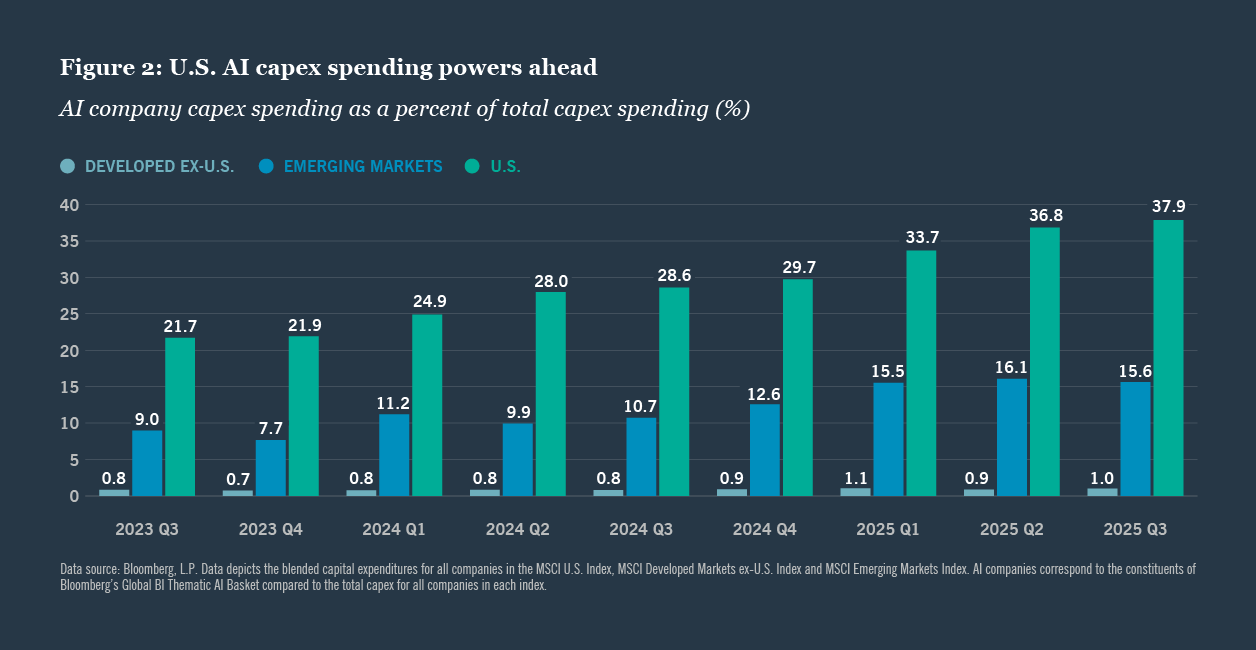
One of the main questions on investors’ minds is whether the AI-driven U.S. equity surge has created a bubble. Additionally, tariffs and the corresponding rise of deglobalization have prompted some investors (particularly those outside the U.S.) to reduce U.S. exposure. But we think U.S. large caps still have room to run. U.S. megacap tech companies may have less-than-clear monetization timelines around some aspects of AI profitability, but we think investors will continue to reward AI-related capex spending, which shows no sign of slowing down in the U.S. (Figure 2).
Outside of the U.S., other global equity markets appear cheaper, but we see no catalyst for a leadership shift. And beyond equities, we think stronger relative economic growth, favorable tax and regulatory policies and a diversified economy offer compelling U.S. opportunities across such areas as private credit, private asset-backed finance and private investment grade bonds.
- Alternative credit and private equity should be core allocations
While global fixed income remains attractive, we’re wary of duration risk and credit spread tightening. At the same time, we think many (if not most) investors are underweight private markets and could benefit from taking on liquidity risk to seek enhanced returns, income and diversification. As such, we encourage investors to seek out alternative credit sectors beyond traditional fixed income benchmarks, including senior loans, collateralized loan obligations, public and private securitized assets, real estate and infrastructure debt and Commercial Property Assessed Clean Energy (C-PACE) financing.
Private credit headlines question whether the market is oversaturated or cracking. We see issues with underwriting and deal structure in riskier segments, but strong opportunities remain, particularly in middle-market direct lending. Selectivity and partner choice will prove critical – rising tides will no longer lift all boats. Deal structure and covenant protections will matter more.
Private equity also shows promise. Lower interest rates should spur M&A activity, and tougher fundraising means experienced managers are deploying capital. We favor senior over junior capital and prefer secondary markets with single-manager structures.
- Municipals may be at the forefront of a new bull market
Throughout 2025, municipal prices lagged despite strong balance sheets, solid credit quality and low defaults. That has started to change over the last couple of months as municipal prices have begun to rally. We believe munis continue to offer value. As supply eases and demand rises, supportive interest rates and strong fundamentals could continue to power municipal bonds forward.
With municipal yield curves steeper than Treasuries, investors may be well compensated for duration risk. We see compelling opportunities across both high grade and high yield municipals.
- The real estate rebound is just getting started
After years of falling values, oversupply and weak demand, 2025 saw values rebound and supply contract. We expect demand should follow.
For now, real estate markets are being driven by rising income returns. Capital appreciation hasn’t materialized yet, but we expect that will rise as well, providing another tailwind. The office sector remains under pressure, but medical office, grocery-anchored retail and affordable housing offer notable opportunities.
- Look for the “second derivative” trades from the AI boom and energy revolution
Megacap tech and data centers led early AI gains. And while we still see opportunities there, we think investors should also look for the secondary and future implications of these trends.
Other infrastructure investments such as utilities, battery storage and energy transmission look compelling, as detailed in our “best ideas” section. AI also creates direct or indirect opportunities in select asset-backed securities, real estate and municipal bonds tied to infrastructure buildouts. Despite U.S. political headwinds, the global shift toward renewables and energy efficiency continues as diverse power sources become essential.
We also think investors should pay attention to broader, longer-term AI and energy trends and risks. Key issues include upgrading the power grid, the intersection of data center growth with water scarcity, and AI’s impact on employment and corporate governance.
Continue reading




About the author

Contact us

















- +44 20 3727 8000
- 201 Bishopsgate, London, United Kingdom
Endnotes
Sources
All market and economic data from Bloomberg, FactSet and Morningstar.
This material is not intended to be a recommendation or investment advice, does not constitute a solicitation to buy, sell or hold a security or an investment strategy, and is not provided in a fiduciary capacity. The information provided does not take into account the specific objectives or circumstances of any particular investor, or suggest any specific course of action. Investment decisions should be made based on an investor’s objectives and circumstances and in consultation with his or her financial professionals.
The views and opinions expressed are for informational and educational purposes only as of the date of production/writing and may change without notice at any time based on numerous factors, such as market or other conditions, legal and regulatory developments, additional risks and uncertainties and may not come to pass. This material may contain “forward-looking” information that is not purely historical in nature.
Such information may include, among other things, projections, forecasts, estimates of market returns, and proposed or expected portfolio composition. Any changes to assumptions that may have been made in preparing this material could have a material impact on the information presented herein by way of example. Performance data shown represents past performance and does not predict or guarantee future results. Investing involves risk; principal loss is possible.
All information has been obtained from sources believed to be reliable, but its accuracy is not guaranteed. There is no representation or warranty as to the current accuracy, reliability or completeness of, nor liability for, decisions based on such information and it should not be relied on as such. For term definitions and index descriptions, please access the glossary on nuveen.com. Please note, it is not possible to invest directly in an index.
Important information on risk
All investments carry a certain degree of risk and there is no assurance that an investment will provide positive performance over any period of time. Equity investing involves risk. Investments are also subject to political, currency and regulatory risks. These risks may be magnified in emerging markets. Diversification is a technique to help reduce risk. There is no guarantee that diversification will protect against a loss of income. Debt or fixed income securities are subject to market risk, credit risk, interest rate risk, call risk, tax risk, political and economic risk, and income risk. As interest rates rise, bond prices fall. Investing in municipal bonds involves risks such as interest rate risk, credit risk and market risk, including the possible loss of principal. The value of the portfolio will fluctuate based on the value of the underlying securities. There are special risks associated with investments in high yield bonds, hedging activities and the potential use of leverage. Portfolios that include lower rated municipal bonds, commonly referred to as “high yield” or “junk” bonds, which are considered to be speculative, the credit and investment risk is heightened for the portfolio. Credit ratings are subject to change. AAA, AA, A, and BBB are investment grade ratings; BB, B, CCC/CC/C and D are below-investment grade ratings. As an asset class, real assets are less developed, more illiquid, and less transparent compared to traditional asset classes. Investments will be subject to risks generally associated with the ownership of real estate-related assets and foreign investing, including changes in economic conditions, currency values, environmental risks, the cost of and ability to obtain insurance, and risks related to leasing of properties. Investors should be aware that alternative investments including private equity and private debt are speculative, subject to substantial risks including the risks associated with limited liquidity, the use of leverage, short sales and concentrated investments and may involve complex tax structures and investment strategies. Alternative investments may be illiquid, there may be no liquid secondary market or ready purchasers for such securities, they may not be required to provide periodic pricing or valuation information to investors, there may be delays in distributing tax information to investors, they are not subject to the same regulatory requirements as other types of pooled investment vehicles, and they may be subject to high fees and expenses, which will reduce profits. Alternative investments are not appropriate for all investors and should not constitute an entire investment program. Investors may lose all or substantially all of the capital invested. The historical returns achieved by alternative asset vehicles is not a prediction of future performance or a guarantee of future results, and there can be no assurance that comparable returns will be achieved by any strategy. Responsible investing incorporates Environmental Social Governance (ESG) factors that may affect exposure to issuers, sectors, industries, limiting the type and number of investment opportunities available, which could result in excluding investments that perform well.
Nuveen, LLC provides investment advisory services through its investment specialists.
This information does not constitute investment research as defined under MiFID.