TOOLS
Login to access your documents and resources.

Infrastructure debt is an established pillar for many European and U.K. insurance portfolios. Yet limiting allocations to investment grade means overlooking a broader opportunity set. An approach that incorporates public and high yield private infrastructure debt could improve capital efficiency, enhance returns and align allocations with the structural forces reshaping local and global economies.
Key takeaways
- The infrastructure debt spectrum has three tiers – municipals, investment grade and high yield – each of which can be used to optimise against return targets and solvency capital budgets.
- Infrastructure debt is a credible alternative to direct lending, offering similar yields with lower volatility, higher recovery rates and a more favourable Solvency II capital profile, while avoiding concentrated exposure to sectors facing AI-driven disruption.
- The opportunity set is only growing, as the energy transition, data centre build-out and the electrification of transport are multi-decade investment themes.
- Allocation to optimisation. Insurers that extend their infrastructure allocations across the full spectrum, rather than stopping at BBB, could be better placed to capture opportunities.
The paper at a glance:
Deal volumes are rising
The infrastructure debt market has grown to match continued allocation intentions from institutional investors. Global infrastructure debt deal activity has risen sharply, from US$950 billion in 2020 to more than US$1.5 trillion in 2025, with European volumes up by over 70% across the same period.1
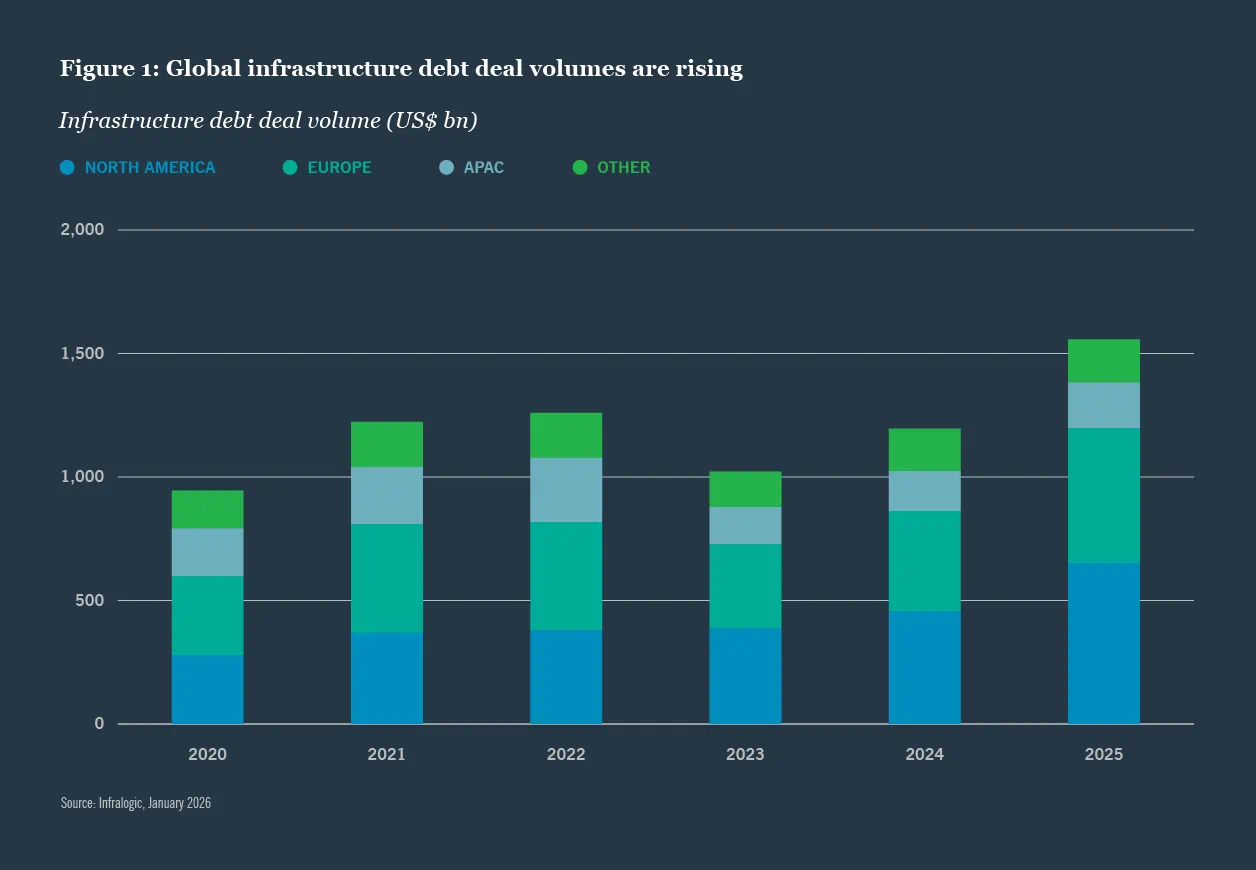
Megatrends, as well as banks retreating from long-dated lending, have driven this growth.
Despite this, most insurance capital occupies a narrow band of the existing credit spectrum, with allocations concentrated in senior investment-grade exposure.
This paper examines the strategic, regulatory and risk-adjusted return rationale for increasing allocations to this asset class across the credit spectrum.
From highly rated to higher yielding: The three tiers of infrastructure debt
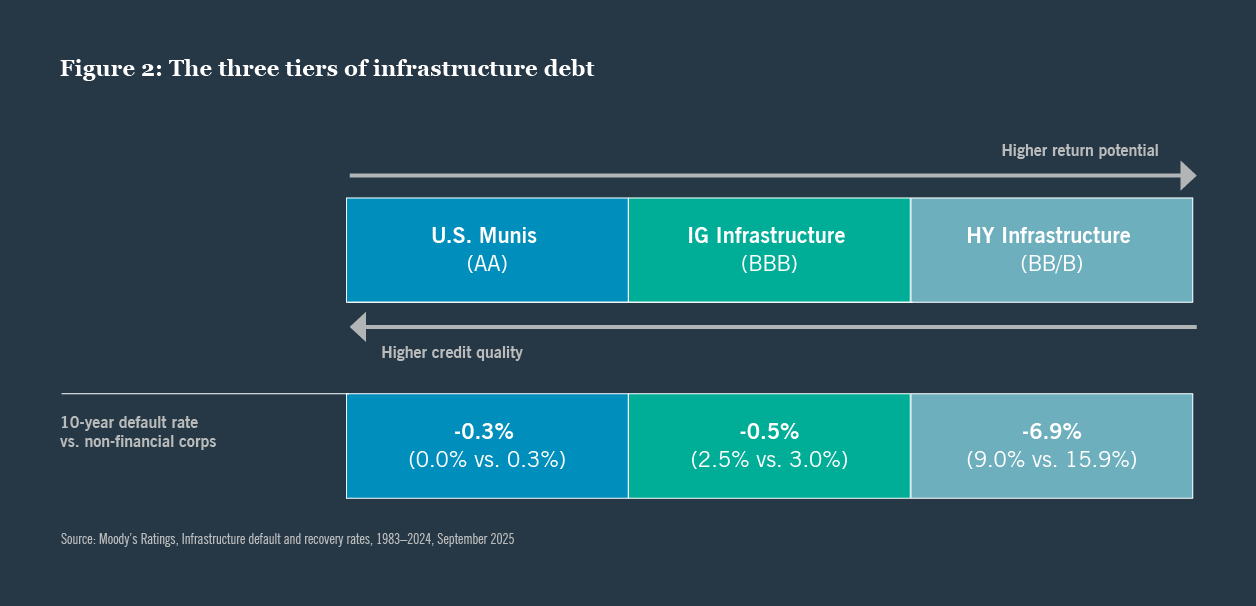
The infrastructure debt spectrum has three tiers — municipals, investment grade and high yield (Figure 2). The characteristics that define the asset class, such as essential services, contractual/regulated revenues, investment grade counterparties, asset security and covenant protection, run through all.
While moving down the ratings spectrum changes the price of risk, it does not mean underwriting discipline has to be sacrificed. A core feature of infrastructure debt markets is significantly higher recovery rates compared with corporate debt.
- Senior-secured infrastructure and project finance debt has recovered an average of 67% in default, against 56% for senior-secured corporate issues; for senior unsecured paper, the gap is wider still, at 60% versus 38%.2
- Put defaults and recoveries together and the expected loss picture diverges sharply: cumulative 10-year credit losses on BA-rated infrastructure debt average 3.5%, roughly a third of the 9.9% recorded by BB-rated corporates.2
Resilience is structurally embedded rather than driven by cyclical market forces. Infrastructure lending is secured against long-term essential assets, governed by covenants that restrict leverage and distributions, and is often supported by step-in rights that allow lenders to take control of a project before value erodes. Default risk is concentrated in the construction phase and declines once assets are operational.
The resilience of the asset class is highlighted by private infrastructure debt indices having exhibited roughly half the volatility of corporate benchmarks over the past decade. Additionally, infrastructure debt posted positive returns in the 2015 and 2018 credit selloffs, when high yield corporate bonds fell, with correlations of only around 0.5 to corporate high yield.3
Building diversified portfolios
Each tier of the infrastructure debt spectrum plays a distinct role. For most institutional investors, a combination of the three tiers will likely be more powerful than any single allocation.
- Municipals anchor the portfolio with low risk, capital-light duration.
- Investment grade private infrastructure debt supplies the core spread pickup over public markets.
- High yield private infrastructure debt adds return and access to sectors where capital is most needed.
For insurers looking to complement or diversify their direct lending exposures, high yield infrastructure offers comparable returns alongside structural protections and regulatory characteristics that align closely with their balance sheets. And the opportunity set will only grow: the energy transition, data centre build-out and the electrification of transport are multi-decade investment themes. Insurers that extend their infrastructure allocations across the full spectrum, rather than stopping at BBB, will be well placed to capture these opportunities.
For more detail, data and charts mapping the opportunity set across three private infrastructure portfolios, download the paper below.
Contact us

1 Infralogic, January 2026
2 Moody’s Ratings, Infrastructure default and recovery rates 1983–2024, September 2025
3 Scientific Infra & Private Assets, The performance of Infrastructure Debt, December 2025; Scientific Infra & Private Assets, infra300 Debt Index Report, March 2026
We consider your privacy our utmost concern. Please read our privacy notice for how we protect your personal information.