
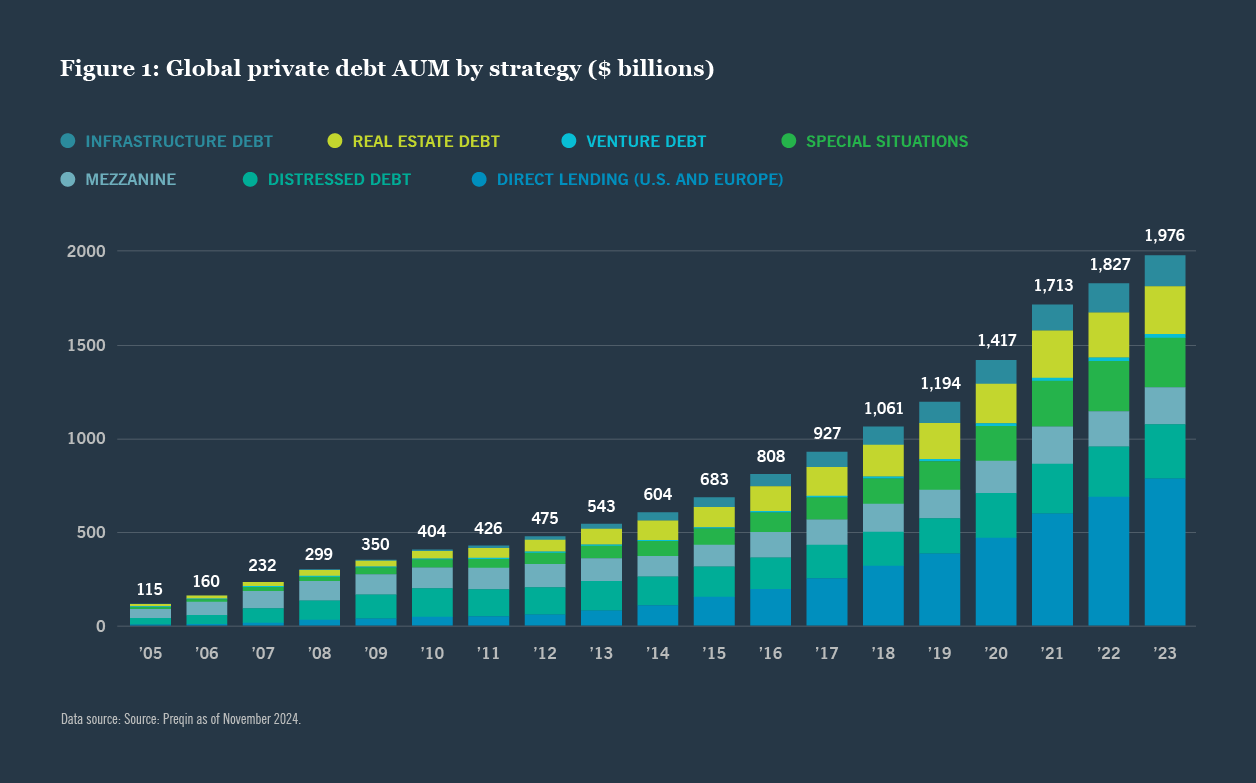
Alternative credit has quietly underpinned economic growth for nearly a century — and today, with assets under management approaching $2 trillion, it has become one of the most significant forces in global finance. This educational primer, designed for both institutional and wealth investors, explains what the asset class is, why the structural forces driving it are stronger than ever, and how investors of all sizes can build a meaningful allocation.
Explore key questions answered in the primer
- What is driving the growth of alternative credit?
- How can alternative credit support a portfolio?
- Who should consider alternative credit?
- How can investors allocate to alternative credit?
What is driving the growth of alternative credit?
Alternative credit has deep historical roots, with private lending in the U.S. dating back to the 1930s. While it has always played a role in financing companies and infrastructure outside public markets, the Global Financial Crisis was the turning point that transformed it into a mainstream asset class. Tighter bank regulation forced lenders to retreat from large areas of the market, creating a structural gap that non-bank lenders have steadily grown to fill — and that gap has only widened since.
How can alternative credit support your portfolio?
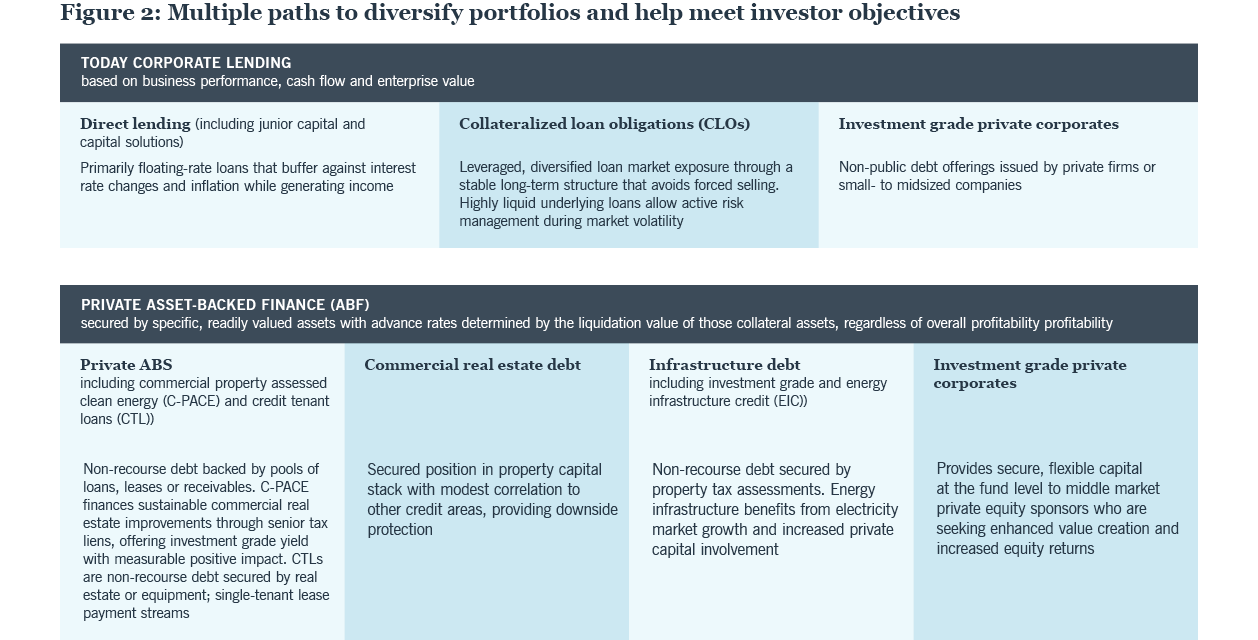
Alternative credit refers to privately negotiated loans and other non-public credit investments that sit outside traditional bond markets. These instruments are typically held to maturity and secured by specific assets or cash flows. For investors, they offer a combination of yield enhancement, genuine diversification from public markets, strong structural protections such as covenants and collateral, and reliable income — with many strategies providing a natural hedge against inflation through floating-rate structures.
Who should consider alternative credit?
Alternative credit can be suitable for a wide range of investors, depending on their objectives, investment horizon and liquidity needs. Insurance companies and pension funds are natural buyers, using long-duration private credit to match their liabilities. Endowments and sovereign wealth funds can access the full breadth of the asset class thanks to their long horizons. Increasingly, defined contribution plans, high-net-worth individuals, and smaller institutions can also participate, thanks to the growth of evergreen funds, interval funds, and other vehicles that have made the asset class far more accessible than it once was.
How can investors allocate to alternative credit?
Building an alternative credit portfolio starts with an investor’s objectives, investment horizon, income needs and risk tolerance. Conservative investors may anchor around investment grade private credit and infrastructure debt, while those seeking higher returns can layer in direct lending, real estate debt, or CLO tranches. Geographic diversification — blending U.S. and European private credit — adds further resilience.
The primer also challenges three common misconceptions:
- alternative credit is inherently high-risk
- it is only for the largest institutions
- it is a recent phenomenon rather than a century-old, cycle-tested asset class
Related articles

Alternative credit insights: Diversifying, not accumulating, risk

The business of private credit: Private credit’s coming home story

IPE webinar replay: AI and Alternative Credit — Opportunity or Disruptive Force?
Contact us









- +1 312 917 7700
- 333 W Wacker Drive, Chicago, United States of America