The US manufacturing industry is preparing for two major transitions: the retirement of a large portion of its workforce and automation. In navigating these, the industry needs to attract new workers to build a future workforce.
Economist Enterprise’s 2025 Benefits 2.0 survey of US manufacturing workers has found that several modern, worker-centered benefits are key to addressing the factors deterring new and continued employment in the sector:
- Retirement plans that meet the needs of a less-than-satisfied workforce rapidly approaching retirement;
- Childcare and health benefits that address perceptions of low pay and affordability; and
- Training and career pathways, with pay linked to skills or performance, that attract workers and help them realize a future in an increasingly automated workplace.
A generation concerned about retirement savings
By 2030, roughly a quarter of the US manufacturing workforce is expected to retire, leaving as many as 1.5 million positions unfilled.1 Retirement is already a primary driver of workforce exits, with 82% of workers who left manufacturing roles doing so to retire.2
Manufacturing employees are aware of this reality and preparing more actively for retirement than employees elsewhere: 50% say they actively review and adjust their retirement plans, compared with just 32% in other industries we surveyed.
Manufacturing retains the highest share of pensioned workers in our survey, yet it also leads all industries in workers who have lost access to pension plans. At the same time, dissatisfaction with retirement plans is widespread among manufacturing workers—regardless of plan type. Among those without pensions, more than a third (34%) would prefer to switch retirement plans, compared with 24% in other industries. The same pattern holds among pensioned workers: 27% would prefer a different plan, compared with 14% elsewhere.
Overcoming affordability concerns to attract the next generation of workers
Recruiting new workers presents its own challenge because manufacturing jobs in the US pay significantly below the national average salary.3 Gen Z employees, in particular, remain hesitant to pursue careers in industrial fields, with low pay a key deterrent to entering this rapidly aging industry.4
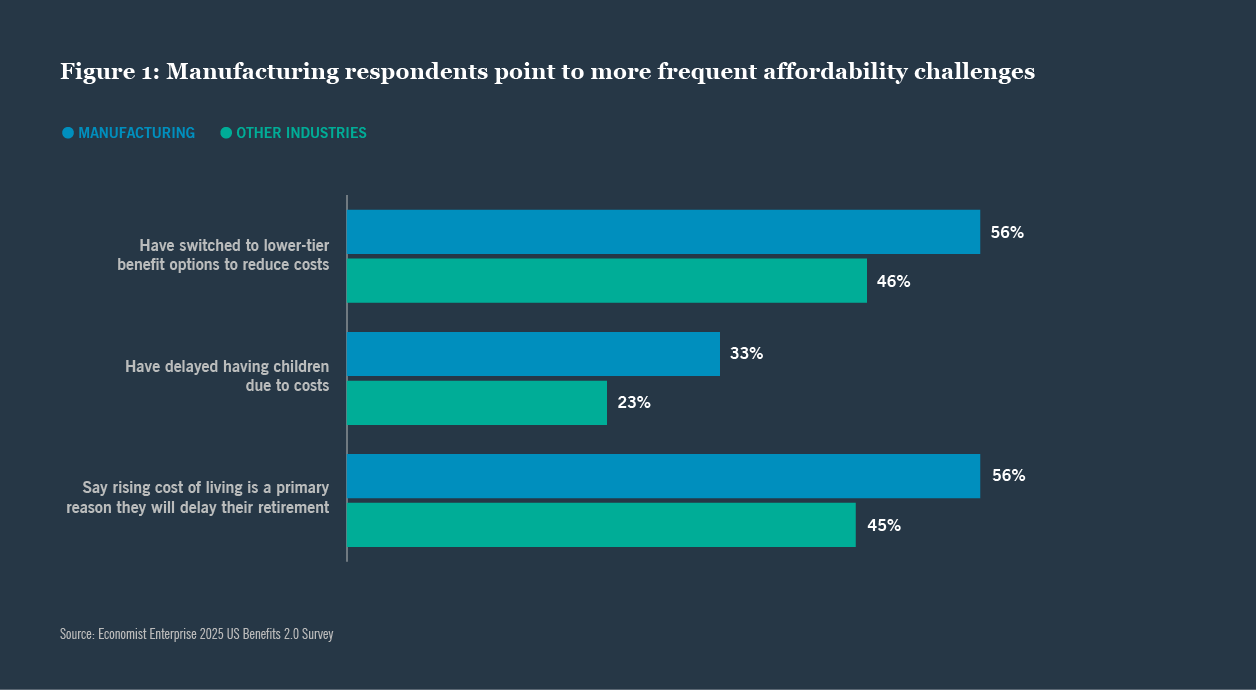
Concerns about affordability are reflected in our survey results, with manufacturing employees more likely to switch to a lower-cost benefit tier, put off having children and delay retirement (see figure 1), making benefits packages all the more important for attracting and retaining workers.
In addition to affordability challenges, women in the manufacturing industry are five times more likely than men to identify a lack of childcare support as their most significant labor force challenge.5 Access to childcare, caregiving benefits and flexible work arrangements can make a significant difference in attracting female workers.
Enabling workers to care for themselves and others
Rising insurance premiums are increasing the cost burden on companies while also making healthcare less affordable for workers.6 Over half (51%) of employees say they have delayed or skipped medical care to avoid out-of-pocket expenses, compared with 41% in other industries. This suggests notable risks to workers in an often physically demanding industry, with employers facing an urgent need to improve healthcare benefits.
Our analysis also shows elevated risk regarding caregiving support for children, elderly and other disabled relatives, with 33% of caregivers in the industry reporting difficulty accessing or using employer caregiving benefits in the past year compared with only 14% in other industries.
Benefits that support employees and their families play a key role in attracting and retaining talent, helping support the long-term growth of manufacturing firms. “We have an on-site clinic for families,” says Tracey M, a vice president of human resources in the industry, “which is beneficial not only from a cost perspective, but from a recruiting and retention perspective.”
The automation opportunity for employee development
At the same time, technological change is transforming the nature of manufacturing work. As companies invest heavily in smart manufacturing technologies,7 training and reskilling programs will be essential to help employees adapt to a more technologically sophisticated workplace. Manufacturing workers in our survey pointed to training and advancement opportunities as one of the top three reasons they remain in the sector, suggesting they prioritize opportunities to learn new technologies.
Automation is also reshaping employee expectations about workplace benefits. Over half (54%) expect automation to lead to a greater focus on training and career development, 43% anticipate more skills-linked or performance-based pay, and 43% think there will be an increased emphasis on mental health and well being as automation delivers productivity gains. By integrating technology into workforce management as well as the factory floor, manufacturers can make industrial roles more appealing to younger, tech-savvy employees.
Modernized workplace benefits matter to manufacturing workers
In our survey, 46% of manufacturing workers cite strong benefits as a key motivator for staying in the industry. Despite lower than average pay, 59% of manufacturing employees said they have taken or applied for a job with equal or lower pay for better benefits, compared with 48% in other sectors.
Facing the necessity of attracting a new generation of workers, the sector has a major opportunity to use digital technologies alongside modernized benefit packages to broaden the appeal of manufacturing work. Expanding childcare and healthcare support, strengthening retirement plans and investing in career development will contribute to making manufacturing careers more accessible and attractive.
But lessons from other industries suggest that improving manufacturing’s appeal will not only stem from adding benefits—it is also about how they function in practice. In some sectors, such as government, benefits reduce financial strain by being stable and requiring little active management. In others, such as energy and financial services, they matter most when they help workers navigate market volatility or financial complexity. For manufacturing, the opportunity comes from drawing on both approaches: simplifying access to ease immediate pressures, while giving workers greater confidence as roles evolve. Done well, benefits can move from a compensating factor to a strategic tool.

References
1 Manufacturing Tomorrow, “REPORT: U.S. MANUFACTURING FACES HIRING CRISIS AS 26% OF WORKFORCE NEARS RETIREMENT”, https://www.manufacturingtomorrow.com/news/2026/01/29/report-us-manufacturing-faces-hiring-crisis-as-26-of workforce-nears-retirement/26926/
2 NAM, “In Manufacturing, “Great Resignation” Really a “Great Retirement””, March 2022, https://nam.org/in-manufacturing-great
resignation-really-a-great-retirement-2-26451/
3 Fortune, “Nearly 4 million new manufacturing jobs are coming to America as boomers retire—but it’s the one trade job Gen Z doesn’t want”, December 2025, https://fortune.com/2025/12/04/gen-z-4-million-new-manufacturing-jobs-america-boomer-retire-one-trade job-young-people-dont-want/
4 Fast Company, “Survey: Gen Zers don’t want to work in factories; they see industrial jobs as low-paying dead ends”, October 2023, https://www.fastcompany.com/90971832/gen-z-careers-factory-manufacturing-low-pay-survey
5 Deloitte, “Taking charge: Manufacturers support growth with active workforce strategies”, April 2024, https://www.deloitte.com/us/ en/insights/industry/manufacturing-industrial-products/supporting-us-manufacturing-growth-amid-workforce-challenges.html
6 Rolling Out, “Why U.S manufacturing companies are relocating overseas”, June 2025, https://rollingout.com/2025/06/23/healthcare-costs-manufacturing-jobs/
7 Deloitte, “2025 Smart Manufacturing and Operations Survey: Navigating challenges to implementation”, May 2025, https://www.deloitte.com/us/en/insights/industry/manufacturing-industrial-products/2025-smart-manufacturing-survey.html
Disclosure
Nuveen and Economist Enterprise, or any of their affiliates or subsidiaries are not affiliated with or in any way related to each other. The research was independently developed by Economist Enterprise and is sponsored by Nuveen, LLC. The views and opinions expressed in this publication are those of Economist Enterprise and do not necessarily reflect the view and policies of Nuveen, LLC.
Nuveen and Economist Enterprise, or any of their affiliates or subsidiaries are not affiliated with or in any way related to each other. The research was independently developed by Economist Enterprise and is sponsored by Nuveen, LLC. This material is prepared by and represents the views and opinions of Economist Enterprise, and does not necessarily represent the views and polices of Nuveen, LLC, its affiliates, or other Nuveen staff.
This material, along with any views and opinions expressed within, are presented for informational and educational purposes only as of the date of production/writing and may change without notice at any time based on numerous factors, such as changing market, economic, political, or other conditions, legal and regulatory developments, additional risks and uncertainties and may not come to pass. There is no promise, representation, or warranty (express or implied) as to the past, future, or current accuracy, reliability or completeness of, nor liability for, decisions based on such information, and it should not be relied on as such. This material should not be regarded by the recipients as a substitute for the exercise of their own judgment.