
The energy and utilities sector is navigating economic turbulence and technological transformation. In this environment, benefits have a critical role to play in providing both short- and long-term stability, supporting retention among an aging workforce while attracting younger and more diverse talent to meet growing demand.
Economist Enterprise’s 2025 Benefits 2.0 survey of US energy and utilities workers has found that several resilient, inclusive and modern benefits are key to addressing the concerns and pressures shaping the workforce:
- stable benefit plansthat mitigate economic volatility, reinforcing workers’ confidence in their financial future;
- caregiving support aligned with an aging workforce, with flexible options that help employees balance family responsibilities; and
- AI-enabled benefitsthat keep pace with industry transformation, improving relevance and accessibility, while reducing costs.
Anxiety about benefits amid economic turbulence
The US energy industry is undergoing a period of profound transformation. Surging power demand, driven by trends such as AI, data centers and electrification,1 is straining an industry already under pressure to rapidly scale its infrastructure. At the same time, energy prices, which have risen by 30% since 2010 across the US, continue to fluctuate,2 driven by geopolitical instability and new demand.
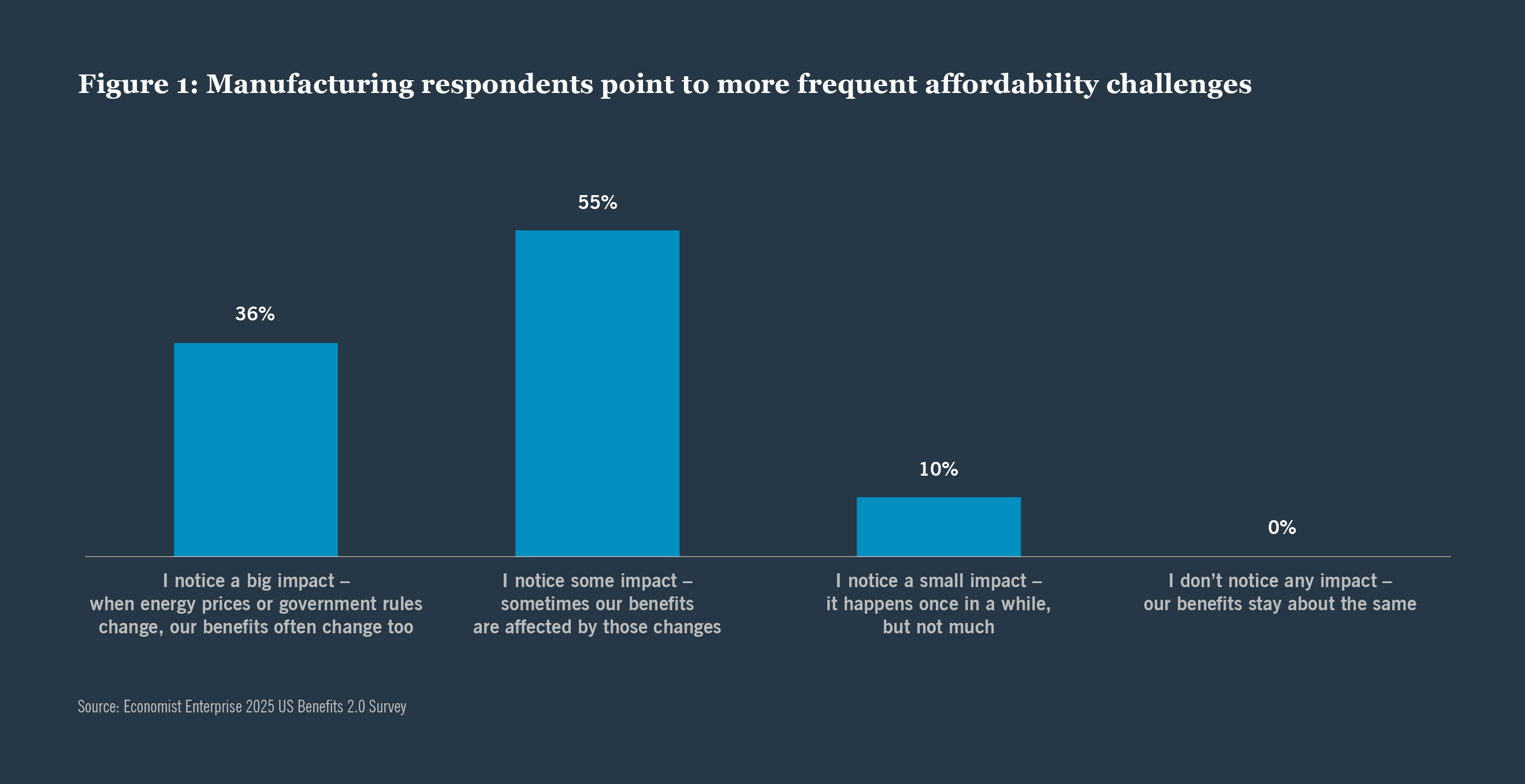
The effects of this turbulence are being felt in everyday life. Across the industry, 90% of the employees we surveyed reported that energy prices or shifting regulations periodically affect their benefits, with more than a third saying there is a significant impact (see figure 1).
Despite this instability, full-time workers in the industry continue to enjoy relatively high wages3 and nearly universal access to healthcare, paid vacation and paid sick leave.4 Yet this apparent security masks deeper unease about the future. Our survey revealed that energy and utilities workers report the highest levels of anxiety that inflation will erode their retirement benefits: 78% agree, compared with 69% in other sectors. This concern reflects a growing employee awareness that benefits are not fixed. Workers recognize that the structure and generosity of those benefits can shift alongside the sector—particularly during periods of transition.
The dual challenge of replacing retirees and staffing for sector growth
Retirement is another source of pressure on the sector, as a quarter5 of employees approach retirement, and the replacement rate is not keeping pace. In advanced economies, 2.4 energy workers are nearing retirement for every new entrant under age 25, compared with a 1:1 ratio in emerging markets and developing economies.6
Replacement is not the only issue. An estimated 510,000 new jobs will need to be filled by 2030 to meet rising power demand in the US.7 High salaries alone appear insufficient to attract talent, with undergraduate enrollment in the high-paying petroleum engineering field declining.8 Benefits will need to shift to appeal to the younger workers the sector needs to attract.
An aging workforce needs accessible caregiver support
As the workforce ages, caregiving pressures are also intensifying. Nearly half of the sector’s workforce is now 45 or older, a 26% increase since 2023.9 With the average age rising quickly and more workers entering the “sandwich generation”—simultaneously caring for children and aging parents—caregiving benefits are becoming a growing priority.
Unfortunately, caregivers in the industry find it far more difficult to access or use caregiving benefits, with 74% struggling compared with only 42% in other sectors. This can also exacerbate workforce issues, as 62% of caregivers surveyed have reduced hours or left a job due to caregiving, compared with just 39% in other sectors.
Amid this pressure, flexibility is the top demand: 64% of employees would prioritize extra paid leave or schedule flexibility for caregiving over subsidies or reimbursements.
Growing the workforce with gender equality
Women in energy and utilities earn 11% less than men (a similar gap as in other sectors),10 hold only 20% of senior management roles (trailing the global average of 34%),11 and are more likely than men to leave the sector for other industries.12 Energy companies report persistent challenges retaining and recruiting women in renewable energy, a growing part of the sector.13 Work-life balance policies, family support and professional development opportunities can help, according to research from the International Renewable Energy Association.14
Our survey underscores the role of benefits in retaining women. Nearly half of women in the industry (47%) say they have taken or applied for a job with equal or lower pay in exchange for better benefits, compared with 38% of men. They are also less likely to feel their benefits demonstrate genuine care (71%, compared with 77% of men). And notably, across industries, 47% of women with caregiving responsibilities have switched to a partner’s plan for better coverage, compared with just 30% of men.
AI-powered benefits for a future-forward industry
Technological innovation can also help employers optimize the benefits landscape by using AI systems to identify unused benefits, simplify enrollment and personalize recommendations for employees with complex needs.
High trust in AI-powered benefits across the energy sector makes this an attractive option, with 73% saying they would trust employers to use AI to reduce benefit premiums and costs, compared with 63% across other industries.
The value of stable benefits in unstable times
As the energy sector continues to navigate volatility, benefits programs will play a critical role in supporting stability and retention. In times of disruption, stability becomes a competitive advantage—not just in markets, but in people’s lives. This is a lesson other industries have already confronted and the energy sector can learn from their experiences.
The companies that recognize that benefits are a strategic shock absorber, rather than a perk that fluctuates from year to year, will be better placed to attract talent and power the workforce growth that is needed. The opportunity now is to strengthen the sector’s human infrastructure: audit which benefits employees value, deploy AI not just to cut costs but to improve relevance, and redesign benefits to foster long-term individual resilience.
Contact us


References
1McKinsey, “Powering a new era of US energy demand”, April 2025, https://www.mckinsey.com/industries/public-sector/our-insights/powering-a-new-era-of-us-energy-demand
2World Resources Institute, “What’s Really Driving Up US Electricity Prices? We Unpack the Numbers.”, December 2025, https://www.wri.org/insights/whats-driving-us-electricity-prices
3U.S. Department of Energy, “2025 United States Energy & Employment Report”, August 2025, https://www.energy.gov/documents/2025-useer-national-report
4U.S. Bureau of Labor Statistics, “Industries at a Glance”, https://www.bls.gov/iag/tgs/iag22.html
5McKinsey, “Talent squeeze: Planning for the energy sector’s talent transition”, February 2024, https://www.mckinsey.com/industries/oil-and-gas/our-insights/talent-squeeze-planning-for-the-energy-sectors-talent-transition
6IEA, “World Energy Employment 2025”, https://iea.blob.core.windows.net/assets/e5b9e908-26fe-4228-8978-e4ee36c555ed/WorldEnergyEmployment2025.pdf
7Goldman Sachs, “The Power Industry May Need More Than 750,000 New Workers by 2030”, July 2025, https://www.goldmansachs.com/insights/articles/power-industry-may-need-more-workers-by-2030
8Wall Street Journal, “Big Oil’s Talent Crisis: High Salaries Are No Longer Enough”, August 2023, https://www.wsj.com/business/energy-oil/big-oils-talent-crisis-high-salaries-are-no-longer-enough-194545be
9GETI, “The Global Energy Talent Index Report”, 2026, https://www.airswift.com/hubfs/GETI/GETI%202026_full%20report_FINAL%20web_version.pdf?__hstc=53004663.16fd66b0e059e319969a24279ca7a026.1773404786248.1773404786248.1773404786248.1&__hssc=53004663.2.1773404786248&__hsfp=3c138d489bf411a0ae933e5c9c2e5f40
10Payscale, “2026 Gender Pay Gap Report (GPGR)”, https://www.payscale.com/featured-content/gender-pay-gap
11Grant Thornton, “Women in Business report: 33.5% of top management worldwide are women”, March 2024, https://www.grantthornton.be/en/press/press-releases-2024/women-in-business-report-33.5-of-top-management-worldwide-are-women/
12World Economic Forum, “These 4 charts show the energy sector’s gender gap and what needs to change”, November 2022, https://www.weforum.org/stories/2022/11/gender-gap-energy-sector/
13IRENA, “Renewable Energy A Gender Perspective”, https://www.irena.org/-/media/Files/IRENA/Agency/Publication/2025/Oct/IRENA_SOC_Renewable_energy_gender_perspective_2Ed_2025.pdf
14Ibid.
Nuveen and Economist Enterprise, or any of their affiliates or subsidiaries are not affiliated with or in any way related to each other. The research was independently developed by Economist Enterprise and is sponsored by Nuveen, LLC.
The views and opinions expressed in this publication are those of Economist Enterprise and do not necessarily reflect the view and policies of Nuveen, LLC. This material, along with any views and opinions expressed within, are presented for informational and educational purposes only as of the date of production/writing and may change without notice at any time based on numerous factors, such as changing market, economic, political, or other conditions, legal and regulatory developments, additional risks and uncertainties and may not come to pass. There is no promise, representation, or warranty (express or implied) as to the past, future, or current accuracy, reliability or completeness of, nor liability for, decisions based on such information, and it should not be relied on as such. This material should not be regarded by the recipients as a substitute for the exercise of their own judgment.
Nuveen, LLC provides investment solutions through its investment specialists.