
Welcome to our first article in The Real Advantage Series , Nuveen's thought leadership series designed with investors like you in mind. We've taken the questions we hear most from our clients and turned them into in-depth insights across real estate, farmland, and timberland — asset classes where Nuveen has long been a trusted voice. New perspectives will be added throughout the year, so check back often and keep exploring.
In this article Nuveen’s research presents a rigorous, data-driven case for why private real assets might deserve a meaningful place in investor portfolios. Drawing on more than 30 years of performance data, supported by mean-variance optimization analysis, the paper examines how private real assets have the potential to improve the performance of portfolios across a range of risk profiles and market environments.
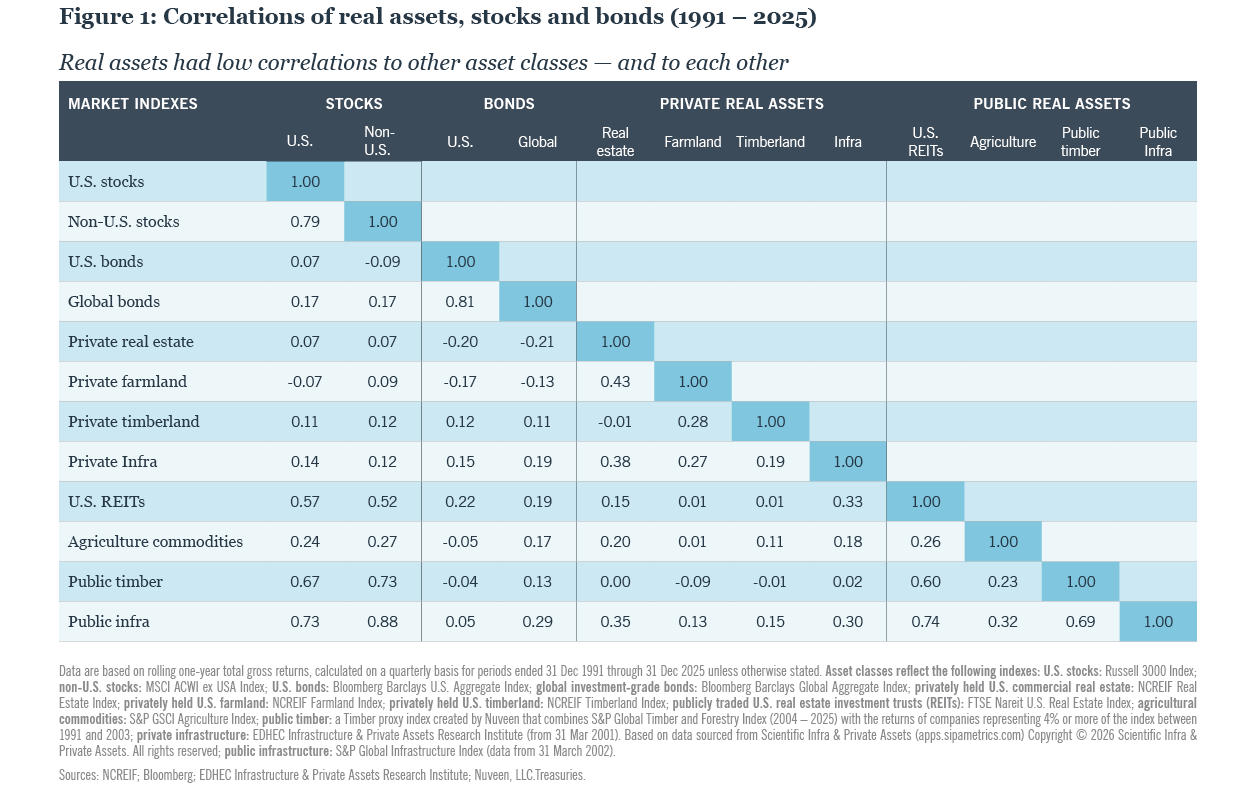
The findings are clear: private real assets have an enduring potential to deliver low or negative correlations to traditional investments, making them a key element for helping diversify risk, hedge against inflation and build the resilience of traditional portfolios.
Private real assets — including farmland, timberland, infrastructure and commercial real estate — have demonstrated low or negative correlations to stocks and bonds, offering compelling diversification backed by over 30 years of performance data.
Key takeaways1
- Across all four asset categories, private real assets delivered comparable or superior returns to traditional investments with significantly lower volatility, as evidenced by higher Sharpe ratios.
- With revenues and values tied to rising commodity prices, lease escalations, and long-term appreciation of physical assets, private real assets serve as a meaningful hedge against inflation.
- We believe even modest, constrained allocations to private real assets can help improve risk-adjusted returns for both conservative and aggressive portfolios.
- Private real assets outperformed publicly traded alternatives such as REITs and commodity stocks on a risk-adjusted basis, while also helping reduce volatility when held alongside public real asset exposure.
- While illiquidity and high barriers to entry present real implementation challenges, partnering with experienced asset managers with specialized expertise and global scale can help investors access these benefits effectively.
Our latest research demonstrates private real assets’ enduring potential to deliver uncorrelated returns, making them a key element for diversifying portfolio risk.
In addition to portfolio diversification benefits, real assets can also play a role in tackling some of the big issues investors currently face, such as increasing volatility and inflationary environments.
Rising energy and food prices, coupled with geopolitical tensions, are fueling inflation pressures, leaving investors grappling with a sustained high-rate environment and continued economic uncertainty. Real assets can potentially help given they offer a combination of inflation-hedging and stability. Our analysis shows how adding them to a traditional portfolio can reduce volatility while achieving compelling returns.1
Recognizing evolving portfolio needs and continued growth of real assets amongst investors, we have built upon our previous analysis2 to include real estate, farmland, timberland and a new infrastructure index.
Our findings demonstrate the potential for all four categories of private real asset classes to deliver uncorrelated returns and diversification benefits.1
We also consider how investors allocate to real assets in practice. These insights feature in an interview with Marc deBree, head of real estate and alternative assets at TIAA, in which we explore the TIAA General Account’s experience with private real asset investments.
How real assets can benefit traditional portfolios1
Results of our analysis support the long-term investment thesis that real assets have potential to improve the performance of traditional portfolios in multiple ways:
Diversification: Real assets have shown to be powerful diversifiers, with low or negative correlations to traditional stocks and bonds — and to each other (Figure 1). Private investments rarely move in lockstep with traditional assets or commodities in part because they are relatively illiquid; they are not traded in public markets.3
Inflation hedging: Real assets have provided a strong hedge against inflation as demonstrated by long-term returns that have far outpaced the inflation rate. Many commodities, such as foodstuffs and raw materials, are components of inflation measures, such as the Consumer Price Index (CPI), and as prices rise so do the revenues and cash yields for real assets producing these commodities. Over time, rising commodity prices increase the profitability of timberland and farmland, causing land values to rise and providing a long-term hedge against inflation. Similarly, real estate hedges inflation through annual lease escalations, and the rising value of buildings and land in desirable locations. Some infrastructure assets may also have payments linked to price levels. More broadly, the necessity-based nature of these assets often means they play a defensive role in portfolios during challenging economic environments.
Higher risk-adjusted returns: For the past 30 years, real assets have provided similar or higher returns than stocks with much lower volatility, resulting in higher risk-adjusted returns, or Sharpe Ratios (Figure 2). Despite higher volatility, real assets generally provided similar or higher risk-adjusted returns than U.S. and global bonds.
Liability-matching characteristics: Real assets have potential to provide bond-like current income from contractual lease obligations and revenues from selling commodities. Long-term capital appreciation from rising land values may also help meet future liabilities.



Contact us

















- +44 20 3727 8000
- 201 Bishopsgate, London, United Kingdom
Sources
1 See figures 1-6 in full PDF
2 The Power of Private Real Assets, Nuveen, January 2023
3 Pricing data for private investments is reported less frequently than for publicly listing investments and often after the time of transaction.