
Section 4: Five investment themes for 2026
- From AI boom to AI disruption: The opportunity is in knowing the difference
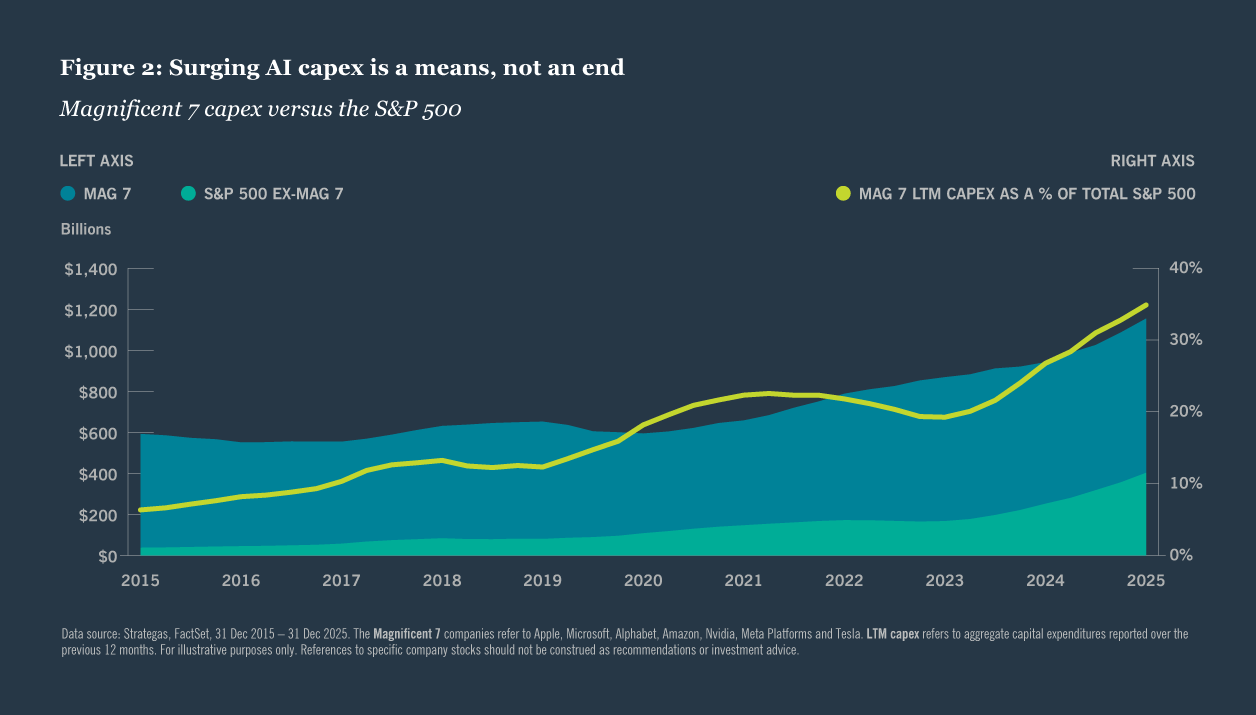
The surge in AI-related capital expenditures has been a massive market driver, but it is important to remember that capital deployment on its own is a means to an end, not a guarantee of success (Figure 2). The AI boom is evolving into something broader, where some investments will benefit from powerful tailwinds while others face meaningful headwinds. In the latter category, we would include certain equity and debt investments tied to software-related and IT services sectors, where valuations are stretched and defaults are elevated. Risks are also mounting for companies that cannot demonstrate a credible path to monetizing AI. Increased spending on AI infrastructure puts pressure on margins and returns on invested capital if that spending doesn’t translate into meaningful revenue growth.
In contrast, we see a number of potential winners. Companies with proprietary data advantages and those able to deliver customized client solutions should be better positioned to navigate AI disruption. We also see opportunity in infrastructure investments such as utilities, battery storage and energy transmission, as well as in asset-backed securities, real estate and municipal bonds tied to infrastructure buildouts.
Regarding direct investments in hyperscalers, we prefer a focus on facilities that rely more on sustainable power, avoid water stress issues and are meaningfully engaged in community feedback — all factors associated with longevity and profitability.
- Don’t bet against
the U.S. in a bid for
diversification
U.S. dominance in AI growth has left some investors feeling unintentionally overweight U.S. assets. While we certainly encourage regular portfolio rebalancing to align with long term asset allocation goals, we also believe some investors may be moving too far away from compelling U.S.-centered opportunities.
The U.S. investment case remains strong given high productivity, solid corporate earnings growth, investor-friendly tax and regulatory conditions and relatively robust economic growth. U.S. large cap valuations are elevated, but we believe investors will continue to reward properly-deployed AI-related capital spending. Beyond equities, areas such as preferred securities, senior loans, real estate, middle-market direct lending, Commercial Property Assessed Clean Energy (C-PACE) lending and infrastructure debt all appear compelling.
- Alternative credit and private markets remain core — but selectivity and structure matter more than ever
Increasing headline noise suggests we may be in the midst of a private credit bubble, or that poorly structured deals could trigger broader financial contagion. We agree risky segments exist and that some transactions have been structured with excess leverage or weak cash flows. But that only reinforces the critical importance of deal structure, manager selection, proper covenants and careful selectivity. We anticipate dispersion in manager performance will drive future success in fundraising.
We continue to see ample opportunity in core U.S. and European middle-market direct lending. The software sector remains in flux, but we see no signs of middle market systemic risk. We also see opportunities to diversify away from AI-centered investments by focusing on “old economy” businesses — such as distribution, waste and stormwater management, commercial landscaping and pest control. On the investment grade side of private credit, rising energy demand creates opportunities through utility operating companies, new power plants and expanding transmission infrastructure. And we also see opportunities in other alternative credit segments, including senior loans, collateralized loan obligations, real estate and infrastructure debt and C-PACE financing.
For private equity, similar concerns apply in the software sector, but other areas of opportunity exist. We are wary toward fund managers who appear to be targeting stretched valuations without corresponding growth prospects. Here too, selectivity and rigorous scrutiny of potential deal partners are essential. Within private equity, we see the best opportunities in the equity secondary market with a focus on single asset opportunities.
- Municipals continue to offer compelling, durable opportunity
Six months in, this theme remains firmly on track. Municipal bonds have outperformed the broader fixed income market this year, and credit spreads have tightened — suggesting room for further upside. In our view, demand remains robust, yields are relatively high and fundamentals are strong, with state and local government finances looking healthy. Municipal yield curves are steeper than Treasuries, making this one area where taking on some duration risk makes sense. We see compelling opportunities across both high grade and high yield municipals.
- The private real estate rebound is just getting started
2025 marked the beginning of a trend toward contracting real estate supply and rising values. Those trends have taken firmer hold, and demand and transaction activity are accelerating as investors recognize growing opportunity sets. As detailed in our real estate outlook, we are primarily focused on sectors that benefit from supply constraints — such as medical office and senior housing — as well as more defensive areas like grocery-anchored retail. We also see select opportunities in retail and housing markets where demand is growing.
Continue reading




About the author

Contact us









- +1 312 917 7700
- 333 W Wacker Drive, Chicago, United States of America
Endnotes
Sources
All market and economic data from Bloomberg, FactSet and Morningstar
This material is not intended to be a recommendation or investment advice, does not constitute a solicitation to buy, sell or hold a security or an investment strategy, and is not provided in a fiduciary capacity. The information provided does not take into account the specific objectives or circumstances of any particular investor, or suggest any specific course of action. Investment decisions should be made based on an investor’s objectives and circumstances and in consultation with his or her financial professionals.
The views and opinions expressed are for informational and educational purposes only as of the date of production/writing and may change without notice at any time based on numerous factors, such as market or other conditions, legal and regulatory developments, additional risks and uncertainties and may not come to pass. This material may contain “forward-looking” information that is not purely historical in nature.
Such information may include, among other things, projections, forecasts, estimates of market returns, and proposed or expected portfolio composition. Any changes to assumptions that may have been made in preparing this material could have a material impact on the information presented herein by way of example. Performance data shown represents past performance and does not predict or guarantee future results. Investing involves risk; principal loss is possible.
All information has been obtained from sources believed to be reliable, but its accuracy is not guaranteed. There is no representation or warranty as to the current accuracy, reliability or completeness of, nor liability for, decisions based on such information and it should not be relied on as such. For term definitions and index descriptions, please access the glossary on nuveen.com. Please note, it is not possible to invest directly in an index.
Important information on risk
All investments carry a certain degree of risk and there is no assurance that an investment will provide positive performance over any period of time. Equity investing involves risk. Investments are also subject to political, currency and regulatory risks. These risks may be magnified in emerging markets. Diversification is a technique to help reduce risk. There is no guarantee that diversification will protect against a loss of income. Debt or fixed income securities are subject to market risk, credit risk, interest rate risk, call risk, tax risk, political and economic risk, and income risk. As interest rates rise, bond prices fall. Investing in municipal bonds involves risks such as interest rate risk, credit risk and market risk, including the possible loss of principal. The value of the portfolio will fluctuate based on the value of the underlying securities. There are special risks associated with investments in high yield bonds, hedging activities and the potential use of leverage. Portfolios that include lower rated municipal bonds, commonly referred to as “high yield” or “junk” bonds, which are considered to be speculative, the credit and investment risk is heightened for the portfolio. Credit ratings are subject to change. AAA, AA, A, and BBB are investment grade ratings; BB, B, CCC/CC/C and D are below-investment grade ratings. As an asset class, real assets are less developed, more illiquid, and less transparent compared to traditional asset classes. Investments will be subject to risks generally associated with the ownership of real estate-related assets and foreign investing, including changes in economic conditions, currency values, environmental risks, the cost of and ability to obtain insurance, and risks related to leasing of properties. Investors should be aware that alternative investments including private equity and private debt are speculative, subject to substantial risks including the risks associated with limited liquidity, the use of leverage, short sales and concentrated investments and may involve complex tax structures and investment strategies. Alternative investments may be illiquid, there may be no liquid secondary market or ready purchasers for such securities, they may not be required to provide periodic pricing or valuation information to investors, there may be delays in distributing tax information to investors, they are not subject to the same regulatory requirements as other types of pooled investment vehicles, and they may be subject to high fees and expenses, which will reduce profits. Alternative investments are not appropriate for all investors and should not constitute an entire investment program. Investors may lose all or substantially all of the capital invested. The historical returns achieved by alternative asset vehicles is not a prediction of future performance or a guarantee of future results, and there can be no assurance that comparable returns will be achieved by any strategy. Responsible investing incorporates Environmental Social Governance (ESG) factors that may affect exposure to issuers, sectors, industries, limiting the type and number of investment opportunities available, which could result in excluding investments that perform well.
Nuveen, LLC provides investment services through its investment specialists.
This information does not constitute investment research as defined under MiFID.
