
Listen to this insight
~ 10 minutes long
The S&P 500 posted its third consecutive year of above-average returns in 2025, driven by AI enthusiasm, strong earnings, and easier monetary policy. Though dividend stocks have lagged recently, dividend growers historically outperform non-payers with lower volatility and competitive returns during turbulence. With persistent inflation, a dividend growth portfolio may offer an inflation hedge plus attractive income and growth potential, making it a compelling consideration for 2026.
Dividend growth stocks have outperformed in various market environments
Dividend growth stocks have provided an attractive combination of earnings and cash flow growth potential, healthy balance sheets and sustainable dividend policies. These stocks have historically offered compelling performance during up markets and provided a buffer during market drawdowns and in volatile environments.
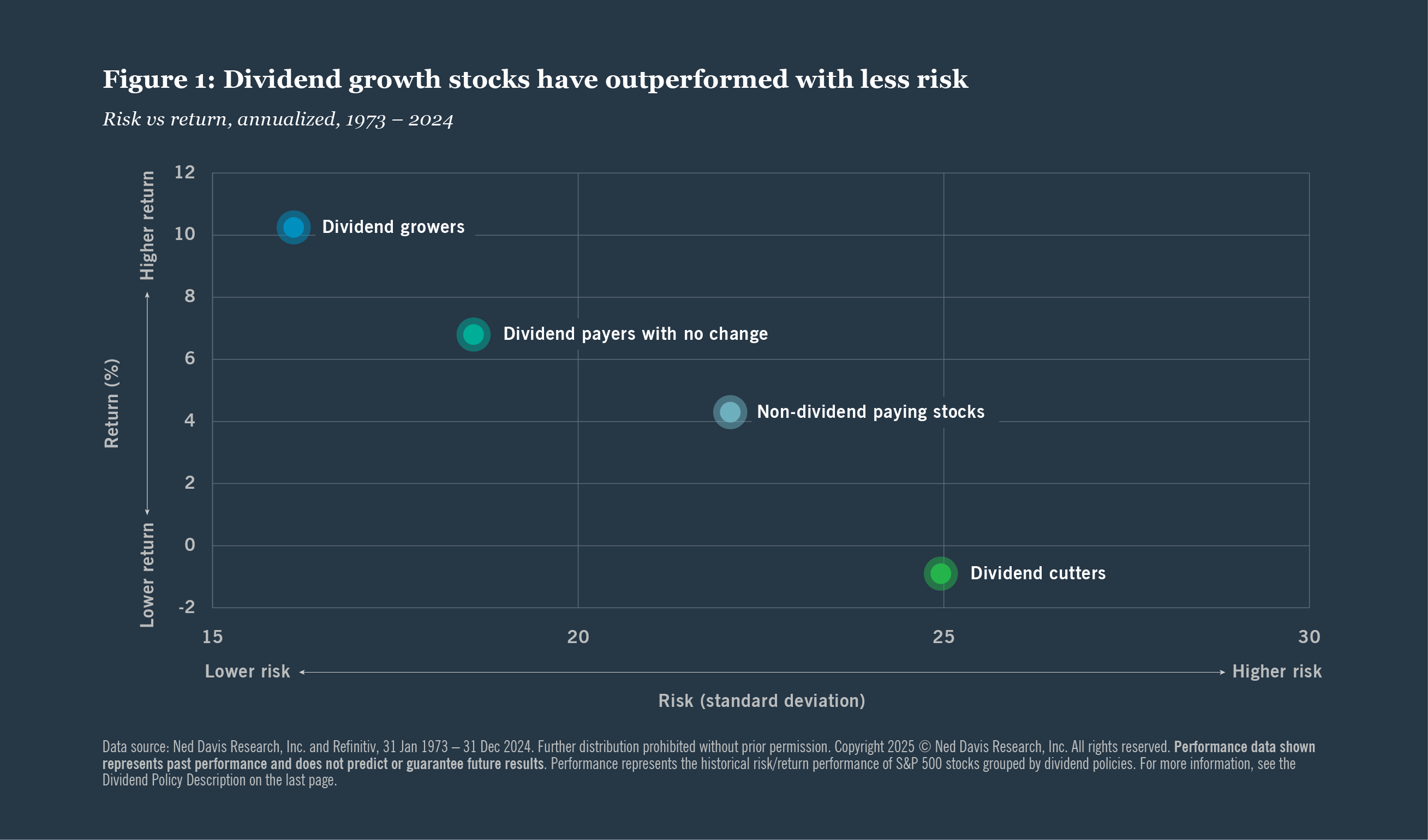
Over the long term, dividend growers and initiators have generated higher returns with less risk, measured by standard deviation, than companies that maintained their dividends, paid no dividend and reduced or eliminated their dividends (Figure 1).
Additionally, while dividends are not guaranteed and will fluctuate, they have contributed significantly to equity total return over the decades. In fact, from 1930 to 2025, 39% of the annualized total return of the S&P 500® was derived from the payment and reinvestment of dividends, with capital appreciation contributing the rest (Figure 2).
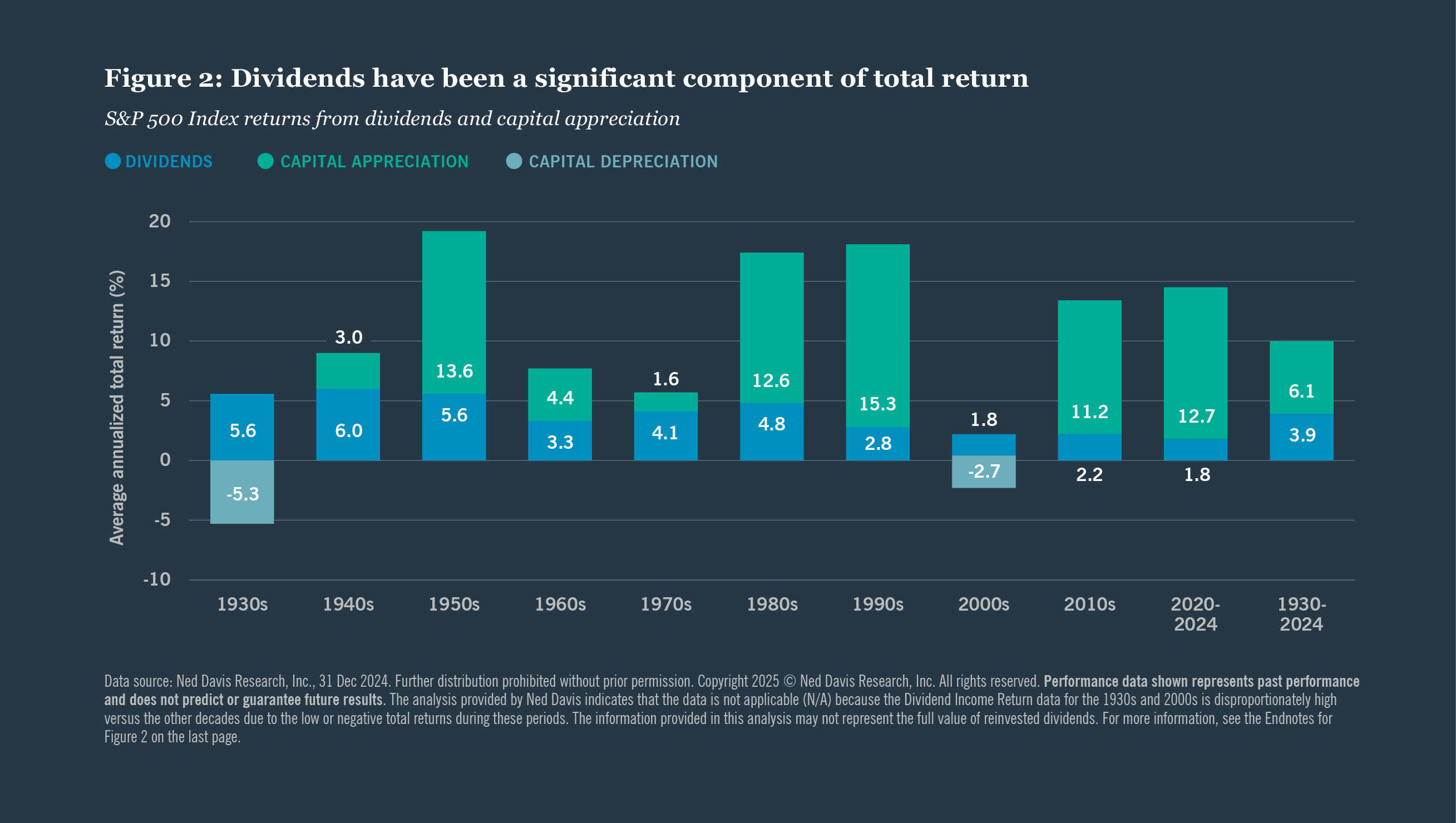
Dividends have contributed significantly to equity total return over the decades.
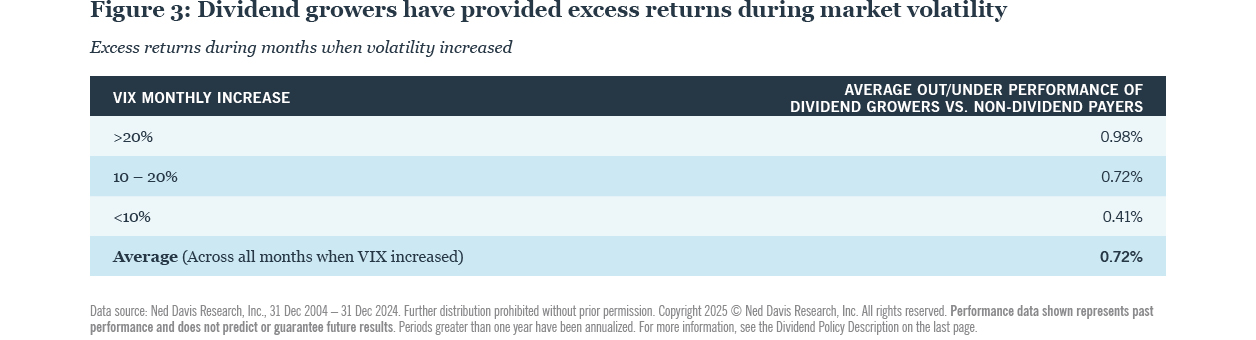
The income produced by dividends may be an essential complement to a strong capital appreciation strategy, as it may limit volatility and contribute to total return over time. Market volatility can cause swings in the price return of a portfolio, but the performance of companies with healthy balance sheets and the financial strength necessary to support dividend growth can help mitigate volatility (Figure 3).
Dividends can be an important check on corporate governance and financial health
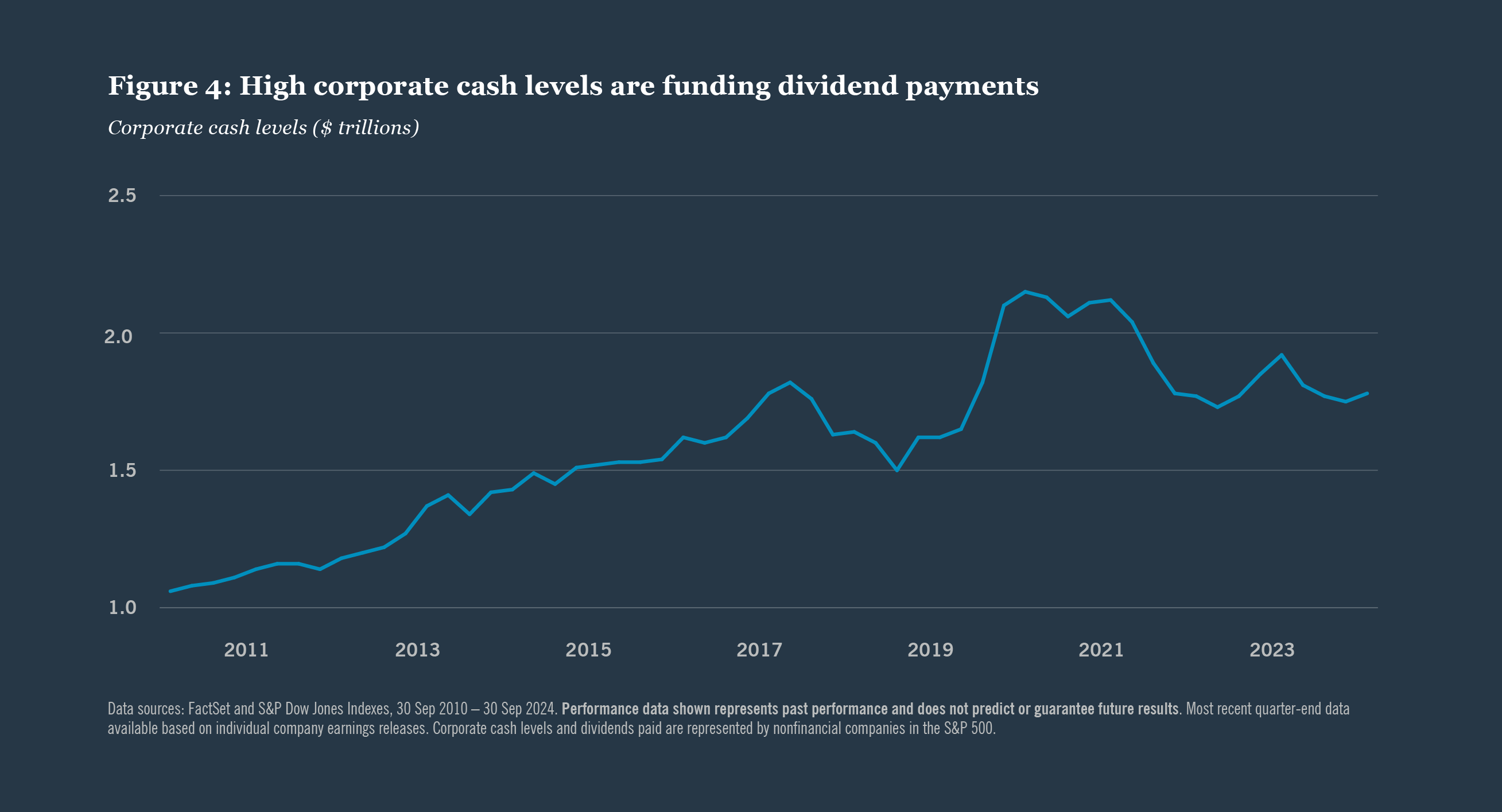
Management teams allocate capital based on a belief that the payoff will provide a positive net present value. A sound capital allocation plan, which includes paying and growing dividends, can indicate a management team's commitment to their shareholders. Companies have accumulated a near record amount of cash and liquid assets and they are increasingly putting that cash back into the hands of investors in the form of dividends (Figure 4).
More technology companies are paying dividends
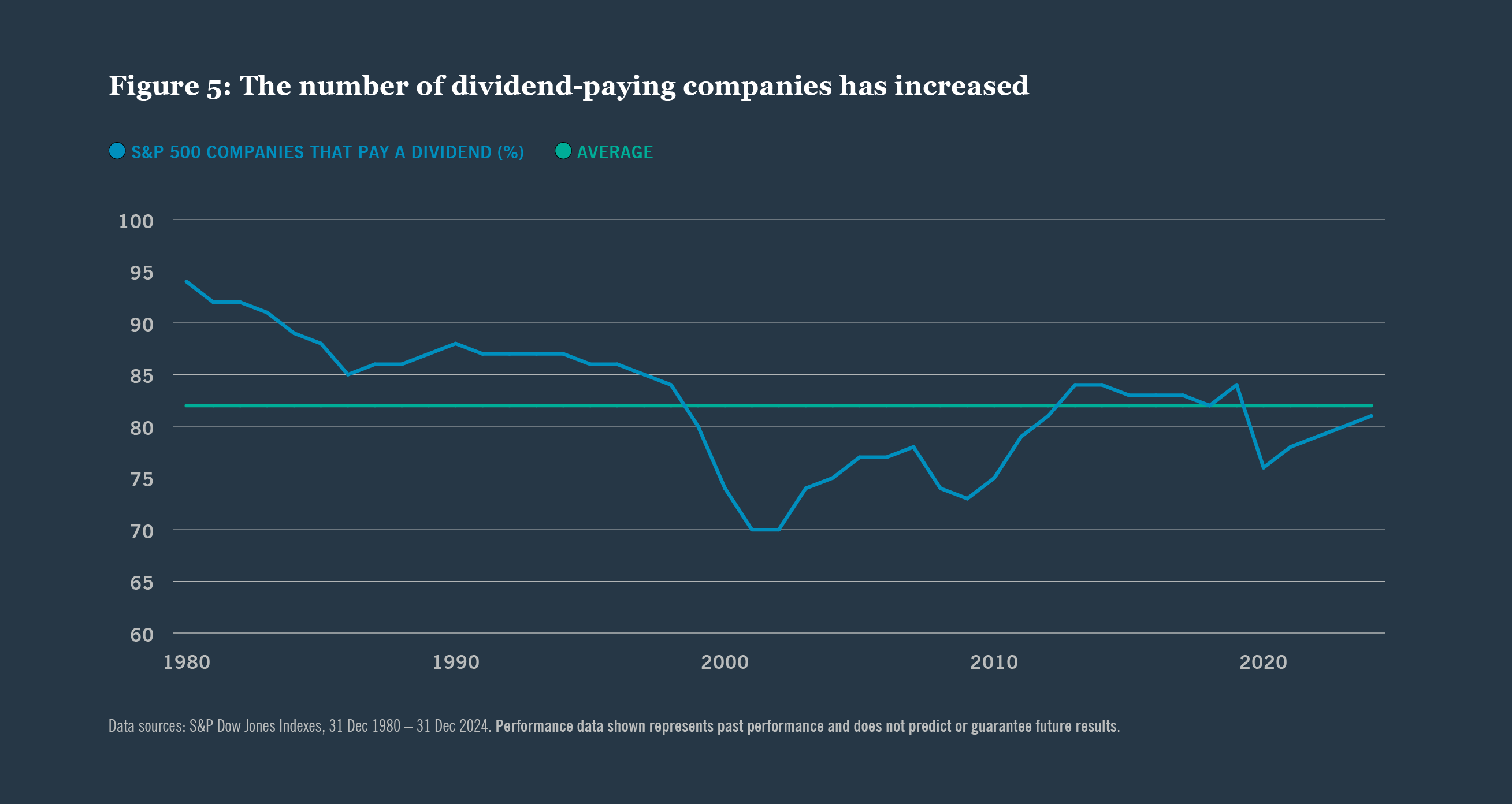
While dividend yields have steadily declined during the past decade given above-average price returns, capital returns to shareholders remain robust, and more companies are starting to pay dividends.
The income produced by dividends may be an essential complement to a strong capital appreciation strategy.
Many information technology companies initiated dividends in the years following the great financial crisis. Management teams emphasized more balanced capital allocation policies given their rising earnings growth potential, expanding profit margins, improved balance sheets and durable profitability.
However, numerous economically sensitive companies halted dividend payments during the pandemic in 2020 (Figure 5). Many of these companies have since reinstated their dividend policies, and several mega cap technology-oriented companies initiated dividend policies in 2024. We view this as a sign of greater capital discipline and expect more non-dividend paying companies to initiate a dividend in the coming years.
Ultimately, the more expansive universe provides diversification advantages for dividend managers with a flexible investment approach and the willingness to own lower-yielding companies and recent dividend initiators.
Companies shift toward dividend growth
While share repurchases have outpaced dividends in recent years, dividend payments have grown consistently and demonstrated greater stability over time (Figure 6). We expect strong S&P 500 dividend growth in 2026, driven by robust earnings expectations and improved cash flows from more favorable R&D and capital expenditure expensing rules.
While we don't expect dividends to overtake share repurchases, companies may incrementally favor dividend growth in 2026 given elevated valuations. At the sector level, information technology, financials and industrials are well positioned for strong dividend growth, while slower-growing, higher-yielding sectors such as consumer staples, utilities and consumer discretionary should post more modest single-digit growth.
We expect strong S&P 500 dividend growth in 2026.
Dividend growers may be an important part of a diversified portfolio
At Nuveen, we believe dividend growth-oriented companies offer desirable long-term attributes and are well positioned for compelling relative performance in the coming year. Over the long-term, companies that continued to grow or initiate dividends have generated higher annualized returns, with a lower annualized standard deviation, than all other segments of the equity market. While dividend growth companies do not outperform in all market environments, their strong risk-adjusted returns over long periods of time can make them an ideal core building block for an equity allocation.
We believe many companies are well positioned to continue increasing their dividends over the long term. Within the U.S., corporate balance sheets remain healthy, the consumer continues to be resilient and earnings growth is expected to accelerate further in 2026. According to FactSet, the S&P 500 dividends per share grew by 4% in 2025 and consensus estimates expect 5% growth in 2026.
The S&P 500's dividend payout ratio remains below its long-term average, and consensus estimates point to 15% earnings per share growth in 2026. Both factors should support attractive returns of capital to shareholders. We expect more companies to initiate dividends in the coming quarters, which could support better-than-expected dividend growth in 2026. Companies continue to maintain high levels of cash on their balance sheets, with balances of $1.9 trillion as of 30 Sep 2025 near their highest levels in two decades. Additionally, with equity market valuations above their long-term averages, we believe corporate management teams may be inclined to focus more on dividend growth as a means of rewarding shareholders in 2026, as opposed to stock buybacks, given the higher valuations.
Investing in companies with sustainable dividend growth can help augment total returns and reduce volatility while providing a growing income stream. Dividend growth-oriented companies have historically participated in up markets and helped to mitigate risk during periods of heightened volatility and market drawdowns.
Given potential volatility ahead from rising unemployment, AI overinvestment concerns, geopolitical tensions and elevated valuations, investors should prioritize high-quality companies and disciplined selection over reacting to macroeconomic shifts or policy announcements. Strong capital flexibility combined with growing dividends can help offset inflationary pressures and higher interest rates.
We find the strong dividend activity this past year to be an important positive signal from management teams regarding confidence in their business prospects despite persistent cost pressures and higher interest rates.
Ultimately, we believe these characteristics create a compelling reason to consider companies with strong balance sheets, strong free cash flow generation and attractive fundamentals supportive of future dividend growth as part of a diversified portfolio.


Contact us









- +1 312 917 7700
- 333 W Wacker Drive, Chicago, United States of America
Endnotes
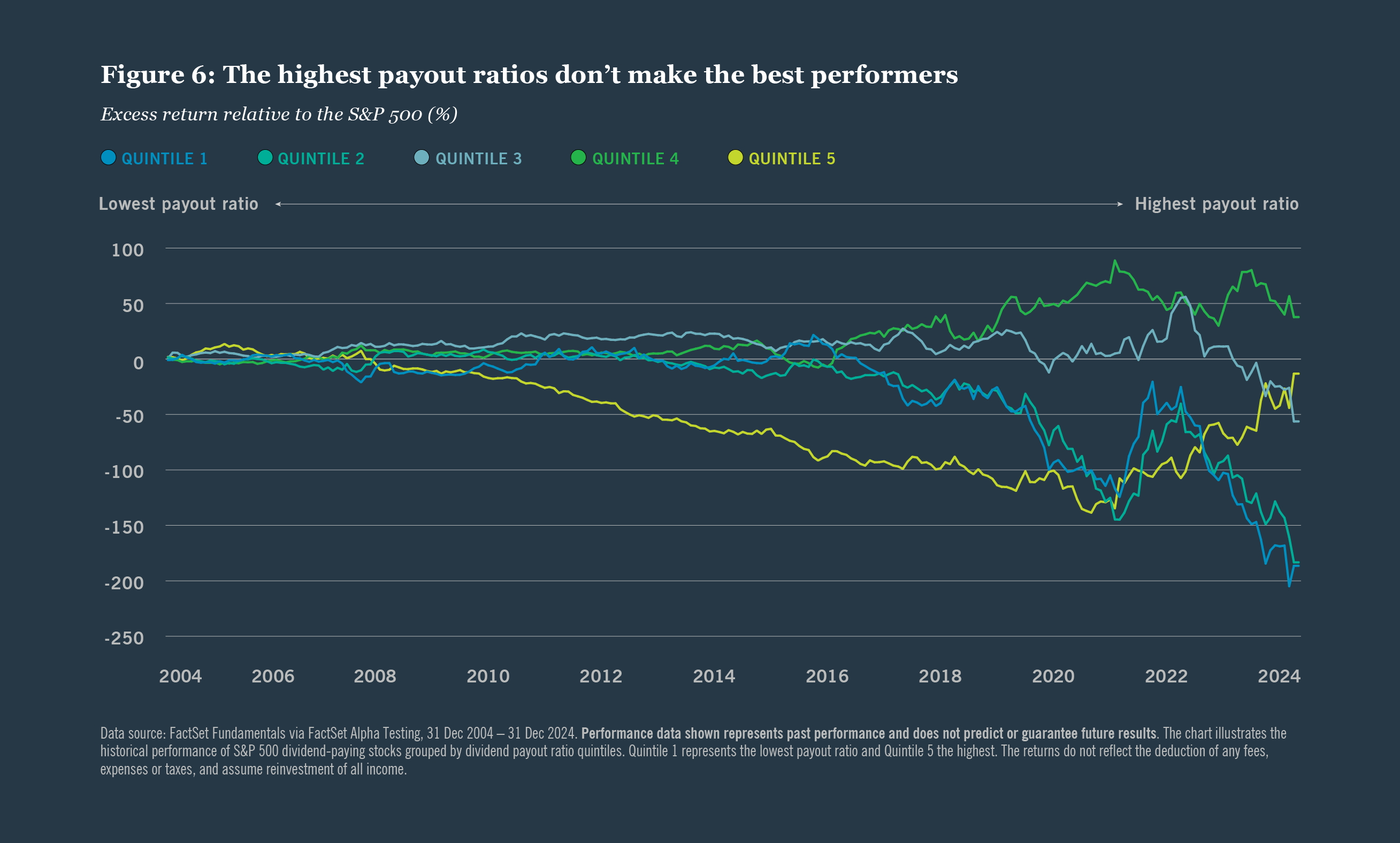
Dividend Policy Description (Figures 1, 3 and 6) The performance of each group is based on the equal-weighted geometric average of dividend-paying and non-dividend-paying historical S&P 500 stocks, rebalanced monthly. Each stock’s dividend policy is determined on a rolling 12-month basis. For example, a stock is classified as dividend-paying if it paid a cash dividend at any time during the previous 12 months. A stock is reclassified only if its dividend payments change. Dividend growers and initiators include stocks that raised their existing dividend or initiated a new dividend during the preceding 12 months. Dividend cutters or eliminators include stocks that lowered their existing dividend or stopped paying regular dividends during the preceding 12 months. The returns do not reflect the deduction of any fees, expenses or taxes that would reduce performance in an actual client portfolio. Returns for stocks that paid dividends assume reinvestment of all income. The periods shown do not represent the full history of the S&P 500; it is the history maintained by the data source. It is not possible to invest in an index. These groups have been determined by Ned Davis Research, Inc. Further distribution of this information is prohibited without prior permission. Copyright 2024 © Ned Davis Research, Inc. All rights reserved.
Figure 2 Periods greater than one year are annualized. The S&P 500 is a capitalization-weighted index of 500 stocks designed to measure the performance of the broad domestic stock market. The S&P 500 in its present form began on 04 Mar 1957. Prior to the 500 Composite, from 1923 to 1926 S&P used as its first broad market indicator a composite index of 233 stocks. In 1926, to disseminate market indicator information more frequently, S&P created a more manageable subset of stocks that became known as the S&P 90 Stock Composite Index. Prices for the 500 Composite were linked to the 90 Stock Composite to provide daily records back to 1928 and monthly data back to 31 Dec 1925. Return performance is based on equal-weighted geometric average, computed monthly. Dividend income return is based on the return percentage of all dividend-paying companies in the S&P 500. The returns do not reflect the deduction of any fees, expenses or taxes, and assume reinvestment of all income. Investors cannot invest in an index. Further distributionof this information is prohibited without prior permission. Copyright 2024 © Ned Davis Research, Inc. All rights reserved.
This material is not intended to be a recommendation or investment advice, does not constitute a solicitation to buy, sell or hold a security or an investment strategy, and is not provided in a fiduciary capacity. The information provided does not take into account the specific objectives or circumstances of any particular investor, or suggest any specific course of action. Investment decisions should be made based on an investor’s objectives and circumstances and in consultation with his or her advisors.
The views and opinions expressed are for informational and educational purposes only as of the date of production/writing and may change without notice at any time based on numerous factors, such as market or other conditions, legal and regulatory developments, additional risks and uncertainties and may not come to pass. This material may contain “forward-looking” information that is not purely historical in nature. Such information may include, among other things, projections, forecasts, estimates of market returns, and proposed or expected portfolio composition. Any changes to assumptions that may have been made in preparing this material could have a material impact on the information presented herein by way of example. Performance data shown represents past performance and does not predict or guarantee future results. Investing involves risk; principal loss is possible.
All information has been obtained from sources believed to be reliable, but its accuracy is not guaranteed. There is no representation or warranty as to the current accuracy, reliability or completeness of, nor liability for, decisions based on such information and it should not be relied on as such. For term definitions and index descriptions, please access the glossary on nuveen.com Please note, it is not possible to invest directly in an index.
Important information on risk
All investments carry a certain degree of risk, including possible loss of principal, and there is no assurance that an investment will provide positive performance over any period of time. Equity investments are subject to market risk or the risk that stocks will decline in response to such factors as adverse company news or industry developments or a general economic decline. Dividend yield is one component of performance and should not be the only consideration for investment. Dividends are not guaranteed and will fluctuate. This report should not be regarded by the recipients as a substitute for the exercise of their own judgment. It is important to review your investment objectives, risk tolerance and liquidity needs before choosing an investment style or manager
CFA® and Chartered Financial Analyst® are registered trademarks owned by CFA institute.
Nuveen, LLC provides investment solutions through its investment specialists.
