Global agriculture is facing a tightening supply of farmland while, at the same time, populations are increasing and demand for food is expanding. These long-term trends are expected to persist and even intensify through 2050.
From an investment perspective, these trends drive farmland values higher over time because as farmland area decreases, the pressure on existing land to be more productive to meet growing demand increases.
Potential sources of productivity gains include planting higher-yielding varieties, better irrigation systems for water efficiency, or even high-tech sensors for site-specific fertilizer application.
Management changes that increase productivity can also make agriculture systems more resilient to climate shocks and improve food security. Private investment in farmland will be key to enabling these productivity gains.
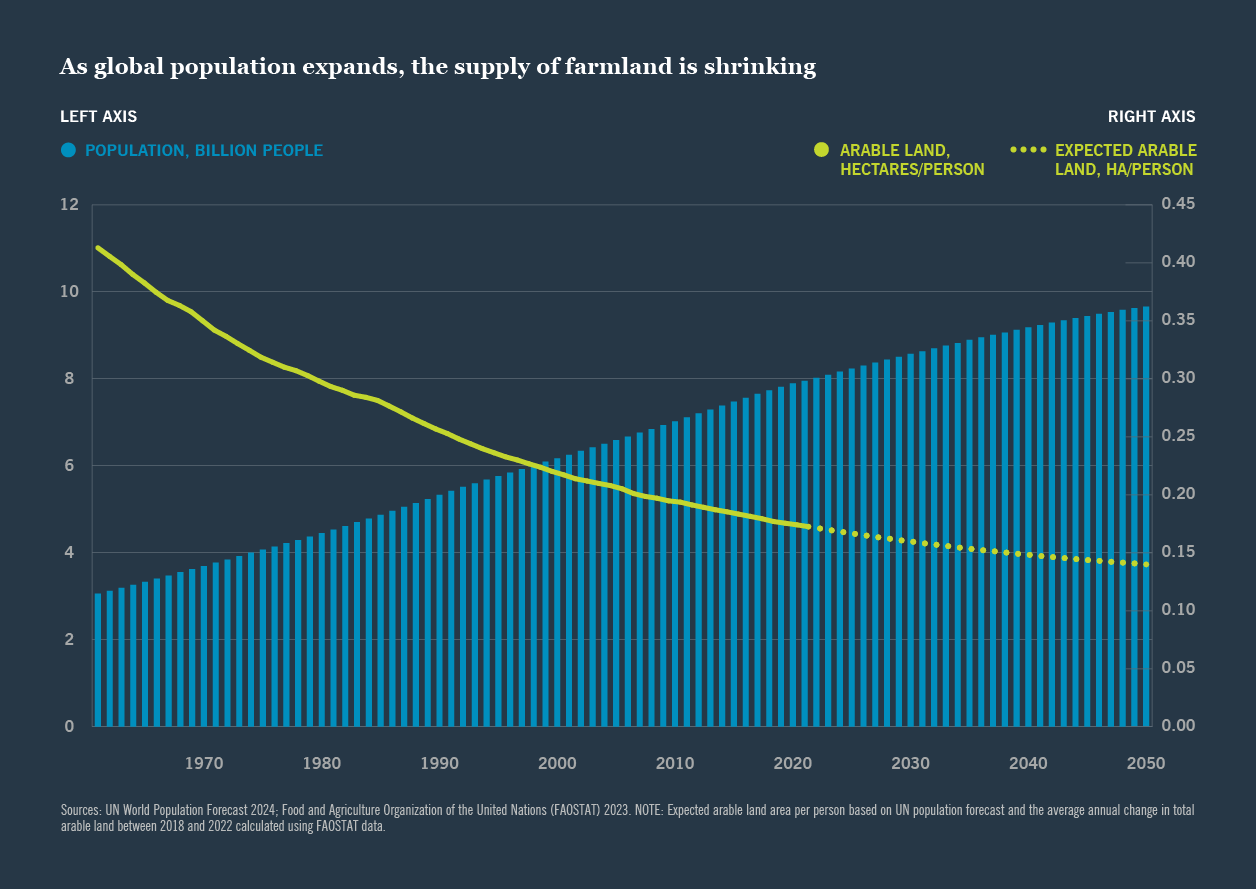
Drivers of farmland loss are likely to intensify across all major agricultural production regions, though specific mechanisms will vary by geography. Worldwide, the three primary sources of change are:
- Development pressure: Urbanization is a key driver worldwide, though emerging land-use change for renewable energy infrastructure and data centers are significant in certain areas.
- Land degradation and climate change: According to the FAO, more than 20% of farmland worldwide (~1 billion hectares) has already been degraded due to unsustainable land-use and management practices.1 The increasing frequency and severity of climate hazards are expected to further degrade the supply of farmland globally.
- Geopolitical tensions and conflict: Farmland and food security are being increasingly threatened amid rising geopolitical tensions and social instability. The FAO reports that in 2023, conflict and instability affected approximately 40% of farmland worldwide (~1.9 billion hectares).
All together, these long-term trends and market dynamics are expected to provide continued support for farmland investment fundamentals.