High earners, constrained outcomes: maximizing benefits in the financial services sector

The financial services sector presents a striking paradox. Despite above-average pay and the prevalence of financial expertise, workers show clear signs of financial strain—taking on side work, reducing retirement contributions and drawing on savings early. Benefits usage helps explain why: strong provision does not always translate into effective use—particularly given the sector's variable income patterns, complex financial decisions and demanding workplace dynamics.
Economist Enterprise's 2025 Benefits 2.0 survey of US financial services workers has found several targeted improvements to how benefits function in practice, which are key to addressing these pressures and contradictions:
- Retirement and financial wellness benefits that better align with workers' inconsistent saving patterns and reduce reliance on withdrawals or secondary income;
- Health benefits that are easier to access and use, reducing care avoidance in a high-pressure environment; and
- Personalized guidance and decision-support tools that simplify complex choices, improve confidence and help employees make more effective use of what they are offered.
Signs of financial strain
Financial pressure is no longer confined to low-income households. Rising costs and shifting spending and saving patterns are placing increasing strain on middle- and high-income groups.1,2 Despite the financial services sector's relatively high pay, several indicators in our survey point to immediate-term financial strain.
Workers in finance are reducing their retirement contributions at a higher rate (42%) than other industries (27%), and 44% have accessed hardship withdrawals or loans compared with 32% elsewhere (see figure 1).
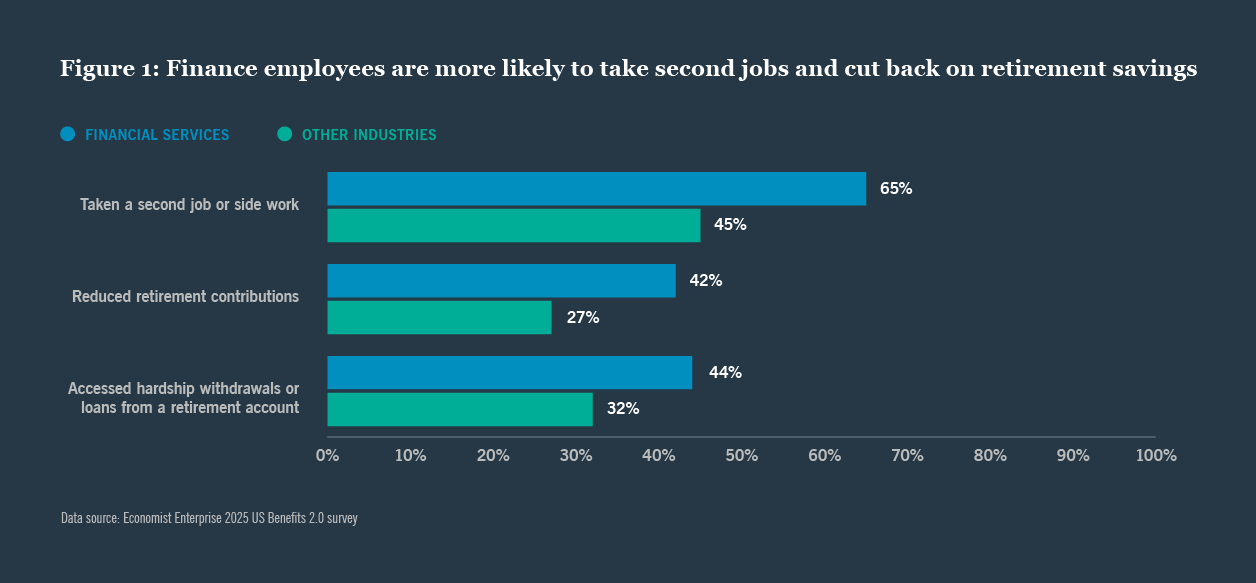
Side work is also unusually high—65% have taken a second job or side work, compared with 45% in other sectors. In the US, a record 8.9 million Americans are working multiple jobs,3 but the educational profile of these workers has shifted notably: more than half today have a college degree, up from a third in the early 1990s and now outnumbering those without a degree for the first time.4 This suggests that even relatively high salaries are not insulating workers from economic strain.
Some of these trends may also reflect the diversity of the sector: although pay is relatively high on average, many still earn modest wages, despite most financial firms being concentrated in high-cost locations. As a result, financial pressure can remain significant, which is reflected not only in how workers earn, but also in how they plan for the future.
Engaged with savings but still falling short
Higher engagement with retirement plans does not necessarily translate into stronger outcomes. This is particularly notable in financial services, where many workers have significant financial expertise. Close to half (44%) say they actively review and adjust their retirement plans, compared with just 33% in other industries. Yet satisfaction still lags: only 49% of employees with 401(k)-style plans are happy with or prefer their current retirement plan, compared with 67% across other sectors.
Similarly, high participation rates do not guarantee adequate savings. Participation in retirement plans is high, says Trent Savage, chief HR officer at Mountain America Credit Union. “About 93% of our employees are leveraging the 401(k), and most of them are at the 5% match.” However, he warns that contribution rates are not increasing fast enough to keep pace: “They need to keep increasing that percentage, and I’m very concerned that people are not saving enough for retirement.”
The challenge of navigating retirement benefits
Even though finance workers are more likely to adjust their retirement plans, the process is not always straightforward. Only 63% feel well equipped to make financial decisions about retirement, compared with 73% across other industries. This may seem surprising for finance professionals, but it could reflect the nature of decision-making in the sector: multiple income streams and variable compensation can make it harder to determine how much to save, when to contribute and how to allocate resources.
Among finance sector respondents, 67% receive an annual performance bonus, 48% receive profit-sharing, 39% receive commissions and 20% earn equity. When bonus compensation fluctuates5 due to market conditions, it contributes to uneven retirement contribution patterns: 44% of workers increase their contributions when bonuses are paid, while another 44% keep them unchanged.
When benefits go underused in high-pressure workplaces
The gap between access and utilization is particularly visible in healthcare. Nearly a quarter (24%) of workers have skipped or delayed medical care in the past 12 months to avoid costs—double the rate in other sectors (12%).
This is notable given the industry’s strong access to health benefits. The finance sector is among those with the highest access to paid sick leave, and 94% of workers in management, business and financial occupations are offered medical benefits.6 So why are workers skipping care?
In some cases, employers face challenges driving engagement. “Some benefits are harder for people to find out about, like our medical co-payment plan—sometimes we just don’t have enough time to educate our employees on that benefit,” says Mr Savage.
But high-pressure environments are another key factor, limiting both the ability and willingness to engage with benefits. Long hours and demanding workloads are common in financial services. Research from Goldman Sachs found that some first-year financial analysts in investment banking were, on average, working an average of 95 hours a week while sleeping just five hours each night.7
More than half (54%) of workers in our survey say that frequent use of benefits like paid leave, caregiving leave or flexible work is sometimes or often seen in a negative light at their organization. Of this group, one in six say these benefits are either rarely used in practice or that junior staff are less comfortable using them than longer-tenured employees.
Making benefits work in practice: the AI opportunity
Employers often invest heavily in benefits, but translating that investment into better outcomes remains a challenge. Access is not the issue: workers need support to translate complex information into action in a reliable, quick and low-effort way.
AI-enabled tools offer a way to bridge this divide. By personalizing the benefits experience, simplifying complex decisions and providing timely recommendations, these tools can strengthen outcomes among employees—particularly in areas such as retirement saving and health, where outcomes are falling short.
Mr Savage points out that HR departments “need to have confidence that we’re leveraging our benefits in the best way to maximize engagement and retention with our employees.” While he’d like to reach a point where the company could “leverage technology to do that in a faster way,” he cautions that accuracy is an essential consideration. “When you’re dealing with people’s benefits, you need to ensure that you’re getting them the right information.”
In a sector defined by financial expertise, the opportunity is not to offer more sophisticated benefits, but to facilitate employees in using them effectively.
Related articles

Insights for financial services plan sponsors | Benefits 2.0

Cutting back on retirement contributions

Lower confidence in retirement decisions

References
1 Financial Health Network, “Financial Health Frontiers: Households Under Financial Pressure”, September 2024 https://finhealthnetwork.org/research/financial-health-frontiers-households-under-pressure/
2 PYMNTS, “52% of Those Earning Over $100K Manage Finances on As-Needed Basis”, April 2025, https://www.pymnts.com/consumer-insights/2025/high-income-earners-have-a-secret-uncertainty-is-impacting-them-too/
3 Forbes, “Why A Record 8.9 Million Americans Are Working Multiple Jobs”, March 2025, https://www.forbes.com/sites/carolinecastrillon/2025/03/24/why-a-record-89-million-americans-are-working-multiple-jobs/
4 Federal Reserve Bank of St. Louis, “Beyond the 9 to 5: Decoding the Overemployment Trend”, March 2025, https://www.stlouisfed.org/on-the-economy/2025/mar/beyond-9-5-decoding-overemployment-trend
5 Forbes, “Year-End Bonuses Are Shrinking And 2026 Raises Will Be Modest. But Not For Everyone”, December 2025, https://www.forbes.com/sites/mariagraciasantillanalinares/2025/12/11/year-end-bonuses-are-shrinking-and-2026-raises-will-be-modest-but-not-for-everyone/
6 Bureau of Labor Statistics, “EMPLOYEE BENEFITS IN THE UNITED STATES – MARCH 2025”, https://www.bls.gov/news.release/pdf/ebs2.pdf
7 Goldman Sachs, “Working Conditions Survey”, February 2021, https://assets.bwbx.io/documents/users/iqjWHBFdfxIU/rSEzNw9cve9E/v0
Nuveen and Economist Enterprise, or any of their affiliates or subsidiaries are not affiliated with or in any way related to each other. The research was independently developed by Economist Enterprise and is sponsored by Nuveen, LLC.
This material is for informational and educational purposes only as of the date of production/writing and may change without notice at any time based on numerous factors, such as market, economic or other conditions, legal and regulatory developments, additional risks and uncertainties and may not come to pass. All information has been obtained from sources believed to be reliable. There is no representation or warranty (express or implied) as to the current accuracy, reliability or completeness of, nor liability for, decisions based on such information, and it should not be relied on as such.
Any guarantees are backed by the claims-paying ability of the issuing company.