
Taxable municipals can offer institutional investors a differentiated source of yield potential, resilient credit fundamentals and portfolio diversification — backed by and a deep opportunity set beyond the index.
Key takeaways: what to know
- Inefficient market requires active management: This large, fragmented, and inherently inefficient market with many idiosyncratic credits and structures, and limited disclosures in some cases, requires active credit selection and market access.
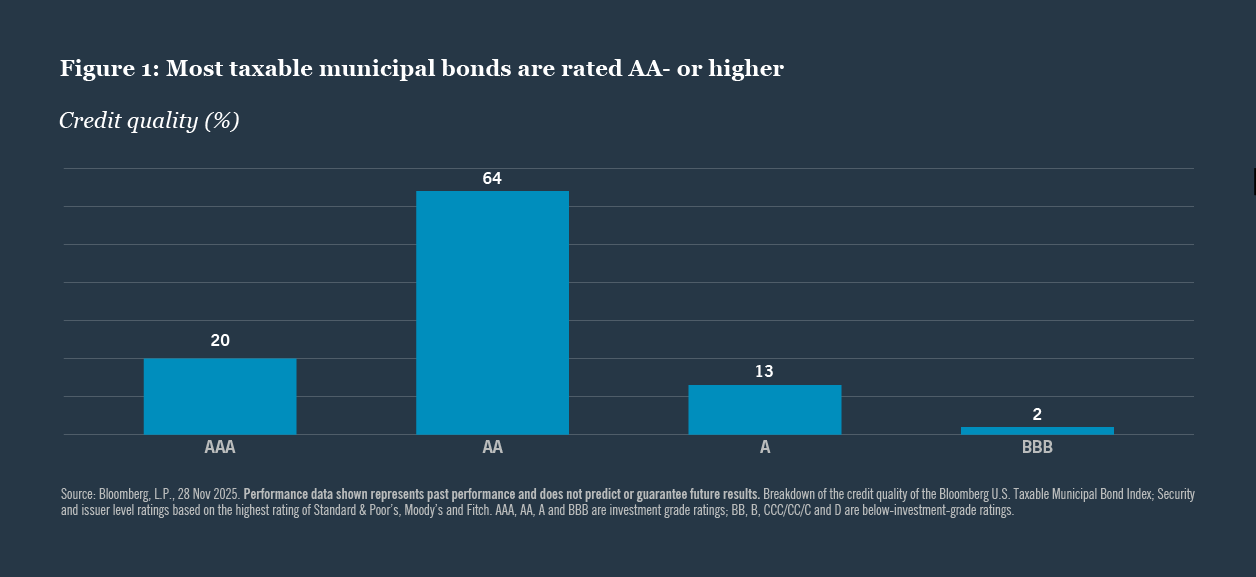
- Competitive yields and high credit quality: Taxable municipals can help institutional investors pursue competitive yields while maintaining high credit quality — 84% of the Bloomberg U.S. Taxable Municipal Bond Index is rated AA- or higher.
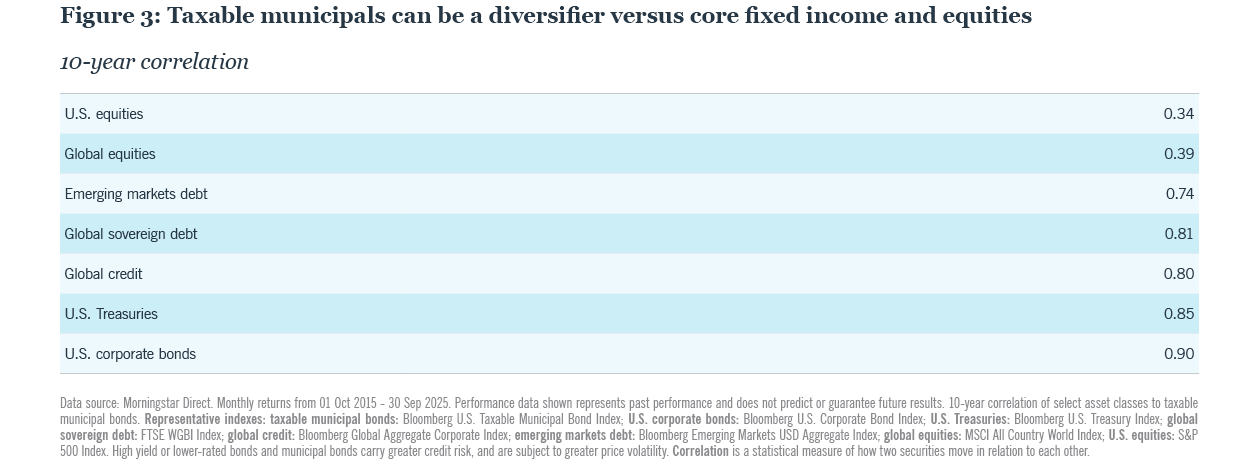
- Enhance risk management: Taxable municipals have had historically lower correlations to equity and fixed income sectors, which can improve overall portfolio diversification for institutional investors.
Another path for institutional allocators
Institutional investors today are balancing three competing demands: the need for durable income, the desire to defend overall portfolio credit quality, and the imperative to diversify risk as market leadership and macro conditions evolve. In that environment, many traditional spread sectors can look fully valued for the level of credit risk assumed — or too correlated to core risk assets.
Taxable municipal bonds provide institutional investors another path – offering a differentiated source of yield potential, resilient credit fundamentals and portfolio diversification — backed by essential-purpose financing and a deep opportunity set beyond the index.
Taxable municipal bonds may strengthen an overall portfolio through yield, portfolio diversification and the ability to target a specific credit quality.
Diversification and resilience
Taxable municipals can help diversify corporate credit exposure because the revenues that support essential services, such as hospitals, education, electric utilities and water and sewer systems, are often strengthened by inelastic demand for these services, defending against more economically sensitive revenues that are often generated by corporate credit.
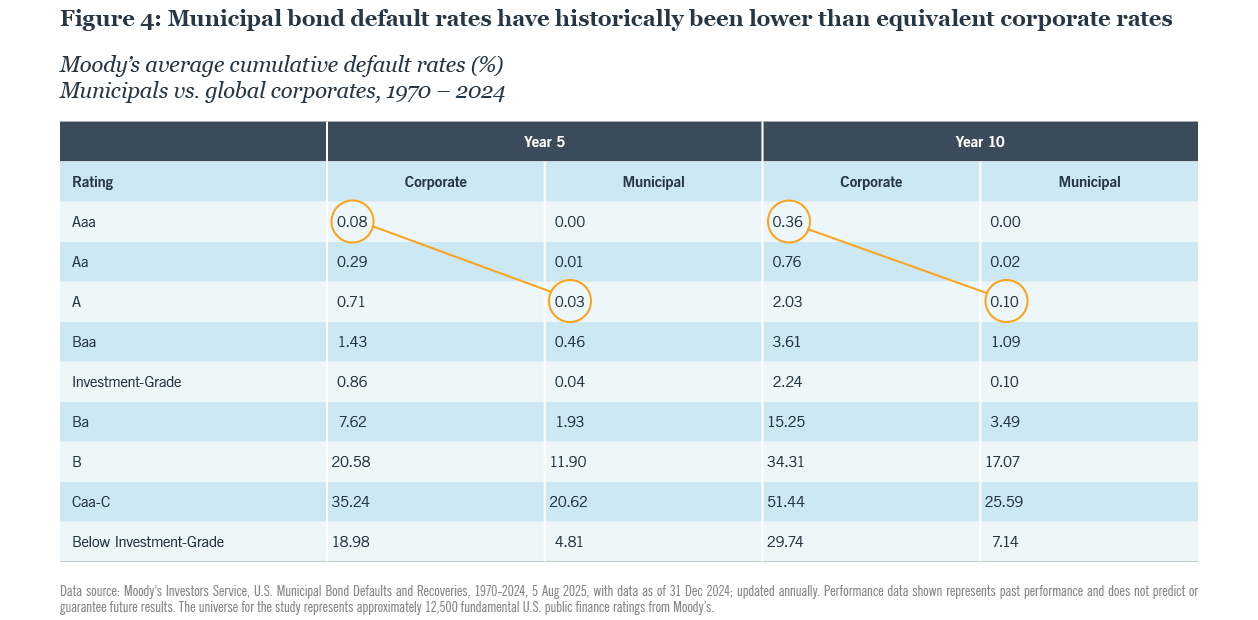
Given the credit characteristics of taxable municipal bonds and the continual demand for the essential services these projects provide, historical performance has been less cyclical than other asset classes. Low to moderate long-term correlations with other asset classes can help improve overall portfolio diversification, while low default rates for municipal bonds have been historically less than their corporate counterparts.
Expanding the traditional opportunity set to enhance yield
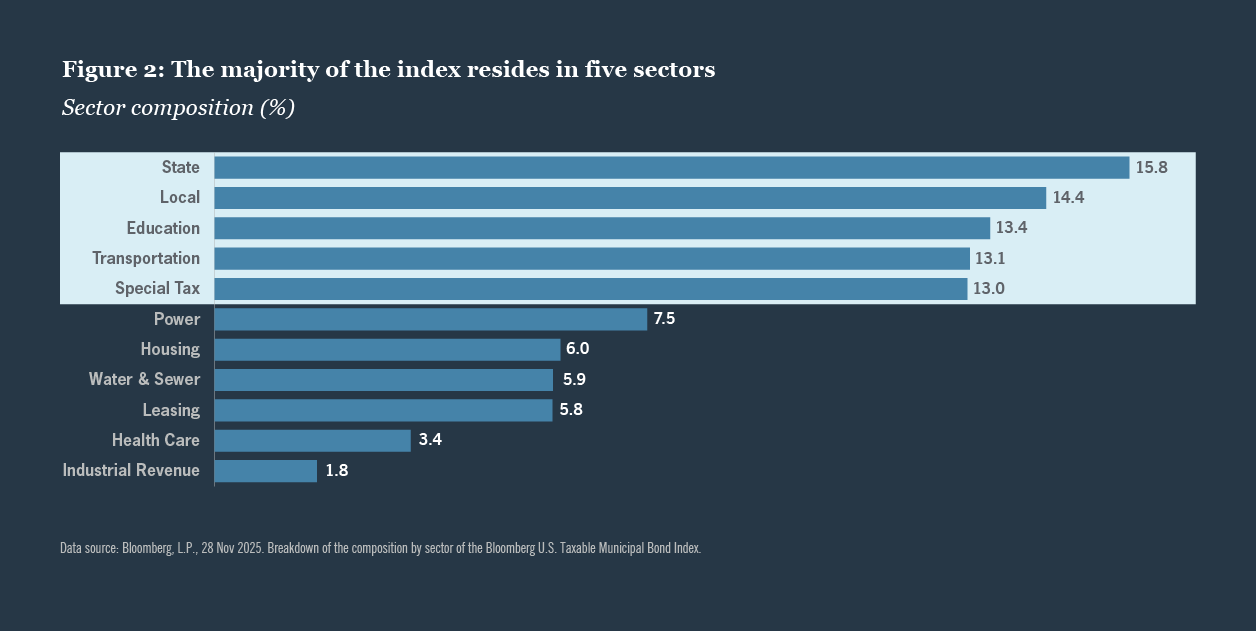
As the taxable municipal market has grown, global investors have gravitated toward the widely covered, more familiar credits such as state GOs and large public universities. These names also tend to be higher-quality and trade at tighter spreads. Including additional sectors and a higher allocation to A-rated credits can enhance portfolio yield and diversification.
Although the Bloomberg U.S. Taxable Municipal Bond Index is a good proxy for the investable universe of taxable municipal bonds, it does not provide a view into the opportunities that span across the municipal market. The largest, widely covered index names generally trade at lower yields than similarly rated bonds not included in the index that have equal credit worthiness.
A municipal bond manager with credit research specialization can better identify mispriced opportunities within the higher-yielding sectors that are made up of diverse, idiosyncratic issuers that span the credit spectrum — to generate excess yield and total return.
Related articles

Muni Minute: What this week’s moderating muni volatility is really telling investors

Leading the way in municipal bonds

Weathering the storm: Muni bonds fund America's climate defenses
Frequently asked questions
Taxable municipal bonds are bonds issued by U.S. state and local governments, quasi-government entities and eligible non-profit organizations where the interest is generally taxable. Proceeds finance public-purpose projects like utilities, transportation, schools and hospitals.
Taxable municipals may help institutions pursue competitive yield potential while maintaining higher overall credit quality and improving diversification. The taxable municipal market is predominantly investment grade, with a large share rated in the AA category and higher. Municipal credit characteristics and historically low default rates can also support a differentiated risk profile versus corporates.
Taxable municipals can help institutions diversify their overall portfolio, as they have shown lower long-term correlations with several major asset classes – including U.S. and global equities, and emerging markets debt, reflecting essential-service revenue foundations and less cyclical historical performance.
The municipal market is large, fragmented and structurally complex. These inefficiencies can create mispricing—especially beyond the most widely held index names — making fundamental credit research and ongoing surveillance important to managing risk and capturing opportunity.
Investing in taxable municipal bonds involves risks such as interest rate risk, credit risk and market risk, and bond prices can fluctuate with rates, market conditions and issuer credit quality.
Several features of municipal bonds make them worthy of consideration for insurers when matching long-term liabilities. These include low default rates, high average credit quality and long durations. Combined, these features tend to result in predictable, reliable income streams that can effectively match insurer liabilities.
Certain U.S. municipal bonds can qualify as an infrastructure investment under the European Union’s Solvency II directive that results in favorable capital treatment for these bonds. This is especially attractive for European insurance companies that may receive superior capital treatment for U.S. municipal bonds when compared to European or U.S. corporate bonds.
Contact us









- +1 312 917 7700
- 333 W Wacker Drive, Chicago, United States of America
Endnotes:
Sources
1 Securities Industry and Financial Markets Association (SIFMA.org), U.S. Municipal Bonds Statistics, as of Dec 2025.
2 Municipal Securities Rulemaking Board (MSRB), Muni Facts, as of Jan 2025.
3 Bloomberg, L.P., 28 Nov 2025.
4 Nuveen assets under management (AUM) is shown as of 31 December 2025 and is inclusive of underlying investment specialists.
Infrastructure fixed assets: Cato Institute; U.S. Bureau of Economic Analysis. Municipal issuance: Securities Industry and Financial Markets Association (SIFMA.org). New money project financing: The Bond Buyer. Bond ratings: Standard & Poor’s, Moody’s, Fitch. Taxable municipal and corporate bond sectors: Bloomberg. Municipal bond yields: Bloomberg and Municipal Market Data. Corporate bond yields: Bloomberg. Treasury yields: Bloomberg (subscription required). Defaults: Municipals Weekly, Bank of America/Merrill Lynch Research; Moody’s Investor Service. Standard & Poor’s and Investortools: http://www.invtools.com/.
Important information on risk
Investing involves risk; principal loss is possible. All investments carry a certain degree of risk and there is no assurance that an investment will provide positive performance over any period of time. Investing in municipal bonds involves risks such as interest rate risk, credit risk and market risk. The value of the portfolio will fluctuate based on the value of the underlying securities. Bond insurance guarantees only the payment of principal and interest on the bond when due, and not the value of the bonds themselves, which will fluctuate with the bond market and the financial success of the issuer and the insurer. No representation is made as to an insurer’s ability to meet their commitments. This information should not replace an investor’s consultation with a financial professional regarding their tax situation. Nuveen is not a tax professional.
Investors should contact a tax professional regarding the appropriateness of tax-exempt investments in their portfolio. If sold prior to maturity, municipal securities aresubject to gain/losses based on the level of interest rates, market conditions and the credit quality of the issuer. Income may be subject to the alternative minimum tax (AMT) and/or state and local taxes, based on the state of residence. Income from municipal bonds held by a portfolio could be declared taxable because of unfavorable changes in tax laws, adverse interpretations by the Internal Revenue Service or state tax authorities, or noncompliant conduct of a bond issuer. It is important to review your investment objectives, risk tolerance and liquidity needs before choosing an investment style or manager.
This material is not intended to be a recommendation or investment advice, does not constitute a solicitation to buy, sell or hold a security or an investment strategy, and is not provided in a fiduciary capacity. The information provided does not take into account the specific objectives or circumstances of any particular investor, or suggest any specific course of action. Investment decisions should be made based on an investor’s objectives and circumstances and in consultation with his or her financial professionals.
The views and opinions expressed are for informational and educational purposes only as of the date of production/writing and may change without notice at any time based on numerous factors, such as market or other conditions, legal and regulatory developments, additional risks and uncertainties and may not come to pass. This material may contain “forward-looking” information that is not purely historical in nature. Such information may include, among other things, projections, forecasts, estimates of market returns, and proposed or expected portfolio composition. Any changes to assumptions that may have been made in preparing this material could have a material impact on the information presented herein by way of example. Performance data shown represents past performance and does not predict or guarantee future results.
All information has been obtained from sources believed to be reliable, but its accuracy is not guaranteed. There is no representation or warranty as to the current accuracy, reliability or completeness of, nor liability for, decisions based on such information and it should not be relied on as such. For term definitions and index descriptions, please access the glossary on nuveen.com. Please note, it is not possible to invest directly in an index.
This information is confidential and must not be made available, published or distributed to any third party without the prior written consent of Nuveen.
Nuveen Asset Management, LLC is a registered investment adviser and an affiliate of Nuveen, LLC.
Nuveen provides investment advisory solutions through its investment specialists.
©2025 Nuveen, LLC. All rights reserved.
This information does not constitute investment research as defined under MiFID.